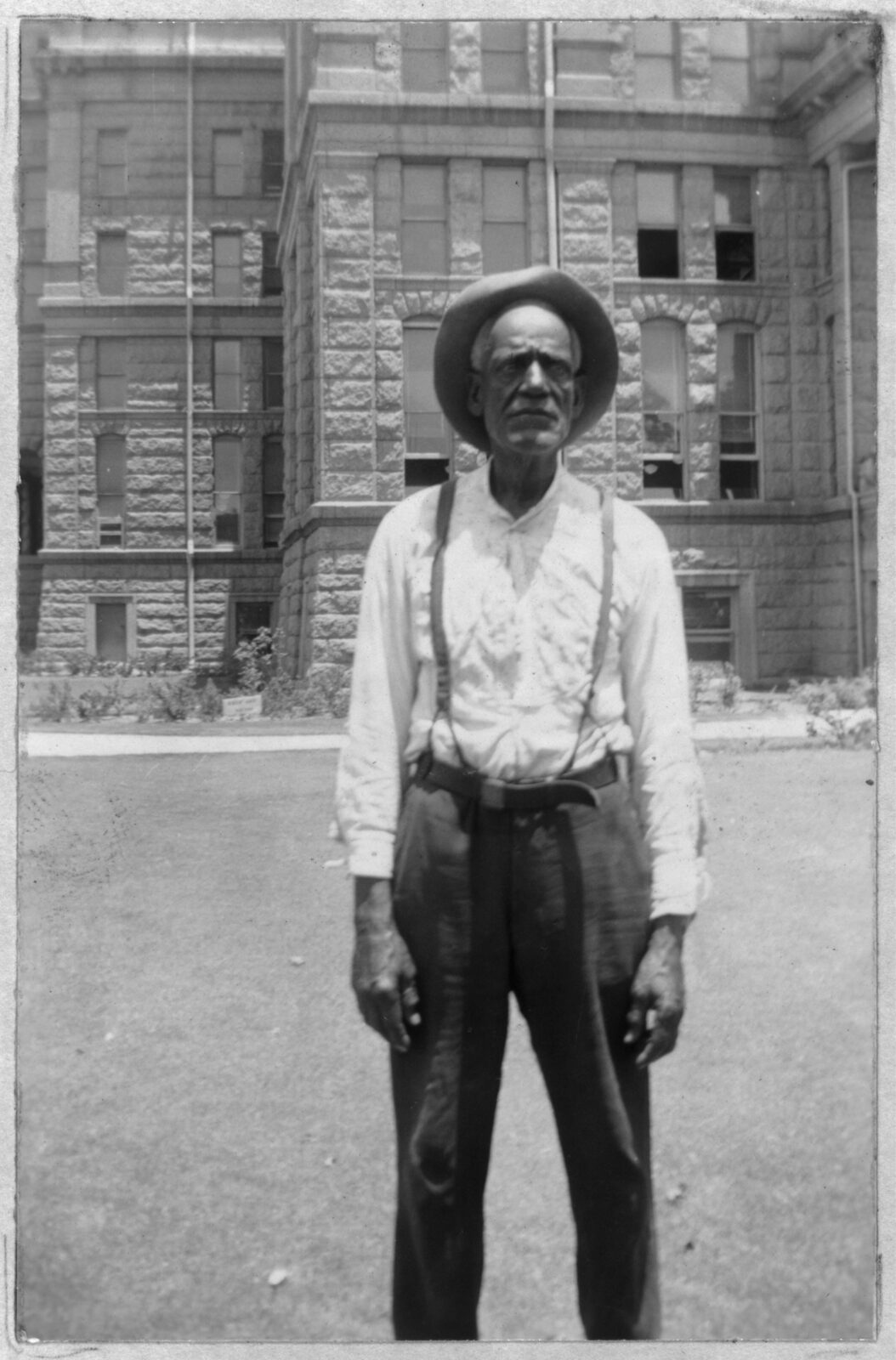
- Born
- June 17, 1850; near Shreveport, Louisiana
- Interviewed in
- Texas
- Age when photographed
- 87
Bill Homer
Bill Homer was born on June 17, 1850, on Jack Homer's plantation near Shreveport, Louisiana, where about a hundred people were enslaved. The quarters were fifty one-room log cabins in five rows of ten, with dirt floors and holes for windows, and the plantation had a nursery for the enslaved children, four cooks for the big house, and hogs caught in the Mississippi River bottoms. He said people who were stubborn were whipped until they changed their minds, and those who ran away got harder whippings. He was trained as a coachman.
In 1860 the enslaver's daughter, Mary, married Bill Johnson. At the wedding, after the music, dancing and peach brandy from the enslaver's still, fifty enslaved people, Bill among them, were lined up in clean clothes and presented to the bride as a wedding gift, "for to give my lovin' daughter de start." The groom's father gave another fifty. The hundred people then walked behind fifteen or twenty wagons to a place near Caldwell, Texas, from daylight to dark for about two weeks. A man named Monk taught them a walking song about the dusty road, and the new mistress sat in the back of a wagon beating time and singing along.
In Texas Bill drove oxen and hoed instead of driving a coach. He laughed about the time a team of stubborn oxen ran off toward the well with him and the overseer shouted to ask where he was going: "I's not gwine, I's bein' took!" He made flutes, called quills, from willow sticks. In old age he lived in Fort Worth, Texas.
From the Federal Writers' Project slave narratives, 1936–1938. The interviewers wrote down their words in the 1930s, often in dialect spellings that reflect the interviewer more than the speaker.