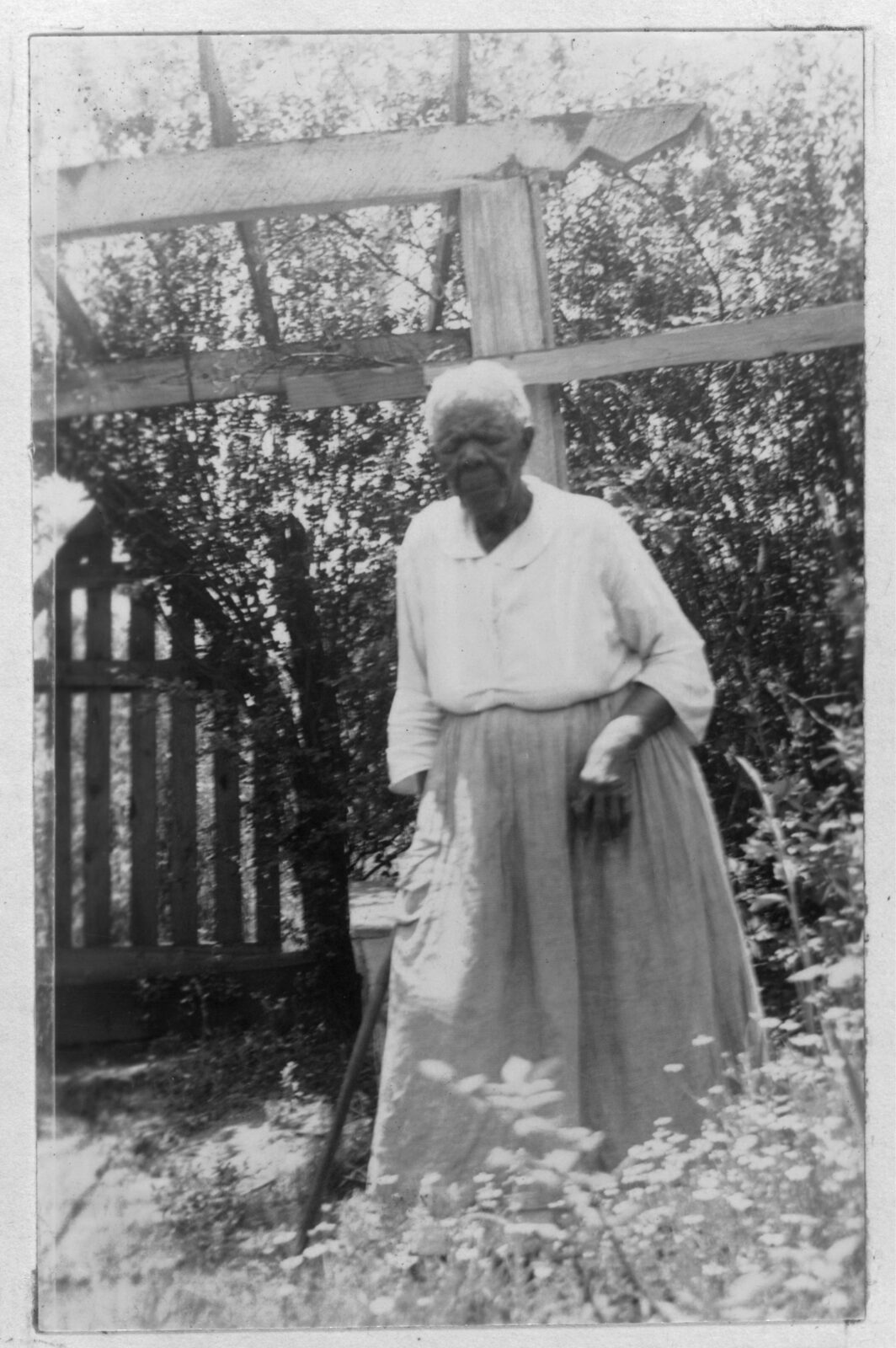
- Born
- About 1837 (said she was 100)
- Interviewed in
- Alabama
- Age when photographed
- 100
Delia Garlic
Delia Garlic insisted she was 100 years old when she was interviewed on the porch of her home at 43 Stone Street in Montgomery, Alabama. Unlike some, she had no good words for slavery: "Them days was hell." She spoke bitterly of babies snatched from their mothers and sold, of brothers and sisters separated forever, and of people tied face-first to trees and whipped until they bled, with the sound carrying a mile.
She was born at Powhatan, Virginia, the youngest of thirteen children, and never knew most of her siblings. She, her mother and her brother William were brought in a speculator's drove to Richmond, held in a warehouse, and sold from the block. She never saw William again. She and her mother were sold to a sheriff named Carter. His daughter, angry when the baby Delia was nursing hurt itself, ran a hot iron down Delia's arm and hand. Later his new wife struck her on the head with stovewood until she was unconscious. When Carter ordered her beaten for looking at him, she ran, and that same night she was taken back to Richmond and sold again. Her last memory of her mother was her mother pressing her hand and telling her to be good and trust in the Lord.
She was sold to a hotel keeper in McDonough, Georgia, then to the Atlanta man who took over the hotel, and finally to a man named Garlic in Louisiana, where she plowed, hoed and chopped cotton until freedom. Breakfast and supper were a piece of cornbread. Her first husband was taken off to the war and never seen again; she then married Miles Garlic. After freedom they moved to Wetumpka, where he worked for the railroad. After Miles died she came to Montgomery to live with her son. She said she was eating white bread now and having the best time of her life.
From the Federal Writers' Project slave narratives, 1936–1938. The interviewers wrote down their words in the 1930s, often in dialect spellings that reflect the interviewer more than the speaker.