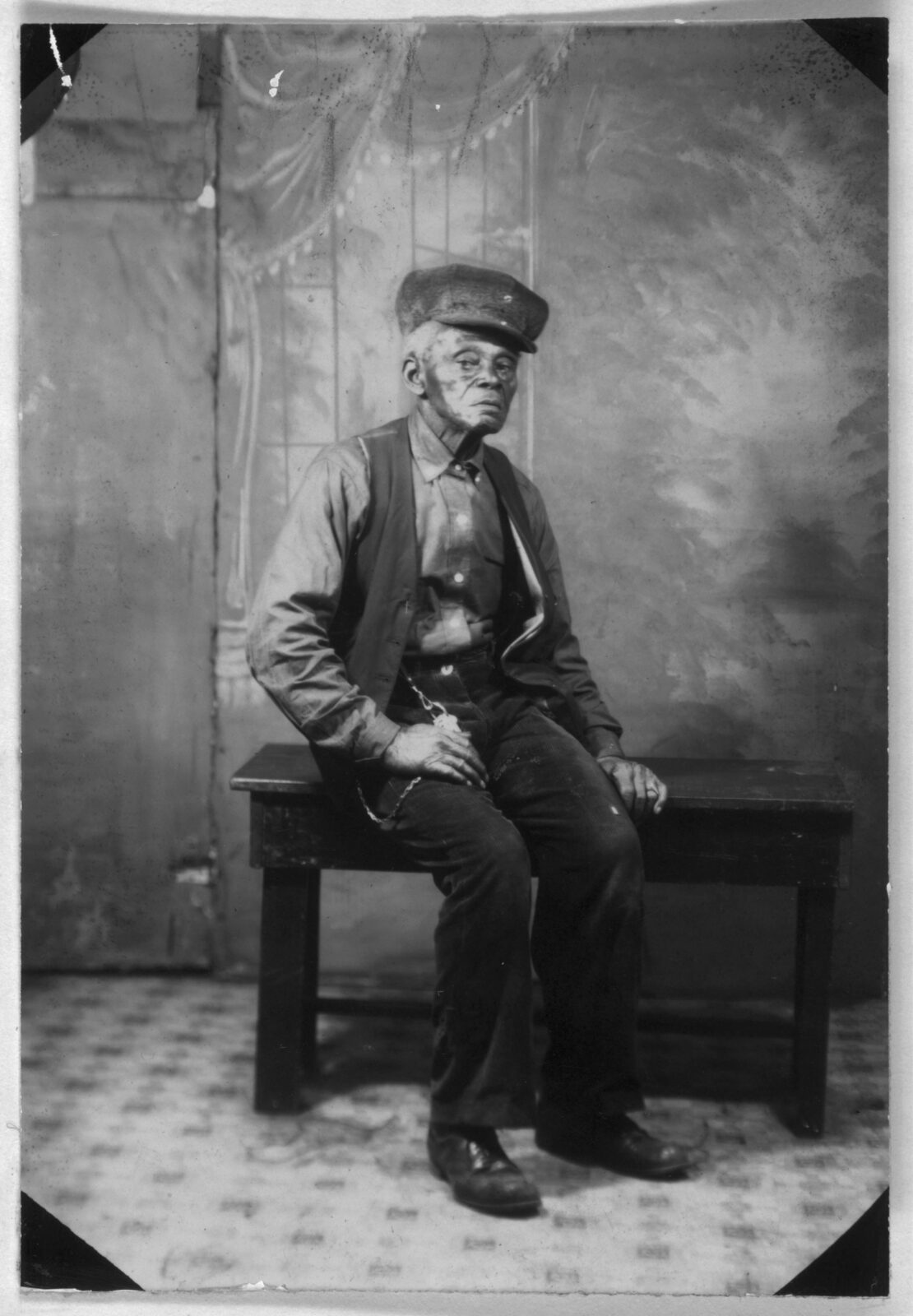
- Born
- January 6, 1848; near Norfolk, Virginia
- Interviewed in
- Alabama
Frank Smith
Frank Smith was born on January 6, 1848, near Norfolk, Virginia, where he could see the ocean, enslaved by a Dr. Constable. His birth was written in the family Bible. When the enslaver died, about eight years before the war, the widow moved to her parents' home in Alexandria, taking Frank and two others, and sold his mother, father and everyone else with the plantation. He never saw his family again.
He worked as a house boy. When the war began he was taken to Culpeper, where he lived near the hotel used by General Robert E. Lee and his officers. Frank waited on them and shined Lee's shoes; Lee always gave him a dime and said, "Dat looks nice." He heard talk of the fighting at Bull Run and thought at first someone's bull had gotten loose. Later in Lynchburg, when he broke an ivory-handled knife, the mistress slapped him and sold him to a man in Cleveland, Tennessee. Frank ran away and joined the Union army as a servant to a captain, following Sherman's forces toward Atlanta, where he saw dead men everywhere, and back to Chattanooga and Nashville. He said he was given a uniform but no gun: "I fought wid a fryin'-pan."
After the war he worked on farms near Baton Rouge for sixteen years, then in Memphis as a house painter, and then came to Birmingham. He worked as a janitor at the Jefferson Theater, sold kerosene from a wagon, and from 1913 worked for the Birmingham baseball association. When interviewed at eighty-nine he still carried the mail and did odd jobs there for three dollars a week, and was waiting on an old-age pension. He joined the Baptist church at Rough Neck and was a deacon for forty years.
From the Federal Writers' Project slave narratives, 1936–1938. The interviewers wrote down their words in the 1930s, often in dialect spellings that reflect the interviewer more than the speaker.