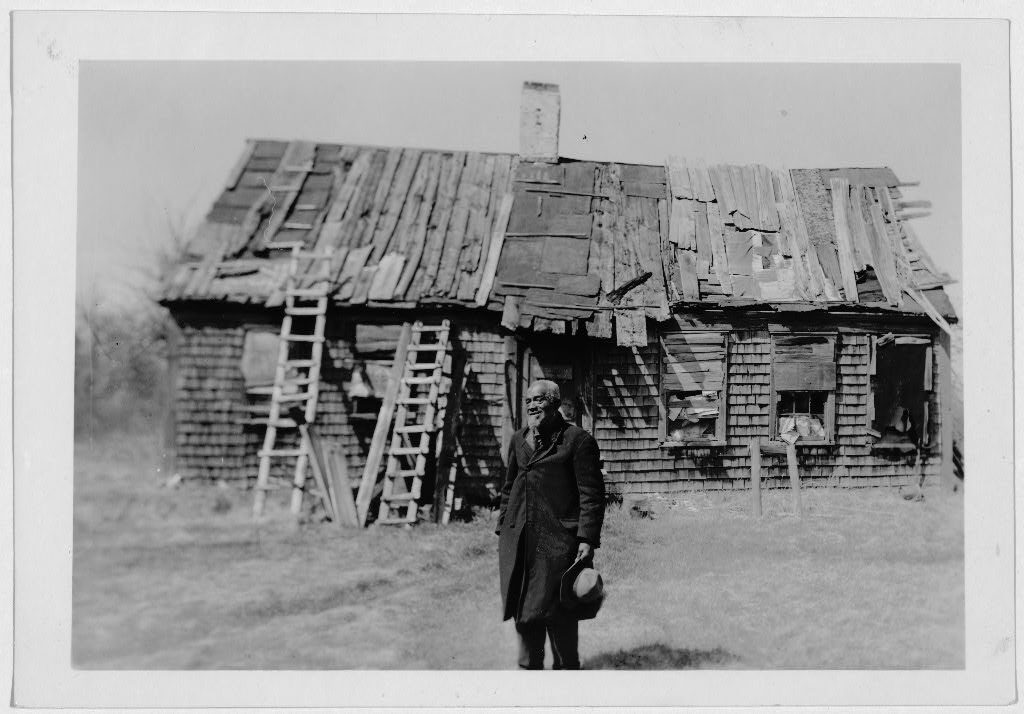
Biography · formerly enslaved
Henry Robinson
A biography drawn from Henry's own account is being prepared. Their own words are below.
g over five states when and as he wishes. "My name am Jeff Calhoun and I was born in Alton, in Alabama, about 1838, 'cause I's told "by my rnassa. old now. Dat makes me 'bout 98 year My father was Henry Robinson and my mammy, she Mary Eobinson, j She was born in Maryland, in Virginia, but didn't know much 'bout her folks, 'cause she was sold off young. Dere was four of us brothers and ten sisters, but oey all dead now but me. "We makes our beds out of forked saplings drove in the ground, 'cause de floors was dirt, we sets de pole in dat ground and it run to de top of de cabin and we makes one bed down low and one bed above. De big folks sleeps in de low beds and de chillun above, 'cause dey can climb. M My massa had 15 chillun and my mamma suckled eveiy one of dem, 'cause his wife was no good to give milk. "We allus had lots to eat, but for meat we has to go to de woods and git deer and turkey and buffalo and some bear. hoss an<L skunk and crow and hawk. -i- * ". I have eat \ * Y ^^g Ex-slave Stories (Texas) Page Two * u<\ lo9 "We has a big fire to cook on, and to make de com cakes we put one leaf down and put Matter on dat and put another leaf over it and cover with hot ashes and by noon it was done. supper, Same thing for fe never have biscuits ' cept on Sunday or Christinas. "My mrroa was de spinner so I has plenty shirts and some britches, and we raises indigo on de place and makes dye of it. We never wore no shoes in de summer and some winters neither* We has a good pair of p<mts and shirt we wears Sundays and holidays and was married in. "De way dey done a.t weddings dem days, you picks out a girl and tell your boss* If she was firom another plpjatation you had to git her bosses 'mission and den dey tells you to come up dat night and git hitched up. They says to…
From the Federal Writers' Project slave narratives, 1936–1938. The interviewers wrote down their words in the 1930s, often in dialect spellings that reflect the interviewer more than the speaker.