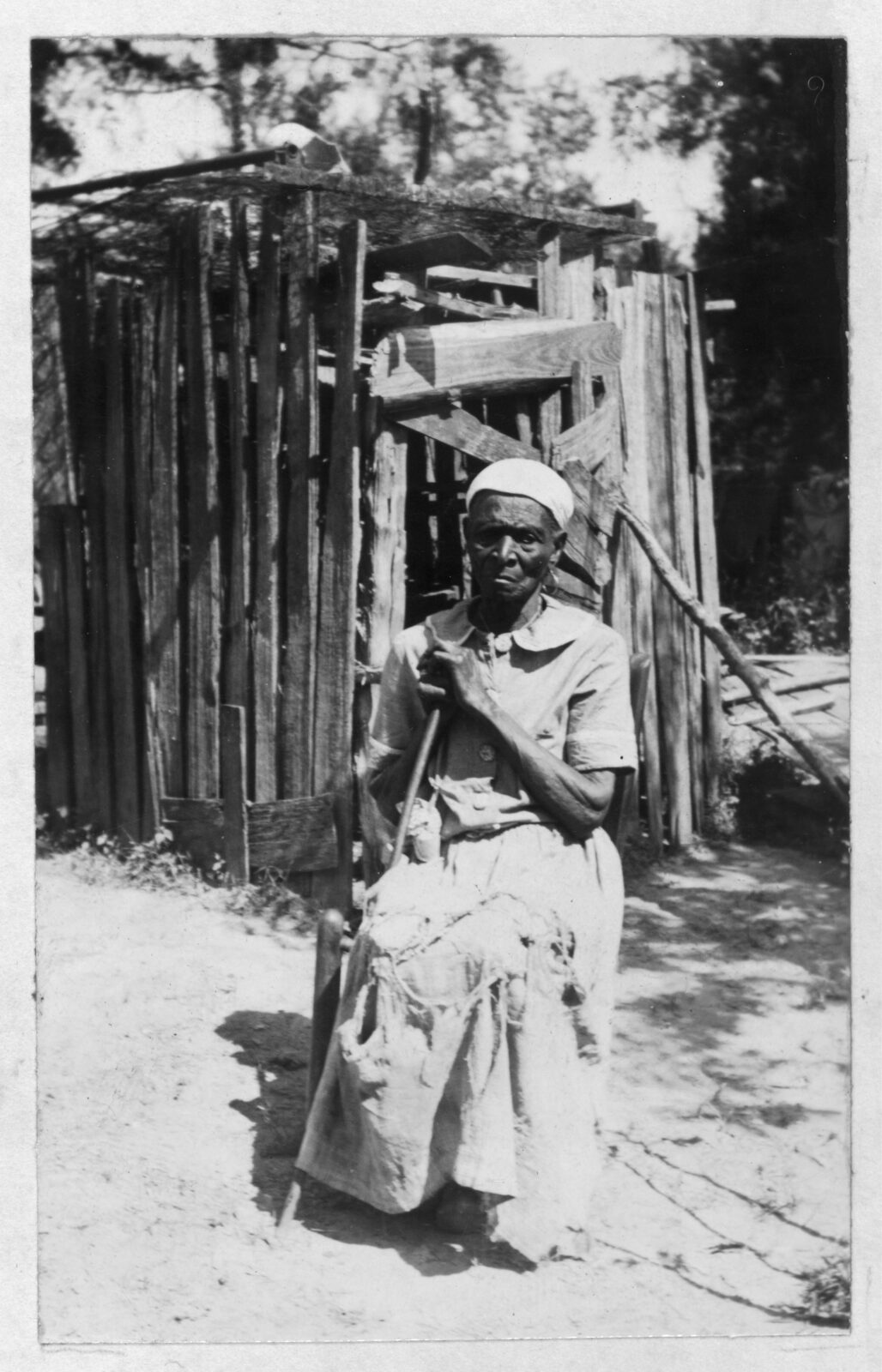
- Born
- About 1851 (age 86 when interviewed)
- Interviewed in
- Alabama
- Age when photographed
- 87
Laura Clark
Laura Clark was 86, crippled and nearly blind, when Ruby Pickens Tartt interviewed her on the porch of her cabin outside Livingston, Alabama, among cans and boxes full of flowers. She was born on Pleasant Powell's place in North Carolina. Her mother, Rachel Powell, had twenty-two children; her father had been sold away before Laura could remember him. When Laura was six or seven, a man named Garrett from the bend near Livingston bought ten children in North Carolina, none of them related, along with an old woman, Julie Powell, and a man named Henry to look after them. He did not buy Laura's mother.
As the wagon pulled away, her mother, holding twins in her lap, told Julie, "Take care of my baby child, and if I never see her no more, raise her for God," then fell off the wagon and rolled on the ground crying. Laura, eating the candy they had been given to keep them quiet, didn't understand. She never saw her mother again; after the surrender she learned her mother had died. Her grandmother, Rose Powell, told her to pray and be a good girl and to meet her in heaven. The trip took a month. Garrett told the overseers to be good to "these motherless children" and went to war. When he returned, missing an arm, he fired both overseers for whipping old Julie nearly to death.
Laura could not read. Her husband died leaving her with nine children. She had children buried in nearly every graveyard around Prospect and in Birmingham and Bessemer; one son was killed with a spade while eating his dinner by the road. She had belonged to the church for 55 years, and when she heard the congregation across the road singing "A motherless child sees a hard time," she said she just burst out crying.
From the Federal Writers' Project slave narratives, 1936–1938. The interviewers wrote down their words in the 1930s, often in dialect spellings that reflect the interviewer more than the speaker.