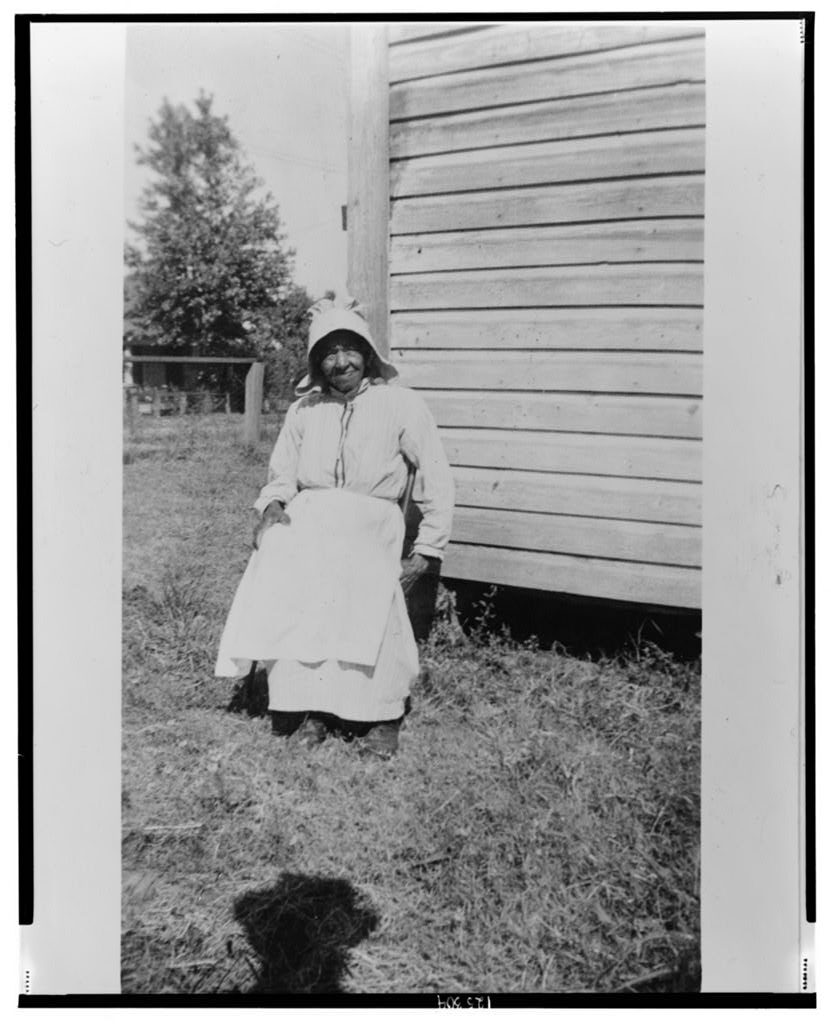

- Interviewed in
- Texas
- Age when photographed
- 89
Biography · formerly enslaved
Mariah Snyder
A biography drawn from Mariah's own account is being prepared. Their own words are below.
Scales 3 Abram Sells 9 George Selraan 15 Callie Shepherd 17 Betty Simmons 19 George Simmons 24 Giles Smith 30 James W. Smith 33 Jordon Smith 36 Uillie Ann Smith 41 John Sneed 47 Mariah Snyder 52 Leithean Spinks 57 William Stone 64 Yach Stringfellow 67 Bert Strong 70 Emma Taylor 73 Allen Thomas 83 Bill and Ellen Thomas 85 Lucy Thomas ' 89 Philles Thomas 92 William K. Thomas 95 Facing page Mary Thompson 100 Penny Thompson 103 Albert Todd 106 Reeves Tucker 116 Lou Turner 118 Sol Walton - 128 Rosa Washington 134 Sam Jones Washington 138 William Watkins 141 Emma Watson 147 James lest 150 Adeline 7/hite 153 Daphne 77illiams 160 Lou Williams . 166 Lou Williams' House Millie T/illiams 166 - 170 Steve Williams 179 Wayman Williams and Henry Freeraan 182 Willie Williams 187 Lulu Wilson 190 Wash Wilson 195 Willis Winn 201 Rube Witt 208 Ruben Woods 211 Willis Woodson 214 Facing page Sallie Wroe 223 Litt Young 227 Louis Young 232 Teshan Young 235 4:20:2(58 EX-SLAVE STGEIES (Texas) Paf?e One 9 UAZIQJJ3 SAKCO was horn a slave of Mrs. Louisa Green, in Columbia, South Carolina, on February 10, 1849. Shortly after Mazique was freed, he enlisted in the array and was sent with the Tenth Cavalry to San Angelo, then Port Concho, Texas. After Mazique left the army he became well-known as a chef, and worked for several large hotels. Mazique uses little dialect. When asked where Mazique is, his young wife says, "In his office," and upon inquiry as to the location of this office, she replies mirthfully, "On de river,,f for since he is t->o old to work, Mazique spends most of his time fishing. "My mistress owned a beautiful home and three hundred twenty acres of land in the edge of Qolurabia, in South Carolina, just back of the *tate house. Her name was Mrs. Louisa Green and she was a widow lady.…
From the Federal Writers' Project slave narratives, 1936–1938. The interviewers wrote down their words in the 1930s, often in dialect spellings that reflect the interviewer more than the speaker.