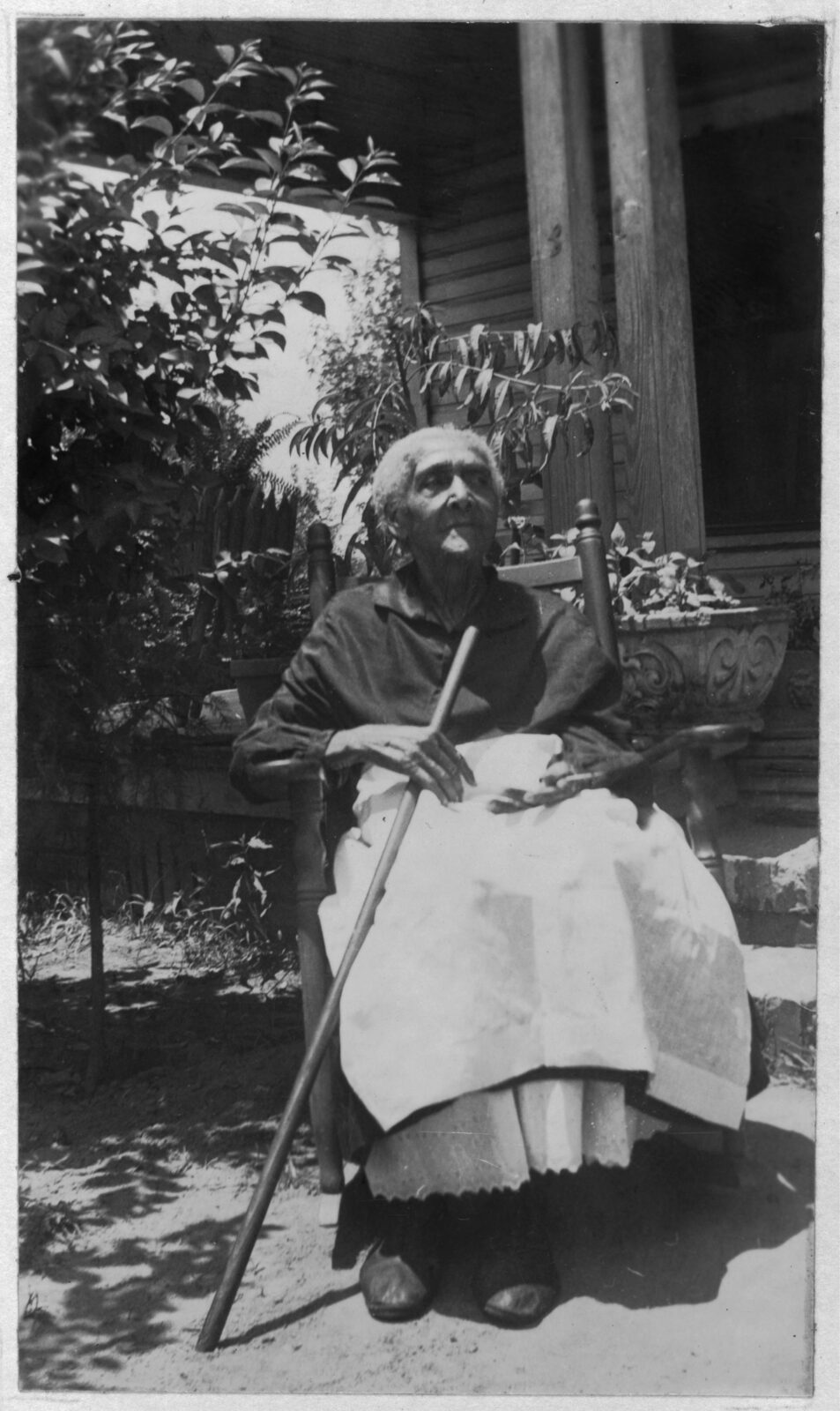
- Born
- About 1834 (31 at the surrender)
- Interviewed in
- North Carolina
- Age when photographed
- 103
Tempie Herndon Durham
Tempie Herndon Durham was 31 when the surrender came, which made her about 103 when Travis Jordan interviewed her at 1312 Pine Street in Durham, North Carolina; she said she was probably the oldest Black person in the city. She was enslaved by George and Betsy Herndon in Chatham County on a big plantation that raised corn, wheat, cotton, tobacco and sheep. She remembered the hum of the spinning wheels and the people singing in the carding and spinning room, and the dye house run by Mammy Rachel, who knew every root, bark, leaf and berry that would make any color and hung the dyed hanks in the sun "every color of the rainbow."
She married Exter Durham, who belonged to Snipes Durham across the county line in Orange County, on the front porch of the big house. She wore a white dress, white shoes, long white gloves and a veil made from a net window curtain, and walked down the path while her mistress played the wedding march on the piano. Exter had carved her ring from a big red button with his pocketknife; she wore it about fifty years until it wore so thin she lost it in the washtub. After the preacher married them, they were made to jump the broom backward: she sailed over "same as a cricket," while Exter, who'd had a big dram, tangled his feet and fell. Because he belonged to another man, Exter could only visit Saturday night through Sunday night. They had eleven children, nine born in slavery. She said she was "worth a heap" to her enslaver because she had so many children, since the more children an enslaved woman bore, the more she was worth.
She was glad when the war ended because she and Exter could finally live together. They rented land for a fourth of the crop, then bought their own farm with $300 they had saved.
From the Federal Writers' Project slave narratives, 1936–1938. The interviewers wrote down their words in the 1930s, often in dialect spellings that reflect the interviewer more than the speaker.