- Born
- About 1859; near the Washita River, Indian Territory
- Interviewed in
- Texas
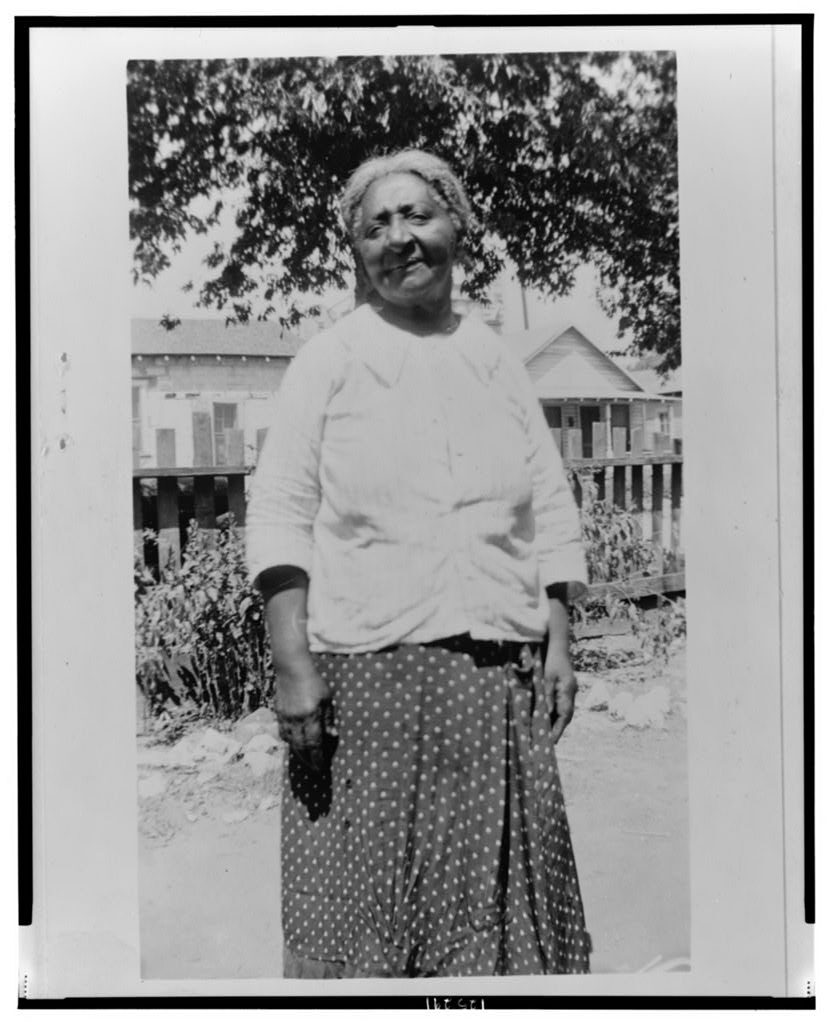
Tillie Powers
Tillie Powers never knew her parents. Everything she knew about her earliest life came from Joseph Powers, an army officer. He told her that while he and his wife were escorting soldiers back to a fort, they found a bundle wrapped in a buffalo robe lying by the road near the Washita River, and inside it was a baby girl. The interviewer recorded that her father had been with a band of raiding Native men and her mother had left her there so she would not grow up among them. Powers took her to his plantation in Edgecombe County, North Carolina, where about fifty people were enslaved, and she was raised there.
She was six when the war ended, so she remembered the plantation's cotton, tobacco and orchards more than its work. She said troublesome people were whipped, but the enslaver ordered that no blood be drawn, unlike on other places she heard about. When food ran short in the war, men were sent out to hunt turkey and squirrel. Near the end she saw soldiers of both armies passing by the thousands. When Powers came home and read the freedom paper, he advised everyone to stay until they had work lined up. Most stayed at first and then left one by one. As an orphan, Tillie stayed, and was paid five dollars a month until she left at eighteen. She said she still cried thinking of the mistress, who had always been good to her.
In 1880 she married John Daniels. She said he would not work and beat her when she complained, and after six years she sent him away. A planter named Race Robinson brought them and about fifty others to Texas to sharecrop. She worked for white families until a few years before her interview, and in old age lived in Fort Worth on a fifteen-dollar state pension.
From the Federal Writers' Project slave narratives, 1936–1938. The interviewers wrote down their words in the 1930s, often in dialect spellings that reflect the interviewer more than the speaker.