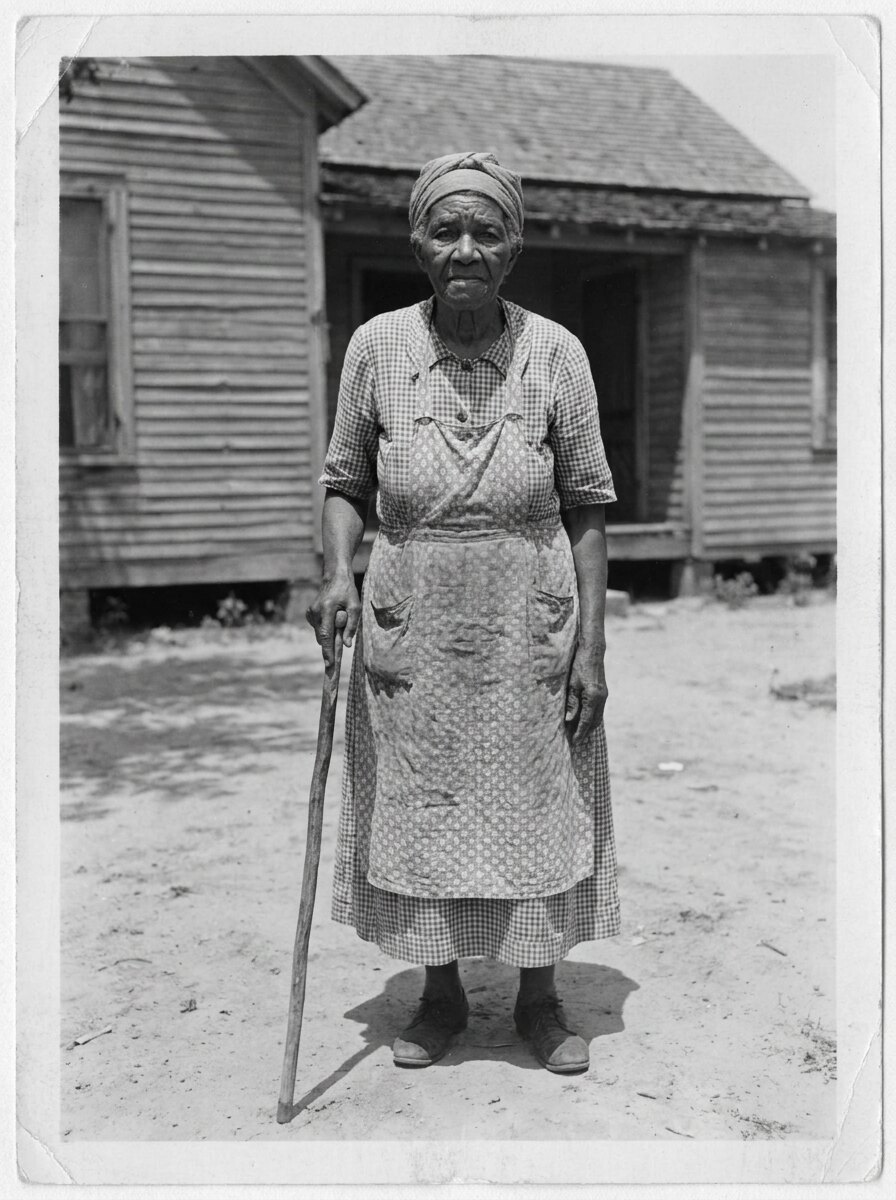
Portrait: artist's interpretation. No photograph of Aunt Harriet Smith is known.
Aunt Harriet Smith
Recorded in Hempstead, Texas, 1941 · Born about 1852; Hays County, Texas
Their Story
Harriet Smith grew up in Hays County, Texas, enslaved by a family she identified by the initials B. She did not know her exact age but said she was about thirteen at "the break up," when slavery ended. Her mother was the cook, and her grandmother worked in the fields. Harriet herself plowed with oxen, which she remembered were named Jerry and Broad, and said she could lay off a corn row "as good as any man." She said her owners did not whip the people they held, though she heard stories of brutal whippings elsewhere. The enslaved people held prayer meetings from house to house and could attend the white church in Mountain City on Sunday evenings, where, she said, preachers taught them mainly to obey their masters. No one taught them to read or write.
She vividly remembered sitting on a white picket fence with other children, watching columns of soldiers, including Black soldiers, ride past for weeks toward San Antonio, with bugles playing and trained horses stepping to the music. A neighbor girl who had lost an arm feeding a molasses mill rode off one day with one of those soldiers and was never heard from again.
After freedom her family stayed on the place and rented on halves until her father bought land across the creek, in a Black settlement she said is now called Buellah. She married J. S., a man who had also been enslaved. He drove cattle north, spoke at political meetings that drew crowds of Black and white listeners, and was shot from ambush in 1901, a killing she linked to politics. His brother had been killed about a year earlier. She later married three more times, including, in the 1930s, a Civil War veteran. She belonged to a Methodist church she had helped build. John Henry Faulk recorded her in Hempstead, Texas, in 1941.
The Recordings & Transcripts
Part 1 of 4 Hempstead, Texas, 1941
Captions open at the bottom of the screen when you press play. Click any transcript line to jump to it.
Transcript
Harriet Smith:And you ask me any words you want to ask me about a slave, you know, back, and uh, I can remember.
John Henry Faulk:Well Aunt Harriet about how old are you?
Harriet Smith:Well I don't know Mr. Faulk. I really don't know my age, only by the, the children telling me, of course. My ma died, and she, and she didn't know nothing about our age. But the children traced back from the ex-slave up to now.
John Henry Faulk:Well how old were you when you were [Harriet Smith interrupts]
Harriet Smith:Well, I was about thirteen years old at the break up.
John Henry Faulk:Uh huh. Can you remember slavery days very well?
Harriet Smith:Of course. I can remember all our white folks. And all the names of them, all the children. Call every one the children's names.
John Henry Faulk:Who, who did you belong to?
Harriet Smith:J. B., the baby boy.
John Henry Faulk:Where was that? Where did he live?
Harriet Smith:Back, out here in Hays County.
John Henry Faulk:Sure enough? How many, how many of, how many slaves did he have?
Harriet Smith:Well, he had my grandma, and uh, and my ma. My ma was the cook, and grandma, you know, and them they worked in the field, and everything. I remember when she used to plow oxen. I plowed, I plowed oxen myself.
John Henry Faulk:Is that right?
Harriet Smith:I can plow and lay off a corn row as good as any man.
John Henry Faulk:Is that right?
Harriet Smith:Course I can.
John Henry Faulk:Well good for you. [John Henry Faulk and Harriet Smith overlap]
Harriet SmithChop, and chop, pick cotton. I used to pick, I've pick [unintelligible] here since I been here. I've [unintelligible] pick, pick my five hundred pounds of cotton.
John Henry Faulk:Knock out five hundred pounds.
Harriet Smith:Knock out around five, five hundred pounds of cotton. Then walk across the field and, and hunt watermelons, pomegranates and [laughs]
John Henry Faulk:That's a [unintelligible].
Harriet Smith:Yeah.
John Henry Faulk:Well Aunt Harriet, do you remember church times?
Harriet Smith:Yes, I remember church time. I remember how [John Henry Faulk interrupts]
John Henry Faulk:You remember during slavery times [Harriet Smith interrupts]
Harriet Smith:Yes, I remember how our folks, they had prayer meeting from one house to another.
John Henry Faulk:Uh, the colored folks.
Harriet Smith:Yes, I think it was [unintelligible]. And over at the houses you know, they'd be in the section, a house, and at different places they'd go and we'd have prayer meeting. Ma and pa and them would go to prayer meeting. And dances too.
John Henry FaulkAnd dances too?
Harriet Smith:Yes. I've seen pa and ma dance a many a time.
John Henry FaulkIs that right? During slavery times?
Harriet Smith:Right. My grandma too. My grandma was name R. P.
John Henry FaulkR. P.
Harriet Smith:Yes. But she belong to the B.'s. [mumbles] That's, that, what she went by, her husband's name. Sure is, that's way back. Now in slavery time, there was my sister, my brother was a slave back. And all of them stayed but me and one, one of the girls and she lives in San Antonio. A. T.
John Henry FaulkA. T. She, she was your sister?
Harriet SmithYes. She's in the young bunch. Sister Ida, and she was the next, brother George and sister Ida and myself were slaves. And the others was born free. And all of them, we the only two in slavery times.
John Henry FaulkWell I declare. Did you go to meetings? Did you ever go to church?
Harriet SmithWe would go to the big house, prayer meetings you know. We children would put us in the comer you know. We was dared to cut up too.
John Henry Faulk:Is that right?
Harriet Smith:Yes, they'd carry us to prayer meetings.
John Henry Faulk:Well did you go to the white folks' church any?
Harriet Smith:Yes. I went to Mountain City to the white folks' church many a time. You see the white folks would have church in the morning, then they'd let the colored people have church at their church in the evening.
John Henry Faulk:That was during slavery time.
Harriet Smith:During slavery time, yes. During slavery time. I can remember that just as well as [John Henry Faulk interrupts]
John Henry FaulkWell what would the preacher preach about in them days?
Harriet Smith:I don't know. I didn't go. He'd preach about you know, maybe something or another.
John Henry FaulkThey didn't preach like they do today?
Harriet Smith:No. They wasn't educated, you know, and they uh, uh, would, would tell you how to do, and how to get along, you know, and how to treat the white people and so on. And they'd read the Bible then, you know, [mumbles]. Yeah, I remember all about in slavery time. Ma and them used to go to dances with the white folks.
John Henry FaulkWell did they treat, did the white folks treat you good? Did you [Harriet Smith interrupts]
Harriet Smith:Why, the B.'s?
John Henry FaulkUh huh.
Harriet Smith:They was good to us. Good. They never whipped none of their colored people, our colored people. They'd take big saddle horse, Mrs. B's saddle horse, big gray animal, and she'd have them riding. Grandma would ride to Mountain City to church. They had white preachers there. Mr. P., he was one of the preachers that lived across from us.
John Henry Faulk:Well would the white preacher tell you to behave yourselves and be [Harriet Smith interrupts]
Harriet SmithOh yes, they [John Henry Faulk interrupts]
John Henry FaulkBe good to your master and mistress?
Harriet SmithOh yes. That's what they preach. We, sure, didn't know there was any such thing as God and, and, and God, you know. We thought that was a, a different man, but he was our master. Uh, our white folks, you know, preachers would refer to the white folks, master, and so on that way. Preach that way. Didn't know no better. All of them, all of them would go up there to church. Then after we come to be free, you know, they begin to, preach us, you know. They, we begin to know, you know, there was a God and so on.
John Henry FaulkWell, well, while you all were slaves did they teach you to read and write?
Harriet SmithNuh huh.
John Henry FaulkDid you all go to school any?
Harriet Smith:Nuh huh. Uh, uh, they didn't know nothing about reading and writing. All that I knowed they teach you is mind your master and your mistress.
John Henry FaulkThey sure didn't teach you any reading and writing?
Harriet Smith:No, they didn't. No. When I picked cotton, I remember then picking cotton, farming [John Henry Faulk interrupts]
John Henry FaulkWell did you ever hear of any slaves being mistreated? That, were there any tales going around in those days about that?
Harriet SmithUh, nuh huh, uh, yes, I know of times they, when, when they mistreated people, they did, and I hear our folks talk you know, about them whipping you know, till they had to grease their back to take the holes from the, the back.
John Henry Faulk:Good Lord have mercy.
Harriet Smith:Them white folks were that a way. But them B.'s sure didn't allow their colored people be whipped. Their horses, their saddle horses, Mr. B's saddle horse and ma and pa and them wanted go anywhere, they, they rode their horses and the saddle. Mountain City to church, and the children stayed home [unintelligible]. Then, that on then, from one to another they begin to learn, town preachers in amongst us. They'd have prayer meeting, you know from one house to the other you know how the house, like there's a house sitting here in a section, in line, you know, and people would come to prayer meeting. And then they, Sunday in the evening the white folks would let the preacher preach, let our folks go to their church for preaching.
John Henry Faulk:Well do you remember any of the songs they sang in those days at churches?
Harriet Smith:No. I, I, if I had the books, I could maybe look, look and see. I know they sang the song, they sang the song, "Are We Born to Die?" They'd sing that the colored church.
John Henry Faulk:"Born to Die." How did that go, you know?
Harriet Smith[mumbles]
John Henry FaulkYes, a little louder.
Harriet SmithYeah, yeah.
John Henry FaulkHow'd it go?
Harriet SmithYeah. They'd sing "Are We Born to Die?" [unintelligible] I was little. I would sit back. I never went much. We children, we stayed at home, parched corn and play you know. Little children. Ma and pa and them and grandma would ride the horses, about two miles from our home, white folks' home, where they stay, and go to the white folks' church. I used to hear them laugh and tell it all the time, you know. We didn't know anything about freedom at all. There was three. There, there was me, and my oldest, next oldest sister and my brother George. He was, uh, [they-they're] all dead. All of them's dead but just two of us.
John Henry FaulkWell, uh, can you remember when the war was going on?
Harriet SmithCourse I can. I've sat on the fence at the time, me and cousin M., and cousin S., and all of us. Our yard had white picket fence around it. The road went right along by our house like this road goes along by my house. We sat on that, stood on that picket fence. All day long we seen them soldiers going back to San Antonio and different places. I had the [unintelligible] they'd blow them bugles. Them horses was ??? and dancing and all just like that.
John Henry FaulkWell what do you know.
Harriet Smith:Colored soldiers`.
John Henry Faulk:Colored soldiers?
Harriet SmithPoor colored soldiers in droves. Went right along by our house. Our home, it was a two story house, the white folk's home, you know. And we stayed on the home until we bought a home, uh, it was over across the creek where we living. [unintelligible]
END OF SIDE
Part 2 of 4 Hempstead, Texas, 1941
Captions open at the bottom of the screen when you press play. Click any transcript line to jump to it.
Transcript
John Henry FaulkI remember a long time ago you told me about during the big break up, the soldiers came by and uh, riding horseback. And you all were sitting on the fence, you children. Can you remember that?
Harriet SmithYeah.
John Henry Faulk:Lean this way just a little bit and tell about it.
Harriet SmithYes, I remember, that's, the, the, just, sit there, sat all day and look at them. They play the prettiest, prettiest music you ever heard in your life. And the soldiers would, you know. And them horses, they'd sing, you know. And them horses dart and follow the music just like that.
John Henry Faulk:Well I'll declare. Had them trained.
Harriet SmithYeah, had them trained.
John Henry Faulk:Well what about this girl you told me about there one time.
Harriet Smith:Well, N. P. was the one that uh, belonged to Mrs. P., the one that our white folk's neighbors. And she got her arm ground off in molasses mill, feeding molasses mill.
John Henry Faulk:How was that? How do you mean feeding a molasses mill?
Harriet Smith:Putting that cane in there for it to grind out to make molasses.
John Henry Faulk:Oh yeah. Ground out juice, uh huh.
Harriet Smith:Yeah, juice. They had them wooden, what you call things, you know, mash the cane with them.
John Henry Faulk:And they hitch a mule to it wouldn't they?
Harriet Smith:Yes.
John Henry FaulkAnd he'd walk in a circle.
Harriet Smith:Yes sir, yes. He'd walk in a circle.
John Henry Faulk:Kind of like a hay baler? [John Henry Faulk and Harriet Smith overlap]
Harriet Smith:It have a, it have, it have a lever to it, you know, and go around and around.
John Henry FaulkUh huh.
Harriet Smith:We've made molasses that way. I've made molasses myself.
John Henry Faulk:You have. Well, now this girl got her arm ground off in molasses, uh, mill.
Harriet SmithYes, feeding the molasses mill, uh huh. That was the, that was the neighbor girl. [mumbles]
John Henry Faulk:Well how old was she?
Harriet Smith:Oh, she was a great big girl. She was about, big enough to feed the mill. About ten or twelve years old I reckon. Maybe that old, maybe even a little older than that. The neighbors had a molasses mill, the P.'s. She made molasses for everybody nearly. That girl had that mill to feed. Cane, would have cane you know, great big piles, piled up. She had to reach down and get that and put it in between them cork grinders and let it grind out and when that grind out, she'd pick up another handful and put in there.
John Henry Faulk:Well did they have good doctors for them in those days? Was, when it ground off her arm what did they do? How did they get her out? [John Henry Faulk and Harriet Smith overlap]
Harriet Smith:I don't, I don't know. I guess they carried her to [unintelligible]. I, I remember Dr. M., and, and uh, Dr. C. I remember them.
John Henry FaulkWell, when the soldiers came by what, where, where was she?
Harriet Smith:Who M.?
John Henry Faulk:Uh huh.
Harriet SmithShe was on the other side. She lived the other side of us. She was living, she was living with our white folk. But this road went right along by our white people's house. I can go right today where I was born there. And they was coming right along by the house and they'd all day for weeks at the time. Them soldiers was traveling going south to San Antonio. [mumbles] We children stand on the fence and looked at them. Oh they had the prettiest horses you most ever saw.
John Henry Faulk:Well now what, what did those girls, what would this girl M. do.
Harriet Smith:M. P.?
John Henry FaulkUh huh.
Harriet SmithWell she, she fed the mill. She [John Henry Faulk interrupts]
John Henry Faulk:Well I mean though when, when the soldiers came by.
Harriet SmithWhy, she's on the fence there with us looking at them. She lived right across from us you know, and that was the road and she [John Henry Faulk interrupts]
John Henry Faulk:Well I thought she went off with a soldier or something.
Harriet Smith:She did. She went off with a soldier. Soldiers come along, we all setting on the fence, and uh, or standing at the fence, setting and a colored soldier come along and ask her did she want to go with him and she said yes. And she mounted one of them horses and [John Henry Faulk interrupts]
John Henry Faulk:Right behind him huh?
Harriet Smith:Uh, uh, no, rode a horse to herself.
John Henry FaulkIs that right?
Harriet Smith:That's right. We could ride horses. We could jump on them horses saddle sometime, ride them sometime. We learn how to do, I could stand flat-footed on the ground, jump on a horse sideways.
John Henry FaulkIs that right?
Harriet Smith:That's right, yeah.
John Henry Faulk:Well you were a rider.
Harriet Smith:Yes. All of us, all of we all was raised to ride horses. Pa had horses of his own, chickens of his own.
John Henry Faulk:Well now what happened to M. P. after she and this soldier [Harriet Smith interrupts]
Harriet Smith:I, she went on with him. I never did see her and hear tell of her no more. She was going toward San Antonio.
John Henry Faulk:Going towards San Antonio.
Harriet SmithYes. She rode on with them down there.
John Henry FaulkWell, what did she do? She didn't even tell her mama she was going or anything, huh?
Harriet Smith:She didn't have any mother.
John Henry Faulk:Oh, I see.
Harriet SmithYeah.
John Henry FaulkAnd it's all, she'd already been freed hadn't she?
Harriet Smith:Yes, yes. That was the time the soldiers was going back you know after the freedom, back. And she'd always come over to our house and stay with us and play around. And she got on that horse and left that day. [John Henry Faulk interrupts]
John Henry FaulkWell, can you remember the times right after the, after the big break up very well? Do you remember were times pretty hard then?
Harriet Smith:Yes. Times was hard. We worked and our white folks wasn't mean to their colored people. They was different from, there was seven brothers of them. Old man S. B., and J. B., and B. B. And they had one more B., that was name Kentucky Joe and so on. Whole passel of them. Seven brothers of them, I know. Some of them lived at Cedar Creek. Ma knowed them all and grandma knowed [John Henry Faulk interrupts]
John Henry FaulkWell what did you all do after the big break up? Did you all leave the place?
Harriet Smith:No. We stayed on the place, and rented on the half.
John Henry Faulk:Oh rented on the half [Harriet Smith interrupts]
Harriet Smith:Yes. All, all our white folks was dead. And the overseer was old uh, B., Tom, Ira B.
John Henry Faulk:Ira B.
Harriet Smith:At Mountain City. That was our uh, uh, over, overseer over the place there, you know.
John Henry Faulk:And y'all rented on the halves.
Harriet SmithRented on the halves till we bought our home across the creek.
John Henry Faulk:Oh you bought your home. About how long after the big break up did you all buy your home?
Harriet Smith:Oh, I didn't buy. We didn't buy. Pa bought the home from old R., across the creek. And he stayed down there. And I used to stay with Aunt Rose an Uncle George. They was old folks, had no children, you know. They used to get me to come stay with them. And when I married they give me a home on the place.
John Henry Faulk:Well were they white folks?
Harriet Smith:No, colored folks.
John Henry Faulk:Oh, colored folks. Well, how old were you when you married?
Harriet Smith:I don't know, about seventeen, eighteen years old. Well maybe not that old. I didn't know my age. But ma and them knew. They didn't tell us though. We just guessed at it.
John Henry FaulkWho did you marry?
Harriet SmithJ. S.
John Henry FaulkJ. S. Had he been a, had he, had he been a, a slave?
Harriet Smith:Oh yes. He was a slave. After the break up they sent him, he come from Blanco and bought a home over across the creek where we bought homes, adjoining our home. His father and mother did, you know. [mumbles]
John Henry Faulk:Uh, well, he, he had been freed then, I guess, the, uh, same time you had.
Harriet SmithOh yes, yes. They lived at Blanco. They bought them a home over in the colony. R. had sold the colored people all the homes there. I don't know.
John Henry Faulk:Who was R.?
Harriet Smith:A white man name R. lived right down the hill from us. They sold P. B. a home, and uh, pa had a home, Uncle Dave a home. All, all of them just all of them [John Henry Faulk interrupts]
John Henry Faulk:Well I declare. Uh, that was right after the big break up was it, uh?
Harriet Smith:Mmmm. About two, three years after the break up.
John Henry Faulk:Huh, and you just had a colony of, uh, colored folks?
Harriet Smith:Yes, that colony, where we, where I come from, has got homes out there. At Buellah they call it now. It wasn't nothing but woods when we bought it.
John Henry FaulkAnd they call it Buellah now?
Harriet SmithYes.
John Henry FaulkOh I know where Buellah is.
Harriet SmithYes, yes, yes [mumbles].
John Henry Faulk:Did you know Mr. T. in those days?
Harriet Smith:I reckon I did know Mr. T.
John Henry FaulkHuh. What was he [Harriet Smith interrupts]
Harriet SmithHe was a deputy sheriff there for a while.
John Henry Faulk:Is that right?
Harriet SmithYes sir. He was a mighty fine man too, that's right.
John Henry Faulk:Yeah, he sure is.
END OF SIDE B
Part 3 of 4 Hempstead, Texas, 1941
Captions open at the bottom of the screen when you press play. Click any transcript line to jump to it.
Transcript
John Henry FaulkLean up this way a little. And you remember, can you remember churches very well Aunt Harriet? Were you a church goer?
Harriet Smith:No. We was just children then, when slavery time. My mother and father, I can remember when they went to church. Our white folks, they'd ride, go to church in the morning, you know, and they'd go in the evening, my grandma, to the white folks' church. In Mountain City, ride their horses.
John Henry Faulk:Well now what do you, when did you start going to church?
Harriet Smith:Oh yeah. I never started to going to church. We never had any church till, uh, much after I married.
John Henry FaulkWell, and you started going, didn't you?
Harriet Smith:Yeah.
John Henry FaulkAfter you got married.
Harriet Smith:I went to church, and [mumbles]
John Henry Faulk:Well, who, who do you, how did you marry? Did you have a preacher to marry you?
Harriet Smith:Course. A white preacher married us.
John Henry FaulkHe did, huh.
Harriet SmithUh huh. White preacher married all of us girls. There wasn't any preachers much when I married.
John Henry FaulkWell, who did you uh, uh, when did you first start going to church then?
Harriet Smith:Well we'd go to church then. We had church before. It wasn't like, you know, preachers didn't know unless, you know, only what they heard [John Henry Faulk interrupts]
John Henry Faulk:Was he a traveling preacher? Or was he just, he was a colored preacher wasn't he? [John Henry Faulk and Harriet Smith overlap]
Harriet SmithYes, just traveling, you know, and stop there and preach. There was a H.and G. and so on. That was our preacher's name. [mumbles]
John Henry Faulk:Well what would they preach about? Can you remember?
Harriet SmithWell, they just preached that we had a God and a soul to be saved and so on.
John Henry Faulk:Did they preach as good as preachers preach today?
Harriet Smith:Oh no. No, they didn't know nothing, you know, only read the Bible sometimes in places they could read a little. No they wasn't, the preacher wasn't educated at all.
John Henry Faulk:They weren't huh.
Harriet Smith:No. Only [John Henry Faulk interrupts]
John Henry Faulk:Some of them couldn't read and write at all.
Harriet Smith:No, they would spell letters and so on. Couldn't read and write at all. [pause] There's some of them couldn't read and write at all. Just only preached what they heard others say, you know. Then some of them, after getting older and wiser, you know they [John Henry Faulk interrupts]
John Henry FaulkWell what about the songs that they sang. that's what I'm interested in. [John Henry Faulk and Harriet Smith overlap]
Harriet SmithOh. I didn't go much when they sung them songs and uh [John Henry Faulk interrupts]
John Henry FaulkWell did they sing these old One Hundreds? Do you know what an old One Hundred is?
Harriet SmithOne of these old time songs?
John Henry Faulk:Uh huh.
Harriet Smith:Yes, yeah.
John Henry Faulk:Where they'd write off one you know. "Must Jesus Bear the Cross Alone, and All the World Go Free?" You've heard that haven't you? [John Henry Faulk and Harriet Smith overlap]
Harriet SmithYes, yes, that's it. That's the wind blowing, I think. I don't know what it's fixing to do out there. See them trees a-bowing down. Yeah, yes we'd sing them songs. But I had the old, old timey books, hymn books, I'd be [John Henry Faulk interrupts]
John Henry Faulk:Well where would you get those books?
Harriet Smith:They had them, sell them. Ma and uh and grandma, and them bought them you know. And my husband bought each of us a hymn book.
John Henry Faulk:Was your husband H. S., uh, much of a [Harriet Smith interrupts]
Harriet Smith:J. S.
John Henry Faulk:Uh, oh, J. S.
Harriet Smith:Hmmm.
John Henry Faulk:Was he a church man?
Harriet Smith:Yes, he was [John Henry Faulk interrupts]
John Henry Faulk:What happened [Harriet Smith interrupts]
Harriet SmithChurch man, church man, and a politic man too.
John Henry Faulk:Oh you were, y'all voted in those days.
Harriet Smith:Yes. My husband was uh, he was known by white folks. He was well, uh, when he got kill them white folks was just crazy about him. He'd gone through [unintelligible]. That boy that killed my husband, I nursed him when he was a baby.
John Henry Faulk:How come him to kill your husband?
Harriet Smith:Well he just mean, just mean you know and he, they didn't like people up to date you know. And course there just thirteen months in the difference in my husband's kill and his brother. Stole [John Henry Faulk interrupts]
John Henry Faulk:Killed your husband's brother?
Harriet Smith:Uh huh. He'd been to church. I think he went to ??? that night to carry a bale of cotton. And this W. B. sat down on a seat and a whole passel of them was setting down talking. And when the time to come to his cotton, they killed him and, and they killed my brother, my husband on the way from the cedar break. I could go right to the spot now nearly where he was killed at.
John Henry Faulk:Shot him or cut him [Harriet Smith interrupts]
Harriet Smith:Shot him, shot him on the way from the cedar, see, we have a cedar break at home, at the old home. [mumbles] Shot him on the way from the cedar break.
John Henry Faulk:Well what kind of politicking did he do?
Harriet Smith:Well, he worked for white, white people when they want to be
elected, you know, anything that time.
John Henry Faulk:He'd work amongst the colored folks.
Harriet Smith:Amongst the colored people. Men speak, and white folks, you couldn't get in the house when he spoke hardly for white people, all that section there. He had a good learning. Uh, all of them boys did.
John Henry FaulkAnd he'd round up the votes, and that's how come them to kill him.
Harriet Smith:Uh huh. He rounded, when he set the night for a speech, people from Austin, from San Marcos, from every which way, white and colored, to hear him speak. He'd go to court house and speak for them.
John Henry Faulk:Hmm.
Harriet Smith:Uh huh.
John Henry Faulk:Hmm.
Harriet Smith:Yeah, he was forever speaking.
John Henry FaulkWell, he uh, did the colored folks not like him?
Harriet Smith:No. The colored people all went too, but these white people, this boy that killed him, old W. B., I nursed him when he was a baby before I was ever acquainted with my husband.
John Henry Faulk:Well what I was, what I'm trying to, to find out is, how come him to kill your husband. Was it over politics?
Harriet SmithUh huh, politics and different things you know. [mumbles] Poor white people.
John Henry Faulk:Did the white folks have your husband killed or did uh, did he just, W. B. just go shoot him [Harriet Smith interrupts]
Harriet Smith:No, my husband went to cedar break that day, and uh, and on his way back from the cedar break, uh, he lay by the road and killed him. And let's see, there was something about a horse, I don't hardly, how they done, but the white people, W. K. and them, was the first one got to him when he was killed. They had to shoot him, you know. And they brought the news to us. My brother and them.
John Henry Faulk:What did they do to W. B.?
Harriet Smith:Well, you know how that was. He lived up in there, you know. They would tell any kind of tale. Didn't do nothing, didn't hang him up, put him in jail about, seemed like (unintelligible]. But his brother-in-law killed him.
John Henry FaulkIs that right?
Harriet Smith:Sure.
John Henry Faulk:They must have been a-shooting a lot of folk up in them days.
Harriet Smith:Oh yeah, Them peoples was poor peoples you know. Rich white people don't bother nobody.
John Henry FaulkOh, it was the poor white folks.
Harriet Smith:Uh yes, it was poor. When they come down, and his brother-in-law S. L. killed him. S., his father moved away. Had a good home over there, and then moved away, said they'd steal his life just like they stole B. and J's. So, and his boy's life, so he left and went to Oklahoma. Yes. His brother-in-law kill him. He rode up to [unintelligible] to kill his brother-in-law.
John Henry FaulkAnd his brother-in-law shot him instead.
Harriet Smith:Yes. His mother tried to keep him from killing him but he just said, I ain't gonna let him kill me like he did Uncle J. Him and my boys all raised together. [mumbles]
John Henry Faulk:Y'all must have all been kin folks in those days.
Harriet Smith:Which?
John Henry Faulk:Well all of you seem to have been [Harriet Smith interrputs]
Harriet Smith:White folks?
John Henry Faulk.... and all.
Harriet Smith:No, they was white people.
END OF SIDE A
Part 4 of 4 Hempstead, Texas, 1941
Captions open at the bottom of the screen when you press play. Click any transcript line to jump to it.
Transcript
John Henry Faulk[addresses someone in the background] Quit H. [addresses Harriet Smith] Did you raise many uh, did the white folks uh, poor white trash and the colored folks have many fights back in the, after the big break up? Have many run-ins?
Harriet SmithNo. We never had nothing to ran in to, but wagons and teams.
John Henry Faulk:Well I mean did they have many uh, you know, quarrels and uh, fusses.
Harriet Smith:No. No, they just have these white, these B.'s that they kill our white, our, our boys, my husband and his brother, was poor white people. They didn't like. And let me see how that did come up. I done forgot now, you know, all about that you know. I know my husband was on his way from the cedar break.
John Henry Faulk:Well did the white folks meddle? Did the poor white trash meddle much with the colored girls in those days?
Harriet Smith:Not, not, not at our home. I don't know where they did it. At other places.
John Henry FaulkWell I did, I didn't mean at your home. I mean around though. Did you hear of any, anything like that going on in those days?
Harriet SmithNo. Yes. [mumbles] Well, the girls, we didn't run with them. They had different classes you know. Girls run, colored girls running with white boys, and white boys would come over at night. But we didn't associate with them [John Henry Faulk interrupts]
John Henry FaulkWell did much of that go on in those days?
Harriet Smith:Very little of it. It's going on more now than it did in my raising up days.
John Henry FaulkIs that right?
Harriet Smith:Yes sir. Yes sir.
John Henry FaulkWell I, I think this might have gone on.
Harriet SmithYes. They, they uh, we didn't go with them. Didn't associate with their kind no how. It's going on more now than it did in my raising. My, my sisters and me [John Henry Faulk interrupts]
John Henry FaulkYeah, you know that little J. Jr. across the street from you looks, he's got almost blonde hair.
Harriet Smith:Yes.
John Henry Faulk:His hair's white looking.
Harriet Smith:Uh huh. His mama, yes, his, his mama, Miss F., is his grandma. Yes, Miss F.'s son P. M. is his, is his father, her oldest son.
John Henry Faulk:Well her name's B. though.
Harriet Smith:I don't care what her name is. Her name's F. B., but she married a B. But B. wasn't these children's father.
John Henry Faulk:Oh I see.
Harriet Smith:Uh huh. M. was these children's father.
John Henry Faulk:Well now who was your second husband Aunt Harriet?
Harriet Smith:Who was my second husband? Let me see, who was my second husband?
John Henry Faulk:You married again after uh, uh, your what's his name, Smith. [John Henry Faulk and Harriet Smith overlap]
Harriet Smith:Old man, old man, uh, oh, I married B. S., was my second husband.
John Henry Faulk:B. S.
Harriet Smith:Yeah. And uh [John Henry Faulk interrupts]
John Henry FaulkHow long did you live with him?
Harriet Smith:Oh, around about a year I reckon, two years. He, he had a good, he had Indian blood in him.
John Henry Faulk:He did.
Harriet Smith:Uh huh. Indian blood. And then my next husband was old man [voice trails off]
John Henry Faulk:Well now what happened to B. S.? He die or did you divorce him?
Harriet SmithHe, he wouldn't sign the divorce but I got my divorce from him just the same.
John Henry FaulkYou did?
Harriet Smith:Yeah, yeah, he, he, he never, he didn't, he, he lived a long time after, after me and him married.
John Henry Faulk:Well after, after you separated from him who did you marry?
Harriet Smith0ld man P.
John Henry FaulkWhat's his name?
Harriet Smith:0ld man P.
John Henry FaulkUh, how old was he?
Harriet SmithOh, he was, he was eighty something. He was older than I was. He was about, I, I was his second wife that he married.
John Henry FaulkWell I, didn't y'all have trouble? Didn't you and he have a little trouble?
Harriet Smith:Who?
John Henry FaulkYou and old man P. Didn't he kind of cut up and carry on?
Harriet SmithYes. He cut up and carried on and I quit him. Come on back home.
John Henry Faulk:Uh huh. Did daddy get you that divorce?
Harriet Smith:Uh huh.
John Henry Faulk:I thought so. What was the matter with him?
Harriet Smith:Old man P. was all right. He was all right, but his son, that's what we had trouble with, A. He come to command the place, you know, tried to put me off of the place. He couldn't do it. I stayed there as long as I wanted to, and when I got ready, I come on home.
John Henry FaulkThen who did you marry?
Harriet Smith:Uh, let me see, who was the last man I married, old man C. over here.
John Henry Faulk:Old man C.
Harriet Smith:Uh huh.
John Henry FaulkWell did you and he, did he try to whip you one time?
Harriet SmithYes, yes. He couldn't whip me.
John Henry FaulkSpeak a little louder Aunt Harriet.
Harriet Smith:No, he couldn't whip me. He tried, but he couldn't. I put him [John Henry Faulk interrupts]
John Henry FaulkWhat, what did you do to him?
Harriet Smith[laughs] Put him outdoor.
John Henry Faulk[laughs] Well he was about a hundred years old wasn't he at that time?
Harriet SmithI don't know how old he was. He was in the Army.
John Henry FaulkIn the Civil War?
Harriet SmithYes.
John Henry FaulkHe fought in the [Harriet Smith interrupts]
Harriet SmithYes, he fought in the Civil War.
John Henry FaulkAnd you married him in the 1930s didn't you? In the 1930s?
Harriet SmithYes.
John Henry FaulkWell you see that would make him, that would make him close to a hundred anyhow.
Harriet SmithYes, but you see, you know there was another party between him, me and him that's the cause of our trouble.
John Henry FaulkIs that right.
Harriet Smith:Yes. [phone rings] Just answer, answer over here.
John Henry FaulkWas he running, was he chasing girls old as he was [Harriet Smith interrupts]
Harriet Smith:Yes.
John Henry FaulkHe was?
Harriet Smith:Yes.
John Henry FaulkHe just could hobble around [Harriet Smith interrupts]
Harriet Smith:Just could hobble around. They was chasing him for his money, you know.
John Henry FaulkOh I see.
Harriet Smith:Because he got, us see, he got, uh, when he quit the Army, got old, you know, he got his, his money, from the Army.
John Henry FaulkWell the girls uh, uh, must have made a fool out of him.
Harriet Smith:Yes they did. Got his money, all his money. He got sixty or seventy dollars a month, every month.
John Henry FaulkHmmm.
Harriet Smith:Yeah, [mumbles]
John Henry FaulkWell do you still go to church Aunt Harriet?
Harriet Smith:Yes. I go to church all the time nearly. Our church up, the Methodist Church up there [John Henry Faulk interrupts]
John Henry FaulkOh that must be [Harriet Smith interrupts]
Harriet Smith:At Saint Anthony. Yes, I, I join that church. After I come here we built that church, we built that church [John Henry Faulk interrupts]
John Henry Faulk:Well who is your preacher up there?
Harriet Smith:I haven't never met him, no. This, this we got a new preacher here, you know. I forget his name. [mumbles] Me and J. belongs to that church up there.
John Henry FaulkIs he a good preacher?
Harriet Smith:I've never askJ. what sort of preacher he is. This Sunday I was preparing to go to the church, some of the folks from [unintelligible - place] come, and I didn't go.
John Henry FaulkWell what do you think about Reverend R. as a preacher?
Harriet Smith:Well Reverend R., he's uh, Reverend R. is Miss F.'s preacher.
John Henry FaulkUh huh. Over at the Free Will Baptist.
Harriet Smith:Over at the Free Will Baptist.
John Henry Faulk:He's just a good friend of mine. I just wondered whether you liked him. [Harriet Smith interrupts and overlaps]
Harriet Smith:Yes. He's a good fellow. I like him fine. He's been to my house.
John Henry Faulk:He has?
Harriet Smith-. Yes.
John Henry Faulk:Well he thinks a lot of you too.
Harriet Smith:Yes. He's been to my house. I like him fine. Yes. Been to my house several times.
John Henry Faulk:Aunt Harriet, what, how has times changed since you uh, came to Austin?
Harriet Smith:Hmmm. I don't know. Times is changed. [mumbles] We've had churches, and different things like that.
John Henry FaulkDid you ever think you'd live to see the automobile?
Harriet SmithNo. I never did think I'd ever live to see the automobile. And the thing is, that I heard talk of them. I heard my husband talk of them. He went North with a herd of beefs with some white folks and he seen them up there.
John Henry Faulk:Is that right? He was a cowboy. Well which husband was that?
Harriet SmithThat was J. S., my first husband, all of these children's father.
John Henry Faulk:Oh, he saw, he saw automobiles then when he went up with the, a herd of cattle [Harriet Smith interrupts]
Harriet Smith:Yes, yes. He'd come back and say, uh, I saw these airplanes and things.
John Henry FaulkIs that right. And came back and told you about that.
Harriet SmithYes. We didn't know what nothing was.
John Henry Faulk:Well Lord, he was killed before the turn of the century, before 1900 wasn't he?
Harriet Smith:No. He was kill in 1901.
John Henry Faulk1901.
Harriet Smith:But he had been up North with a herd of beefs, you know, for cattle [John Henry Faulk interrupts]
John Henry Faulk:Who'd he work for?
Harriet Smith:Well he worked for different people. Worked, we worked for ourselves then. We bought a home of our own. [slight pause] Yes the white folks [ John Faulk interrupts]
John Henry Faulk:Did you ever, you, you've plowed in the field haven't you?
Harriet Smith:Sure, I reckon I did. Plowed and chopped cotton up there. I could drop corn just as fast as I walk that a way. Grandma too.
John Henry Faulk:Plow oxen?
Harriet Smith:Uh huh, yes.
John Henry Faulk:What was the name of your oxen? Do you remember?
Harriet Smith:Oh, I forgot them. One of them name Jerry and the other name Broad.
John Henry FaulkUh, named what?
Harriet Smith:Broad, they called him.
John Henry FaulkJerry and Broad.
Harriet Smith:Uh huh. Yes, we'd pop them whips and them oxen would go ’round there and plow. Yes, I, I don't know if my children ever seen any oxen.
END OF SIDE B
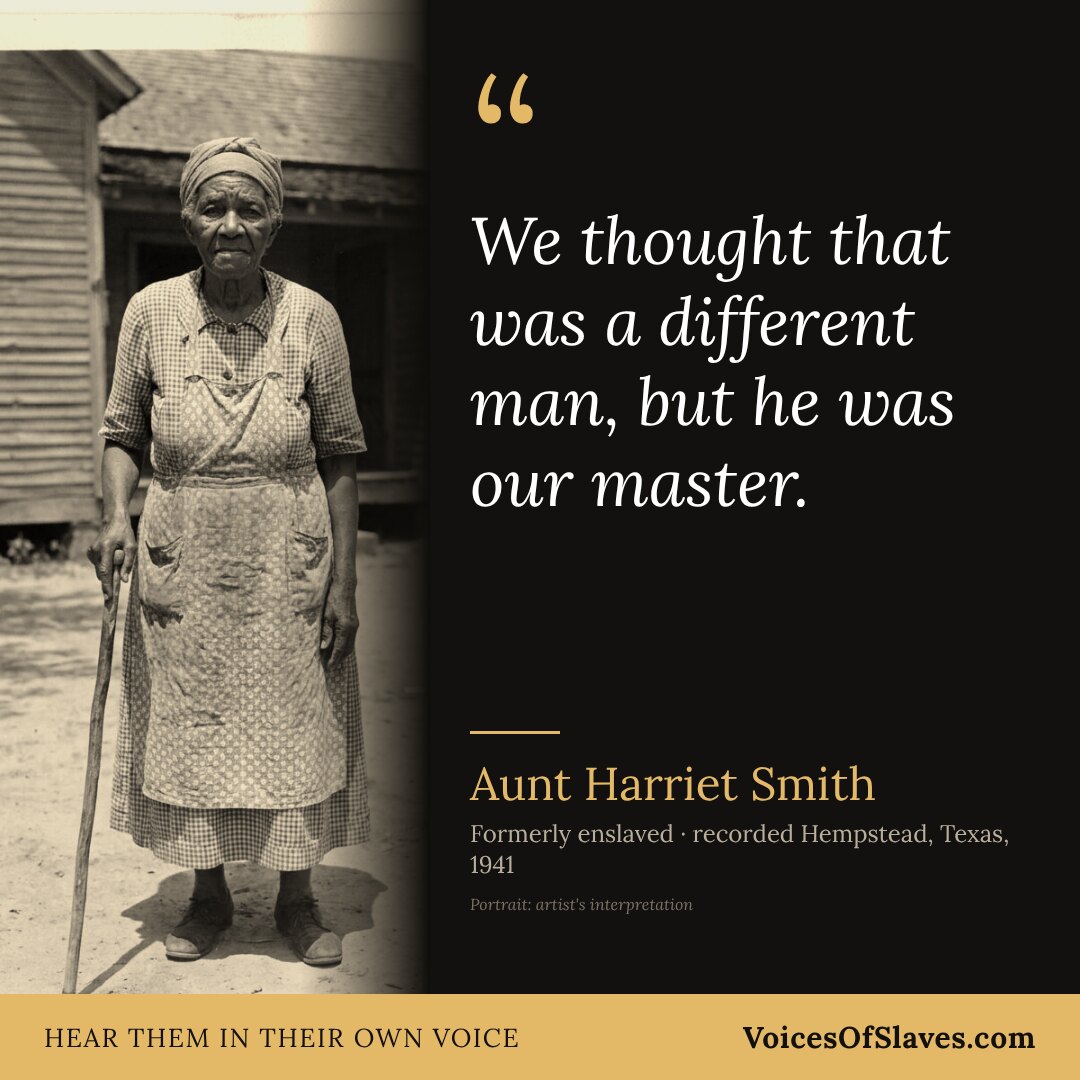
Share their words
Post this card so more people hear Harriet's voice.
Discuss Harriet's story in the Community
Recorded by John Henry Faulk, Hempstead, Texas, 1941. From Voices Remembering Slavery: Freed People Tell Their Stories. Bracketed notes and question marks in the transcripts mark sounds or words that are hard to hear.