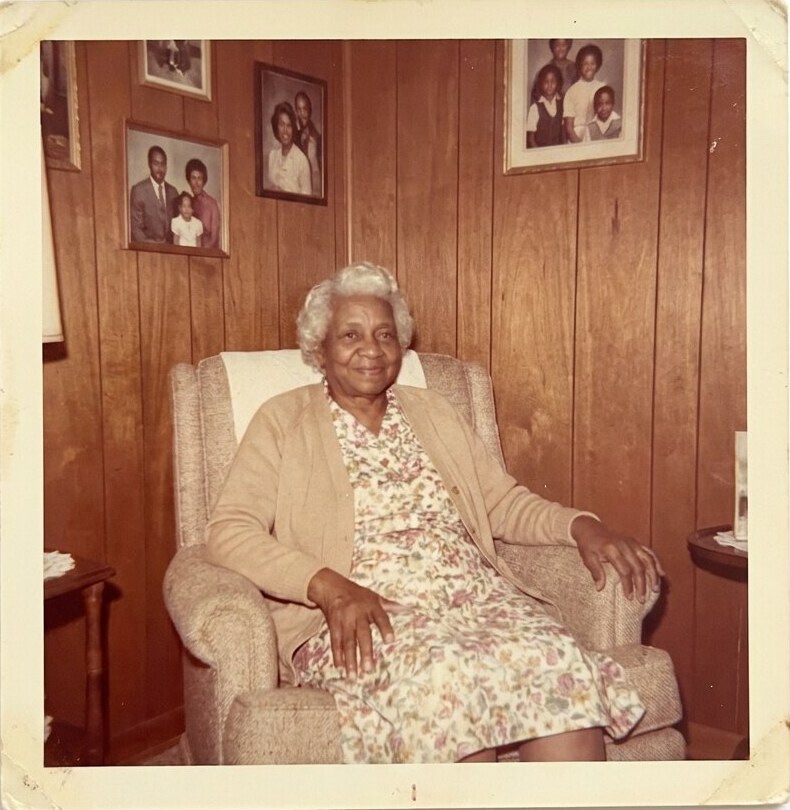
Portrait: artist's interpretation. No photograph of Celia Black is known.
Celia Black
Recorded in Tyler, Texas, October 11, 1974 · Born September 10, 1859; Texas
Their Story
Celia Black was born on September 10, 1859, "on a Tuesday morning, my mother said." Her mother had been brought to Texas as a young girl by a wealthy white woman Celia called Mrs. C. Her mother grew up as a house girl in that household, and her father was hired as a yard boy who looked after the yard and the horses. She said Mrs. C. would not agree to let her father take her mother away, because in those days the people who held Black workers rarely let them go.
Her most vivid memory was of her grandfather's oxen, Corley and Let. As a small child she liked to sit between Corley's wide horns. Once, on a summer trip across a river to fetch lumber, the overheated oxen ran into the river with the wagon. She held on to Corley's horns the whole way through the water and did not fall: "I held to his horns. I didn't fall off in the river." She said her parents spoke well of Abraham Lincoln and thought he was the best president.
As a grown woman she worked in the fields, and she and her husband went out West to pick cotton every year. She went to dances and balls when she was young, but later devoted herself to serving God. She took pride in having always been ready to help anyone, Black or white, who called on her.
She was recorded in Tyler, Texas, on October 11, 1974, at the age of 115, by Elmer Sparks. Her daughter helped with the questions. She spoke of a recent birthday celebration where, she said, the President and his wife shook her hand.
The Recordings & Transcripts
The recording Tyler, Texas, October 11, 1974
Captions open at the bottom of the screen when you press play. Click any transcript line to jump to it.
Transcript
Elmer SparksThe following is an interview by Elmer Sparks with Celia Black, former slave of Tyler, Texas. This being October 11, 1974. Many years have passed since Mrs. Black first arrived in this world on September 10, 1859. [pause in tape] Just like to ask you a few questions about your early life, and-
Celia BlackYes sir.
Elmer SparksUh, uh, how, about from the time you were born and your schooling, and you go ahead and tell what you might and we might ask you a few more questions.
Celia BlackOh, I had my birthday.[sound of door opening/closing] My birthday I had a,a nice time. I had a nice time. I enjoyed it. I enjoyed it, enjoyed all the good nice white people that was there, and the President was there and his, his wife, and shook hands with me, and just, I don't know. I just enjoyed it. I did. I enjoyed it. Was so many people there. Oh, and I been thinking, if I had, uh, oh I had, had, had to name the [unintelligible] that didn't recognize nothing but to, to go on the air. I didn't think I'd be able to recognize enough to go on the air. Well, I've always have been, been a woman would carry myself in a way that white and colored both of them would care for me. Well if my, my colored or white had called for me to do anything, have anything to do with them, I's always there ready. Ready. Clean, care for myself, clean, and I always tried to treat them nice and I was good to them, I was good to the children, and I, I just couldn't be no better to them than I was. And I could, I didn't care when they call for me to do anything, I was right there ready to do it because I'm going to try to do what I could. Everybody knows. So that's the way I carried myself. And that's, I'm so proud to know that I been recognized enough to, they care for me. Oh, and in Texas and, in the United States. I'm thrilled and proud to know that I'm cared, that I'm cared for in the United States. Oh, oh, that I'm an old poor worn out colored woman down, and can't help myself. If I was up, why I could go cut hair. I'd always be ready. I be ready. I'd be ready to help. Oh God, it's true. I'd help white or colored. I'd be ready to help. So, I'm down now and can't, but I've got a good desire. I've got a good mind. Oh, to be [content, content at home (?)] trying to do what I can, by the help of the Lord. If I can't do, if I can't do, I can speak well. I can speak well, oh, trying to help. Oh, as I can speak well of trying to help, oh, in my speech. And I trust my Heavenly Father. If I can be honored enough to keep my, oh, keep my recommendation [i.e. reputation] up as long as the good Lord will help me, let me, spare me. As long as He spare me.
Elmer SparksWell you're, you're speaking of your, of your uh, birthday celebration. Do you remember anything about your folks a talking about, back when you were born and, and that days?
Celia BlackDo what?
Elmer SparksAnd, back, your mother telling about from the time you were born and where you were born at?
Celia BlackBorn?
Elmer SparksYes.
Celia BlackI don't understand.
Celia Black's Daughter:Celia,-
Celia BlackMa'am?
???:-Tell him about when you were a little baby and a little girl.
Celia BlackOh. When I was a baby I, well I, I couldn't remember nothing. I couldn't remember nothing from when I was a baby. No sir.
Elmer SparksYou remember your mother talking about it though don't you?
Celia BlackYes sir.
Celia Black's DaughterMama,-
Celia Black[unintelligible]
Celia Black's Daughter-You remember when you used to, tell him about the days when you was [unintelligible] was uh, baby girl and you used to ride the oxen and things.
Celia BlackYeah. Oh, my grandfather had some big old oxen. He had one with, uh, big with wide horns. Oh, looked like a house. [laughs] Wide horns, and, and, and I used to set up there in between them horns. And he, his name was Corley. His name was Corley. And the other one was named Let. Oh. And grandpa and them drive them to church, and he carried where he went. And put us children in the, in the old, old ox wagon and carry us on his chest just as big as he was in the, in a, in a carriage. And, and I'd get up there and on, and on, and on Corley, clinging on Corley's horns, and sit up there. Sit up there just as big as I was setting in a house. Well, the furthest of the my grandfather went to, went to, to lumber. Want to get some lumber, and he had to go across the river. It was in the summertime, in June, and the, the, the old oxen got hot. They got hot. Oh, and then, uh, when we knowed anything, grandpa knowed anything, them old oxen done run off in, runned off in the river with us, with us, with that, with that wagon. And,and there I sat up there in the old, old Cor,old Corley's horns, horns. Sit up in old Corley's horns. Oh, and he's wading through the water, and I was setting up in there. I stayed in there too. I held to his horns. I held to his horns. I didn't fall off in the river. I held, I'm telling you, I held it too, yes I did. Oh, oh, my grandpa was just a whipping with that whip, trying to get them out of that uh, river. And we was, and old Corley and Let was coming through. They come out too. Yes they did.
Celia Black's DaughterCelia? Tell him about when you were born in Mrs. C.'s bed.
Celia BlackI did. I was born behind a rich white woman. I sure was. She wasn't no poor woman. No, she wasn't. Her husband was living then. Oh, she wasn't no poor woman. Mama, she, she brought my mother up here from South, oh from one the other, in this country. She brought my mother here in Texas, when she was young. Oh, my mother was young. She wasn't grown. Oh, she brought her here. Oh, way up Texas [unintelligible] get grown. Oh, we've heard, we've heard tell. Oh. Well, my pa, my father and that, they, hired him to help her. Her white man, was name Mr. R. Mr. R. was a white man, and papa, papa was a [unintelligible] a boy. And he raised, Mr. C.'s boss, boss, uh got, hired him to be his yard boy. When mama, she was at Mrs. C.'s here uh, uh, uh a house girl there. [unintelligible] papa and mama got, got together somehow. I don't know how they got together. But anyhow, my, my papa and then mama, uh. Mr. C. hired my, my father be a yard boy. He stayed there till he was a grown young man too, with Mr.C. There they kept in her yard and kept her house, her yard and her horses. Oh.
Celia Black's DaughterAnd you was born in Mrs.C.'s bed?
Celia BlackHuh?
Celia Black's DaughterWere you born at Mrs. C.'s?
Celia BlackI was born right be, behind Mrs. C.'s on a Tuesday morning, my mother said. My mother said it was on a Tuesday morning. Mama. I was born right behind Mrs. C.'s, in her bed. She always, my mother always slept with Mrs. C. when she was young, was young, before she was married. And Mrs. C.,after she was married, my papa, Mrs.C. wouldn't, wouldn't agree for my papa to take her away from there. No, she wouldn't. She wouldn't agree for her to try and take her away from there. Oh, oh. In them days, them days the white people had control over the, when they had, uh, uh, uh colored help, they wouldn't hardly, wouldn't agree, agree for you to take them away from them. Then, and my, Mrs. C. brought my mother to this country, she wouldn't let no, wouldn't let, wouldn't let nobody take, take her away from there. She raised here there, with, with her children, with her children. She raised her there with her boys and girls. She didn't have but one girl. Oh, but she had five or six boys. She had, had, she had five boys, Mrs. C. did. Oh, but mama was just the only one, uh, only, and uh, and uh, Mrs. C.'s girl, she didn't have but one girl, and she, and she was a little. She was little. She wasn't no big girl. Oh. Oh, but she stayed there till, till she got to be a young missy. Oh, with, with, with mama, with mama and then, uh, I was a, she growed up to a big [unintelligible] when I was grown. [unintelligible] Before she, ever think about time to get around amongst her boys.
Celia Black's DaughterMama, you remember Abraham Lincoln?
Celia BlackOh, ma'am?
Celia Black's DaughterYou remember Abraham Lincoln, the President?
Celia BlackWho?
Celia Black's DaughterAbraham Lincoln.
Celia BlackOh, I heard my mother talk about him and my father, but I never did know him. I didn't ever know him myself, but I hear them talking about him all time.
Celia Black's DaughterWhat did they say about President Lincoln?
Celia BlackOh well, they, they give him a good name. They give him a good name. Oh, oh, and, and President [unintelligible] Oh, oh, they, they give him, oh, pretty good name. They give him a pretty good name. There's another one I know but I done forgot it, forgot his name. I just, Abraham Lin, Abraham Lincoln, that's it. Oh, oh, Abraham Lincoln. They thought Abraham was, was the best, they thought, everybody thought Abraham was the best President there was. They thought he was the very best. Oh.
Elmer SparksDid you, uh, do any, uh, picking geese for feather beds and things like that in them days?
Celia BlackDid I have any? I wasn't nothing but a kid. I didn't, didn't, you know, didn't have sense enough to think like I gots now. I didn't have sense to think. Nothing but just to play in the block with the children. I didn't know nothing, know nothing about them, none, none of the Presidents.
Elmer SparksYou didn't pick cotton or nothing?
Celia BlackNo, no sir I didn't. Oh, oh. Not, not until Mrs. C. raised me up, to be a young, young missus. A young missus. That's the only time I knowed anything about courting. And then, and then my papa had this, oh, to marry her. Mrs. C. didn't want him to have her then. Didn't want him to marry her then.
Celia Black's DaughterHe said did you ever pick cotton.
Celia BlackTo marry.
Celia Black's DaughterCelia.
Celia BlackMa'am.
Celia Black's Daughter:Did you ever pick cotton out in the fields?
Celia BlackUh huh.
Celia BlackOh, good gracious alive. Pick cotton. I was raised in the field [unintelligible]. Mrs. C. left, got, got, my ma and my, I was raised in the field after I growed up and got away from Mrs. C. Oh, I didn't do nothing but work in the field. Worked in the field, goodness, goodness, every year I would go out and out [unintelligible] work for myself. We'd go, my, me, and my husband would go out, out West and pick cotton. Pick cotton. Go out West every year. We wouldn't miss a year going out there picking cotton.
Elmer SparksWell that was hard work. Didn't you have some entertainment, do any dancing or anything?
Celia BlackHuh?
Celia Black's DaughterYou dance, didn't you mama?
Elmer SparksWhen you were young?
Celia BlackMa'am?
Celia Black's DaughterDid you dance?
Celia BlackDance?
Celia Black's DaughterYeah.
Celia BlackOh. I used to dance, but I don't do it now. No, I don't dance now. I try my best to serve my master. I'm trying my best to serve my Heav, Heav, Heavenly Father. [others talk in background] Try, trying my best to serve God. Oh, I ain't, I don't study about no man, no dancing now.
Celia Black's DaughterHe wants to know mama, if you danced in your young days?
Celia BlackOh, in my young days?
???: Yes ma'am.
Celia BlackOh, I went to balls when I was young. Oh, when I was young I went to dances. I didn't tell, I ain't gonna tell no lies. I went to dances when I was young. Oh.
Celia Black's DaughterCelia.
Celia BlackMa'am?
Celia Black's DaughterDo you remember going to town when you were young? Were there any big buildings back then?
Celia BlackWho?
Celia Black's DaughterBig building, mama. When you went to town when you were young, were the streets dirt? When, did you go to town in a wagon when you were a young girl?
Celia BlackI don't know.
Celia Black's DaughterMama, you know you used to tell us you used to go to town in the wagon.
Celia BlackOh, oh. Oh, we used to go in, in a horse wagon. I thought you was talking about something else. Oh, yeah we used to go in the wagon.
Celia Black's DaughterCelia, did you ever see a stage coach?
Celia BlackEver see what?
Celia Black's DaughterA stage coach.
Celia Black's DaughterA stage coach, where the people rode in the stage coach and the horses pulled them? Did you ever see one?
Celia BlackYes, I did. You call them in such a funny name, that I didn't know, know what you was talking about.
Celia Black's DaughterWhat did you call them?
Celia BlackI call them horses. Horses. Mules and horses. Mules and horses. 'That's what they, what my, my grandpa call them. Hor, mules and horses.
Celia Black's DaughterWhat, what did Mr. and Mrs. C. ride in when they would go somewhere?
Celia BlackWhat, in a, in carriage, what they called it. Carriage.
Celia Black's DaughterCarriage. You know, you've seen those carriage, you know.
Elmer SparksYes, I know.
Celia BlackShe ride in what she called a carriage. It's what the, what the, what Miss C. and them, they, [unintelligible] A big old thing look like a, a, look like a, a cart, look like a cart.
Elmer SparksDid you hear anything about the uh, uh Indians in the days when you were young and the things that they did? The Indians?
Celia BlackNo, no, Lord no.
Celia Black's DaughterHe's talking about Indian, mama, the Indian people. The people.
Celia BlackOh. I have seen them, but I didn't know them. I've seen them, but I didn't know nothing about them. Never did. I never did get any kind of, any kind of, no contact with them, with them. I never did.
Elmer SparksThe Indians were pretty well gone at that time down here I think. But not farther north. Is there anything else that you want me to put there?
Celia Black's DaughterWhatever you'd like. A few many more birthdays.
Celia BlackWell.
Elmer SparksAnd we'll come up in the Panhandle. So we'll be thinking of you.
Celia BlackWell.
Elmer SparksWe'll be thinking of you.
Celia BlackGod bless you all.
Elmer SparksGood bye.
Celia BlackGood bye. You, you folks are leaving here. If, if we don't meet in this, this world, then I hope we'll meet in yonder world. Meet in the new world.
Elmer SparksWell [unintelligible] [tape ends in the middle of a sentence]
END OF TAPE
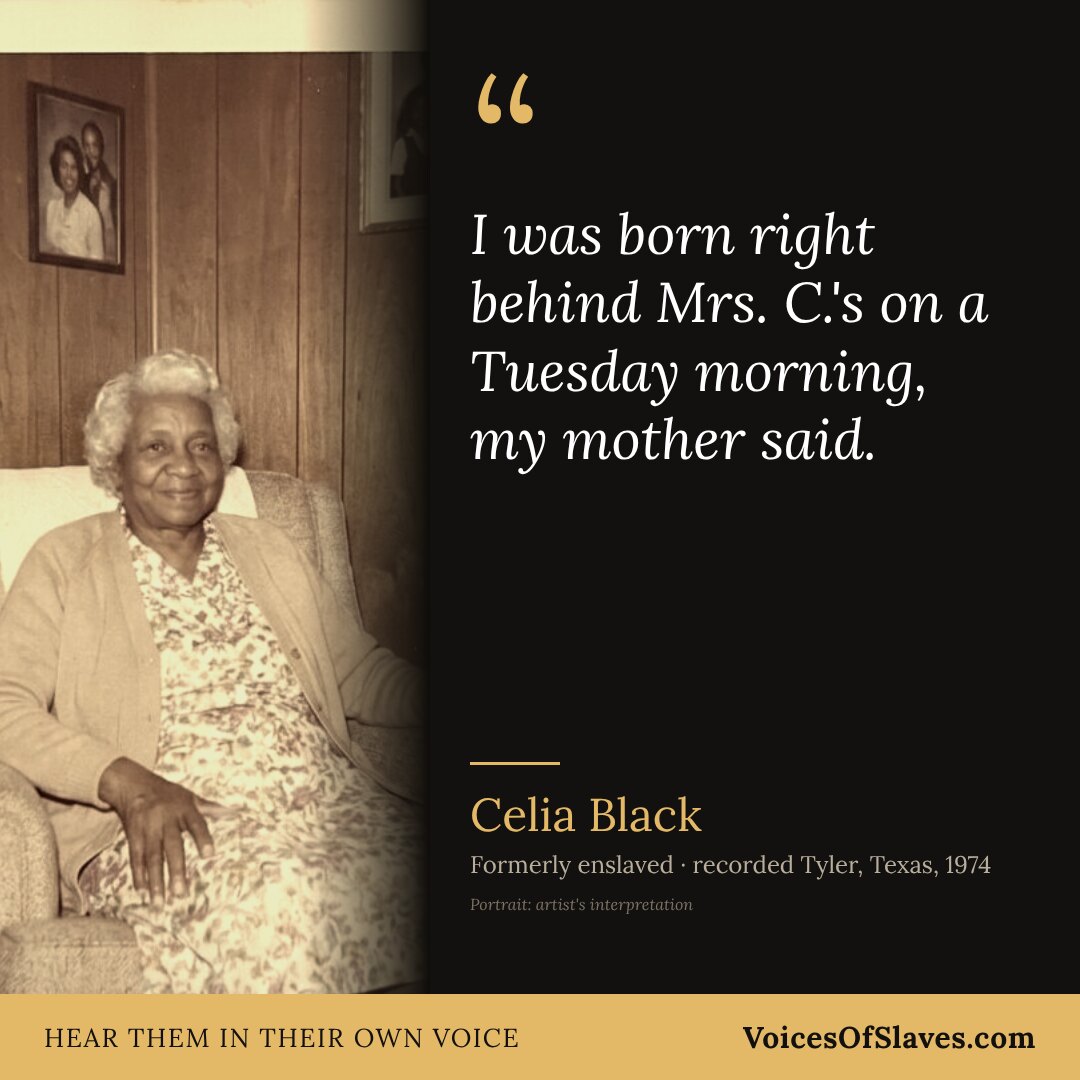
Share their words
Post this card so more people hear Celia's voice.
Discuss Celia's story in the Community
Recorded by Elmer Sparks, Tyler, Texas, October 11, 1974. From Voices Remembering Slavery: Freed People Tell Their Stories. Bracketed notes and question marks in the transcripts mark sounds or words that are hard to hear.