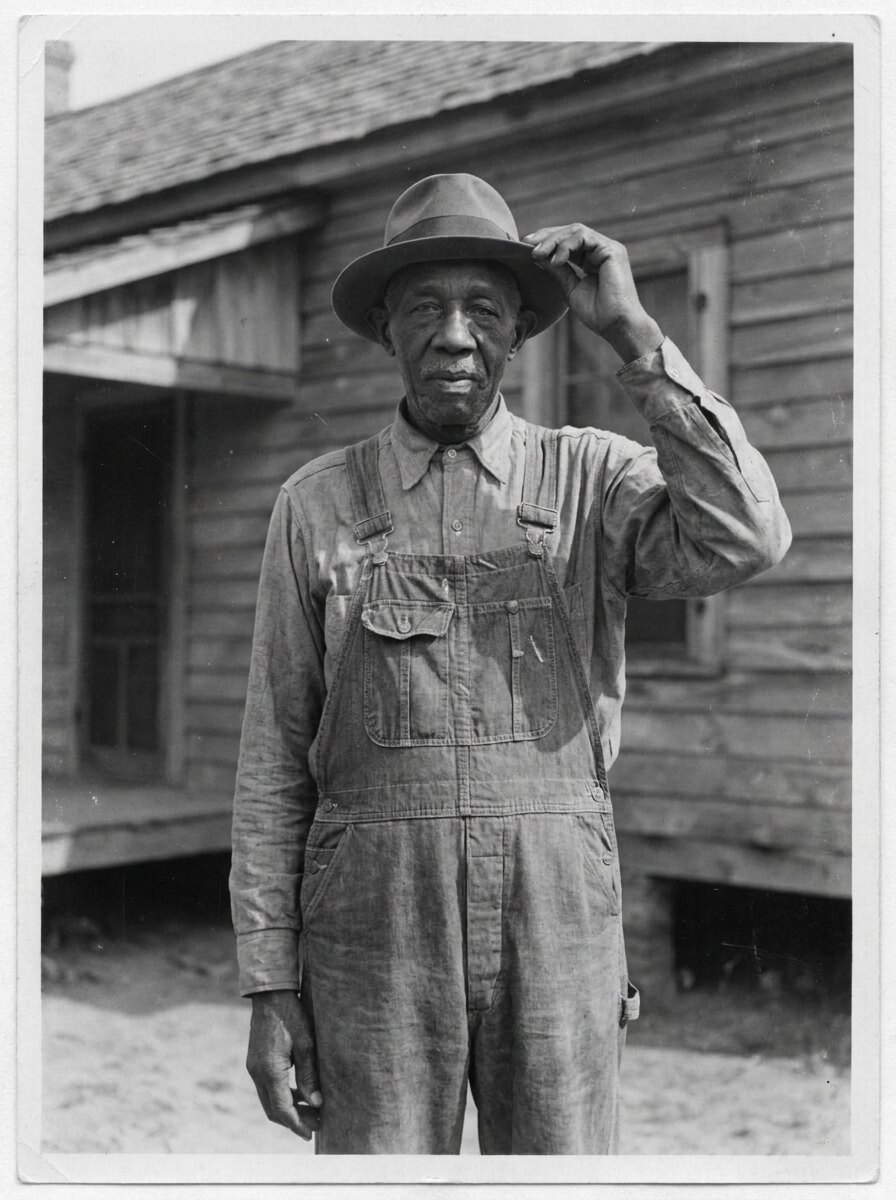
Portrait: artist's interpretation. No photograph of George Johnson is known.
George Johnson
Recorded in Mound Bayou, Mississippi, September 1941
Their Story
George Johnson was born on Brierfield, one of the plantations Jefferson Davis owned at Davis Bend, Mississippi. He said Davis had owned his grandfather and father and brought them from Richmond, Virginia. His grandfather was a blacksmith, and his father, Isaiah, had learned to write from a white woman in Richmond. Johnson told how his father was caught chalking words on the sidewalk, and said this led to a school being opened for the people on the plantations. His father became a civil engineer. His mother, he said, was Creole from the Red River sugar country in Louisiana, and he spoke a few lines of Louisiana Creole for the interviewers.
Johnson's account of Davis was admiring. He described a plantation court where a driver was fired for trying to whip a boy who had "hoed a clean row," and he told how Benjamin Montgomery had the land deeded to him so Union troops would leave it alone. He remembered holding Davis's mule, Righteous Bill, with a rope from his grandfather's shop. He also remembered cotton pickings with hog meat cooked all night in a wash pot, corn shuckings, ring tournaments on horseback, and quadrille dances. He sang the hymns "Mercy Seat" and "Hallelujah 'Tis Done" and a few lines of "Old Black Joe."
Music was his great love. He played in the Davis Bend brass band, later studied music at Alcorn, and named many of the marches and quicksteps he played. He left school when his father died, came home for his mother, and later farmed for a few years after he married. He said he had lived in Mound Bayou for nearly 55 years and led his own brass band there. He disliked the blues, calling it "too wild for me." He still kept a cane he said had belonged to Davis, given to him by Mr. Montgomery about forty years earlier. He was recorded in Mound Bayou in September 1941 by Charles S. Johnson, Lewis Jones, John Work, and Elizabeth and Alan Lomax.
The Recordings & Transcripts
Part 1 of 6 Mound Bayou, Mississippi, September 1941
Captions open at the bottom of the screen when you press play. Click any transcript line to jump to it.
Transcript
Mr. George Johnson???
Dr. Charles S. JohnsonHmm.
Mr. George Johnson[He gave us all that (?)].
Dr. Charles S. JohnsonI never heard that.
Mr. George JohnsonThat's what I know.
Dr. Charles S. JohnsonHmm?
Mr. George JohnsonYes, sir. Yeah, why? And he walked he straight like a peacock all the time.
Dr. Charles S. JohnsonHmm.
Mr. George JohnsonWore fur coat and a high hat, you understand. He knew like he should be.
Dr. Charles S. JohnsonHmm?
Mr. George Johnson[He bring us more (?)] ??? . Anyhow cotton picking now do anything with.
Dr. Charles S. JohnsonHmm?
Mr. George JohnsonYes, sir. Do anything with. Make a man's ??? of day, you know. With cotton picking.
Dr. Charles S. JohnsonHmm?
Mr. George JohnsonWe [gin (?)], we [gin (?)] cut throw it down on a saw and cut length. Make it short. Grind it up
Dr. Charles S. JohnsonHmm?
Mr. George JohnsonYes, sir. [pause] These young youth learn [gin (?)] long enough know how to, had a young fellow cousin Isaiah was here—
Dr. Charles S. JohnsonHmm.
Mr. George Johnson—never allowed [Jim (?)] come and pick cotton.
Dr. Charles S. JohnsonHmm.
Mr. George JohnsonNo, sir. Doing the sawing, doing cotton too. In the [gin (?)] doesn't clean seed.
Dr. Charles S. JohnsonHmm.
Mr. George JohnsonLoose. Loose whole lot. Why that lent go on those seed, can't get it off. Make cotton dry. Yes, sir. [pause] We ??? over at the Grandmaster, that'd be a long time ago. [pause] [Mr. Johnson mumbles something] Fill up the Grandmaster.
Dr. Charles S. JohnsonHmm.
[long pause occurs before Dr. Johnson addresses Mr. Johnson with his first question]
Mr. George Johnson[a woman inquires about Mr. Johnson and he answers] Here! Okay.
Dr. Charles S. JohnsonWell, Mr. Johnson, we're going to start off.
Mr. George JohnsonAll right. [pause] All right.
Dr. Charles S. JohnsonI want you to tell me how you got your name?
Mr. George JohnsonI got my name from President Jeff Davis. He was president of the Southern Confederacy. He owned my grandfather and my father. Brought them from Richmond, Virginia. My grandfather was a blacksmith. My father was a young kid, wasn't grown. And my father had learned how to write a little bit in Richmond, Virginia, before they brought him down here. Grandpa used to keep chalk in his shop to mark ??? things; and my father take a piece put in his pocket and pass in front master Jeff's house he write on the sidewalk. And so one morning master Jeff come by and saw that writing on the walk, he go back and ask the cook, [old lady named (?)] Meli, Meliza: “There's writing on the sidewalk, who writing out there?” Say, “I don't know master Jeff.” Say, “Come out there I show to you. I can read it.” So he read it. He say, “Meliza, if you can find out who ever wrote on that walk out there, [I carry you down (?)] to the store and give you a free dress.” She say, “Yes, master, Jeff.” So, one morning she's out, throw out some dishwater. And she peek under the dishpan and she look down and saw my father down on his knees writing on the sidewalk. She told master Jeff. Master Jeff sent for the boy to come to the shop. Come to the house, and, ah, asked him who learned him how to write? He said, “Master Jeff, I learned how to write Richmond, Virginia. A white woman learned me how to write. Before you brought me down here.” “You did?” “Yes, sir.” He give him a pencil and [say] “Write my name.” My father's name, Isaiah. He called him, “Ike, write my name.” He wrote Jeff Davis' name. He said write, “Joe Davis.” He wrote, “Joe Davis.” “Write Vicksburg.” He wrote “Vicksburg,” you see. “Ah ha, Ike, that's pretty nice for you.” And he send him on back to the shop and master Jeff's son from Richmond, Virginia, and got two teachers. They opened a nice school. Educate all his niggas. And made my father a civil engineer. And then made Isaiah Montgomery his bookkeeper. And on and on they made different ones ??? farmers, carpenters, sawmills, gins and all like that. That's just because of, of, of, of my father and Isaiah Montgomery. Isaiah is born Davis' Bend. He born on, on the Hurricane Plantation. Just [giant ??? (?)] from Brierfield. I was born on Brierfield. Master Jeff had five plantations over there: Ursino, Brierfield, Hurricane, Palmyra and Lick Place. It all belong to master Jeff. And ah, had all those niggas from different places, on those plantation to come to that school. Nice school. He give them all a formal education. When they all got free, they could take care theyself. They had so much business they couldn't hire [people (?)] who got business, you just can't give a nigga a education so he can tend to his business. Everyone learned tend to master Jeff's business. Everyone admired him. Obeyed him. Don't care where he's going he obeyed master Jeff. Once master Jeff was going to landing in a buggy, in a hack. The gate was locked. That same old man I tell you about, Old Man Jack Raily, he got to the gate, say “Master Jeff this gate's locked.” He say, “Oh, well, Jack, it's locked, it's my gate, break it down! It's my gate.” So the boy pick it up and Jack said, “Break down the gate!” He took the fence down. And drove on through there and the wagon on behind him, you understand, with the band, carry him to the landing; and when they come back they put the fence up. That's the reason why master Jeff need his Negro. And when he met his Negro on the road first thing master Jeff look up there and see if he tip his hat to him. And everyone give him the same thing back. Give him honor. And when he come home from New Orleans up to the Bend, steamboat landing, unloaded the freight and loading cotton. And ah, he be up the bed there sleep and the captain would say, “Mr. Davis' up?” “No he ain't up.” “Well, when he [come up (?)], when he wake up?” Mr. Davis wake up and he come downstairs. He pick up ??? . He pack it up out on the land set it down side his hat. And he get up there by [his boots (?)] third time before he gets his hat. He never allowed him to do it just like that. You just obey him. Well, they all obey master Jeff. The white people would alway's go up the bank and go fishing and hunting on the banks when master Jeff be in the bed sleep. They ain't never do him like that. They would always obey him all the time. White and black. They gave him honor. His best man would escort him home. Escort him back when he got ready. And ah, he was on the plantation that one day, on Lickfield Place, he told Mrs. [Coldyarn (?)] say, “Mrs. [Coldyarn (?)], I'm going home tomorrow, don't forget to feed my niggas. When they get through ??? by the crops, let them be. Wouldn't even let them cut cord wood. But don't disturb them. I want them undisturbed. See, anything happen to any my Negroes, we to see Mr. Davis. And don't forget, I'm Mr. Davis. See, my Negroes is my summer shade. He's my winter fire. He's my umbrella. Don't disturb them.” So all they live by the crops over there with the sweeps. Mrs. [Coldyarn (?)] once live by the crops with the ??? that wouldn't do no good. Wouldn't cut those vines. The Negro, the Negro master Jeff educated, one old ??? slave, live by the crop with the ??? sweeps. And he come back and he held court. And the next day he fired the white man. He wanted the place lead, lead by he wanted. He lead by the crops like he wanted, you understand? He had the crops clean, master Jeff come. With those little big sweeps, you un, going in middle. Clean them out you understand. With your ??? cause he kept those vines. Jumped those vines. Sweep. Get them all out. Clean this place out. Lick Place. He had a hundred things over there. Got all those mules from different plantation, you understand, come over and clean that place. He had plenty of stock, you know. They raised stock All this, now on Hurricane, the pasture there, oh ??? , understand, roadside you know. All that stock it belong to master Jeff. All that stock: mules, cows, horses everything else. Hogs everything else. Sheep. Goats. All belonged to him. Now he had those sheeps sheared certain time of year and bale that wool and shipped it somewhere. Same they do cotton. Carry it to the gin and packed it. Had three or four steam engines, understand, you see. Steam engine on Hurricane. One on Brierfield. One on Ursino. He had three gins. I know, he had three gin. ??? and he had a sawmill on Hurricane called, Steam Mill Quarter. And all that belonged to old master Jeff. And when he wanted things done he just put it on paper and it's gone. It done. He had no trouble at all. All his niggas had a common education. All ofthem.
Dr. Charles S. JohnsonYou, tell me how ah, the, how, the story as to how Isaiah T. Montgomery's father saved the plantation during the Civil War for him?
Mr. George JohnsonYes, well, when, when, when, ah the Yankee was coming South. Look after those places down there to rob somebody. Uncle Ben see it. Uncle Ben went to old Mrs. Mrs. Irene, his wife, say, “Well, Mrs. I'm have to go Richmond. Got to see master Jeff.” She say, “What you want to see master Jeff for, Ben?” Say, “I got to see him.” Say, “??? No, Mrs. you can't do no good. I can't, I don't want to see you. I want to see master Jeff. I want a passport. Send me to Richmond, Virginia, see master Jeff.” So they give Uncle Ben the passport. He went on to Richmond. Got some bread in his sack and went on to Richmond, Virginia. Got on his ??? where he went on to Vicksburg. On to Richmond, Virginia, and met master Jeff ??? [Mr. Johnson taps his cane to imitate Benjamin T. Montgomery, knocking on Jefferson Davis' door] “Whose that? Come in.” Walk in there. “Hi there master Jeff.” “Hey, Ben, what you doing here?” Say, “I come here to see you master Jeff.” Say, “Ben, sit down and tell me all you know. How everybody doing?” “Everybody all right master Jeff, but something I come to see you about.” “What is it, Ben?” Say, “Master Jeff, those Yankees coming South near Vicksburg. They coming down South getting our white folks' land and robbing the niggas. Steal all the mules. And they in pursuit of Davis' land. I'm tell you what I want you to do.” Say, “What is it Ben?” “I want you to deed this land to me. So I'll have it.” He say, “Ben that won't do no good.” Say, “Don't you belong to me? The land's mine. You mine. Why, that won't do no good.” Say, “Yes, it will do, master Jeff. It will do.” Say, “How do you know?” Say, “Master Jeff, can't you free me?” Say, “My God, free me, man.” Master Jeff held his head down and say, “Ben you right.” Sent ??? Ben up to Saint ??? coast and deed that land to him and freed him. And made notes ??? on a page, you understand. And free ??? and send him back home. And them Yankees got down to the Bend, our home there. The Yankees come, you understand. They asked, “Davis land? Is it Davis' farm?” Say, “Davis ain't got no land.” “Who land is here?” “It belongs to Ben Montgomery.” “Where's Ben Montgomery?” “There he is.” Say, “Come here, Ben.” “This your land?” “Yes,sir.” “Where did you get that?” “Bought it from my old master.” He called my, called Mrs. He asked her to bring those papers, you understand. Show it to him. Read these notes and papers, you understand. “Ah ha, that is your land. Now I want white folk. I didn't know no kind of Negro land. Right on!” Ran across the road; didn't bother the land at all. And when, freedom time come back, master Jeff come on home, you understand. And he met them and they give him ??? back his money. “What you doing?” “Cotton business. Cotton business.” Oh ??? high this table. I ??? could show Betsy now. Right out there on Brierfield Place. On Brierfield. Right in master Jeff's house. Cotton picking, [green back (?)]. [Do (?)] that myself.
Dr. Charles S. JohnsonWell, this band you say that ah, ah Jefferson Davis organized for his, [recording skip] organized for his slaves.
Mr. George JohnsonYes, sir.
Dr. Charles S. JohnsonWill you tell me a little something about that band? [record skip]
END OF SIDE A
Part 2 of 6 Mound Bayou, Mississippi, September 1941
Captions open at the bottom of the screen when you press play. Click any transcript line to jump to it.
Transcript
Dr. Charles S. JohnsonYou started to tell me about this band that ah, Jefferson Davis organized for his slaves.
Mr. George JohnsonYes, he organized that band for his Negroes, in Davis Bend, on Brierfield Plantation. And ah, he hired a man in Vicksburg named Charles Morgan, teach them boys music. And he taught those boys music. They got so they could play and he escorted them from landing up home in a wagon and master Jeff be in his hack, and the band would play for them going and coming. And ah, after they got so they could play he bought them a uniform, and named that band the Davis Bend Band. Escorted everywhere he went.
Dr. Charles S. JohnsonHow many pieces were, how many pieces were in the band?
Mr. George JohnsonThey had fourteen. Fourteen men in the band. Fourteen men.
Dr. Charles S. JohnsonWhat kind of music did they play? Do you remember any of pieces they played?
Mr. George JohnsonOh, lord, yes indeed know them, I played them myself. Played Grand National. Fort Watch. ??? [Regiments (?)]. Mount Rose. Dream On. Please the Birches Mountain. Not Guilty. Band ??? . I'm A Soldier. Farm Quickstep. All that kind of stuff. We played, I played it myself.
[Mrs. Elizabeth Lomax, encourages Dr. Johnson to ask Mr. Johnson if he can recall more songs]
Dr. Charles S. JohnsonName some more, if-f-f-f you remember any of them.
Mr. George JohnsonUhmm. I see. Dream On. That's a piece. Dream On. And—
Dr. Charles S. JohnsonDi-did you ever play this piece, Dixie, that was so popular?
Mr. George JohnsonDixie. Oh, yeah. I played Dixie. Yeah, I played Dixie. I could play it now. And ah, Flower Flop. And I don't know that other piece I used to play, I'm A Soldier, I think it was. [mumbles something] And da—
Dr. Charles S. JohnsonWell, did you, ah, you all didn't play any ah, plantation songs?
Mr. George JohnsonNo, sir. Played strict music itself. I got music right, we got it from Sergeant Pepper, and Lyon Healey, and Joyce [Sullivan (?)]; that's where we got our music. We got a band from Lyon Healey in Chicago.
Dr. Charles S. JohnsonWell, did the other ah, slaves on the plantation sing any of the plantation songs? They, sing in the fields and sing around the place? Did you ever sing in the yard for him when he had visitors, anything like that?
Mr. George JohnsonWell, they, kids would sing some them little funny things, you know, around there. And dance, you know and all like that, you know. They, they, they had little plays. Used to plays down there. Play ah, Scoops of [Sam (?)], you understand. Dance, stick a bottle and ??? all day, you know, and then you dance, you know, call it, Scoops of [Sam (?)]. Everybody dance Scoops of [Sam (?)]. They ring play, you know.
Dr. Charles S. JohnsonHmm.
Mr. George JohnsonAnd, ah every fellow dance his time to dance hold that bottle. He dance with a bottle, didn't have a bottle get a brick, [tipped up (?)], you understand; and he just play that song [around (?)] that place and they sing, Scoops of [Sam (?)] and dance with a bottle, or that brick.
Dr. Charles S. JohnsonWell do you remember any of the words of Scoops of [Sam (?)]?
Mr. George JohnsonNo. I don't relect [recollect] those words now. Wish I could relect them. It's been so long. And I had, we had a little song we used to sing, too. You going to a lady say, “Yes I am” and she was talking to a man. [laughter]
Dr. Charles S. JohnsonDo you know that?
Mr. George JohnsonNo, I don't know that's the first word I think about the thing.
Dr. Charles S. JohnsonDo you remember any, any of the other lines of it?
Mr. George JohnsonNo, sir. [pause] No, sir.
Dr. Charles S. JohnsonWell, ah di-d-did you all have any dances at that time or had you, had you joined a church—
Mr. George JohnsonYeah, we had dances.
Dr. Charles S. JohnsonYou did?
Mr. George JohnsonWe had dances. We had dances, you know, this, this, this quad, quadrille. And danced ah, thirty-two on a set. And twenty-four on a set. Had this thing called [Palm Major (?)] Partner, and Dance to Your Partner, like that; then, Palm Major Swing, all that kind of stuff, you understand, see? And ah you pointing at your partner pointing her to bar. Had a bar, you know. Where they bought candy and so on like that, you know. And apples and oranges, understand. Carry your partner and spend a dime or a quarter on them, buy them candy, or cookies, or something else like that, you know.
Dr. Charles S. JohnsonHmm.
Mr. George JohnsonNever had no soda water, you understand. They had ah, lemonade made in a barrel.
Dr. Charles S. JohnsonHmm.
Mr. George JohnsonSee, had no nothing like soda water then. No soda water.
Dr. Charles S. JohnsonDid you all sing any songs at those dances while you were doing the quadrille and the promenade?
Mr. George JohnsonNo they didn't sing. We had, we would dance, you know, hoot and holler.
Dr. Charles S. JohnsonDid you have anybody to call tiggers?
Part 3 of 6 Mound Bayou, Mississippi, September 1941
Captions open at the bottom of the screen when you press play. Click any transcript line to jump to it.
Transcript
Dr. Charles S. JohnsonOh, ah, you say you, you in AME? [African Methodist Episcopal Church]
Mr. George JohnsonAME, yes, sir.
Dr. Charles S. JohnsonDo you remember how you got religion down there on the ah, plantation?
Mr. George JohnsonOh, lord, yes indeed, yeah, yeah, indeed. We just got, just got converted just, right in daytime. Right in the daytime. God spoke peace to our soul, that's in the daytime. Noontime. It's just noontime. Cause it's called noontime. Eleven o'clock. Yes, sir. Ain't no question about it. We didn't have, I didn't go to no ??? . Just got, got blessed right ??? come home to and told mom about it.
Dr. Charles S. JohnsonMhmm.
Mr. George JohnsonAnd they saw me carried me on to church. And took me to church that same day, same night.
Dr. Charles S. JohnsonWell, were they running a [protracted (?)] meeting?
Mr. George JohnsonYes, sir. Yes, sir. Right on Hurricane.
Dr. Charles S. JohnsonMhmm.
Mr. George JohnsonRight on Hurricane. Right on Jeff Davis plantation.
Dr. Charles S. JohnsonAh do,do you remember who the preacher was?
Mr. George JohnsonOh, I know his name better than I know my own name: O. A. Douglass.
Dr. Charles S. JohnsonO. A. Douglass?
Mr. George JohnsonO. A. Douglass, pastor our church.
Dr. Charles S. JohnsonWa, wa, was he a good, good preacher?
Mr. George JohnsonYes, sir. Yes, sir. Yes, sir.
Dr. Charles S. JohnsonAh wha, what kind of songs did they sing in the church then?
Mr. George JohnsonNow, ah, well they sing songs like they sing now. Now let me tell you a song we used to sing when I was a boy: Mercy Seat, the calm and easy Mercy Seat. See. We sang that song. We sang that song down there when I was a little boy. [sings]
Mercy Seat
There is a calm, Oh, sure to be. It's underneath the Mercy Seat. Oh, Mercy Seat. Oh, Mercy Seat. Calm to be, Oh, Mercy Seat. There is a calm, Oh, sure to be. Around a calm, Oh, Mercy Seat.
Mr. George JohnsonThat's one of our favorite songs.
Dr. Charles S. JohnsonMhmm.
Mr. George JohnsonYes, sir right in church. And all the women shout: ‘My Lord, oh mercy.’
Dr. Charles S. Johnson[laughter]
Mr. George JohnsonYes, sir.
Dr. Charles S. JohnsonDid they have these things in this church then that they called the shouts?
Mr. George JohnsonShouts? Yes, sir. Yes, sir. They shout without end.
Dr. Charles S. JohnsonWell, I don't mean when they, when they ju, ju, jump up and shout, but these, these kind of singing they called the shouts, then?
Mr. George JohnsonNo, sir. I don't think we did. No, sir. Not in my day.
Dr. Charles S. JohnsonDi, di, di, did they have any Baptist on your plantation?
Mr. George JohnsonYes, sir. We had plenty Baptist. Plenty Baptist. Main church we had there Baptist Church.
Dr. Charles S. JohnsonDi,di,did they do any different singing and things from what you all did?
Mr. George JohnsonMighty little. Mighty little.
Dr. Charles S. JohnsonYou all sang about the same things they did?
Mr. George JohnsonYes, sir. They all was [something brushes against the microphone] well reckon they Christianized, you understand, under the ??? of ah, they pastor and our pastor, you understand, they all sang together. They mixed. You couldn't hardly find tell the difference, you know. Cause they all mixed together. Go to one church. Go to the other, see.
Dr. Charles S. JohnsonMhmm.
Mr. George JohnsonThey all ??? . They all Christianized. Yes, sir. All Christianized.
Charles S. JohnsonWell ah, di,di,did you all have any ah, did, did, did, did,did you remember any of the Negroes singing in the fields? Any s- songs out there? Any songs they liked to sing when they were out in the fields?
Mr. George JohnsonIn the fields? [steam engine snorts] I hear them, I used hear them singing Old Black Joe, in the fields.
Dr. Charles S. JohnsonYou did?
[steam engine creeps forward tolling its bell]
Mr. George JohnsonYes, sir. When I was quite a boy I sing, Old Black Joe. Remember that song used to sing:
Old Black Joe
Gone am the days when my heart was young and gay.
Gone am the friend from a cotton field away.
Gone from this world to a better world I know.
I ??? a voice a calling, Old Black Joe.
I am coming keep a coming. From ??? I am a ??? a voice a calling, Old Black Joe.
[steam engine muscles down the tracks]
Mr. George JohnsonYeah, you see that's how men sing out in the field. Yes, sir.
Dr. Charles S. JohnsonDi, di, di, did they sing any reels? [the train pushes through with a head of steam]
Mr. George JohnsonWell, I don't know that much. I ain't hear but ??? . Most things I hear them, I hear at down pretty far from where I lived, you understand. Right around here, they didn't sing no tough songs, you understand, around, near the house. You understand. See cause still Missile Hill.
Dr. Charles S. JohnsonStill Missile Hill tough song.
Mr. George JohnsonYeah, Missile Hill. Yes tough song, they wouldn't sing that around the house.
Dr. Charles S. JohnsonMhmm
Mr. George JohnsonBut I always down in master Jeff's yard, you understand. Down in Grandpa's shop. And ah, they wouldn't. ??? mighty nice down there ??? . Yes, sir.
Dr. Charles S. JohnsonWell, did you ah, did the, who, when'd you first hear the blues?
Mr. George JohnsonAfter I come up here.
Dr. Charles S. JohnsonAfter you came up here to Mound Bayou?
Mr. George JohnsonYes. Yes, sir. Yes, sir.
Dr. Charles S. JohnsonWell, what do you think about the blues? Do you think they're good music, eh?
Mr. George JohnsonWell, I don't, I don't like it.
Dr. Charles S. JohnsonYou don't like the blues?
Mr. George JohnsonDon't like the blues. It's too wild for me. I'm scared of it.
Dr. Charles S. JohnsonIt's too wild?
Mr. George JohnsonToo wild. Hear it when come up here. Yes, sir. Yes, sir.
[steam engine whistles]
Dr. Charles S. JohnsonWell, in the song, in the ah, in the dances that that you all had up here, you all didn't play any of that kind of music for your dances?
Mr. George JohnsonNo, sir. No, sir. No sir. We played. We played, now this here, we play up here now, this Ragtime stuff they play now, why, that's today's stuff, you understand. That's modern dance, you understand. See.
Dr. Charles S. JohnsonMhmm.
Mr. George JohnsonNow we be dancing fourteen on a set.
Dr. Charles S. JohnsonMhmm.
Mr. George JohnsonYeah, four over there. Four over there. Four here and four there. And they all dance. They call Swing, you understand. Part as you swing.
Dr. Charles S. JohnsonMhmm.
Mr. George JohnsonMeet your partners, like that, you understand. See. Part as you swing. Dance to your partner. Dance to your right. Dance to your left. Then on to your partner. Then on to the other fellow, you understand, see.
Dr. Charles S. JohnsonMhmm.
Mr. George JohnsonAnd then get bring pull in to your partner. Your partner pull you back. Then pull back to your partner again. Then half swing around. Half swing around. Till you got to the bar then point her to the bar.
Dr. Charles S. JohnsonMhmm.
Mr. George JohnsonThat, that's the dance we had then. Yes, sir.
Dr. Charles S. JohnsonDid you ever play any for the white people's dances?
Mr. George JohnsonDown there?
Dr. Charles S. JohnsonMhmm.
Mr. George JohnsonPlayed music. Brass band for them.
Dr. Charles S. JohnsonThat's what I mean.
Mr. George JohnsonYes, sir. Played string band for white folks. Brass band.
Dr. Charles S. JohnsonWha, what, what kind of, what kind of music di, di, did they have? They have the same you had, or did they have different songs you played for them?
Mr. George JohnsonNaw, they we, we, we played just the string band. Me and the brass band played for white folk. They'd have a big outing, you understand. In their lawn. We played music for them, you understand. Brass band music, you know.
Dr. Charles S. JohnsonMhmm.
Mr. George JohnsonThey'd have people up there dancing. They-they-they, they didn't ??? somebody wouldn't have a dance like the way we have. They just dance, you understand, in their way.
Dr. Charles S. JohnsonMhmm.
Mr. George JohnsonBut we played that brass band music, you understand. You see.
Dr. Charles S. JohnsonMhmm.
Mr. George JohnsonYes, sir. We played that square front of Joe Davis' house. Right in the shade. Right in the great big shade. Right in Joe Davis' ya, ya, yard. Yard big as the railroad over there.
Dr. Charles S. JohnsonMhmm.
Mr. George JohnsonYes, sir. Like, master Jeff's yard was. Yes, sir.
Dr. Charles S. JohnsonWell ah, you didn't like these songs like ah, Joe Turner: Make Me A Pallet On the Floor?
Mr. George JohnsonNo, sir. I didn't like those kind things. No, sir. No, sir. I hear a guy that come up here. Yes, sir.
Dr. Charles S. JohnsonAh what year was that? Ah wha, wha, what year did you first hear there? About what time was it—
Mr. George JohnsonOh, been about fifty-years ago.
Dr. Charles S. JohnsonMhmm.
Mr. George JohnsonSince I been here.
Dr. Charles S. JohnsonMhmm.
Mr. George JohnsonI been here fifty-four years, going on fifty-five.
Dr. Charles S. JohnsonMhmm.
Mr. George JohnsonI didn't know [anything (?)] about it since I come up here.
Dr. Charles S. JohnsonMhmm.
Mr. George JohnsonYes, sir. ??? . They got the lake stuff, come up out of the lake Negro, you understand, see. And he wild. He just say anything.
Dr. Charles S. Johnson[laugh] Say anything.
Mr. George JohnsonSay anything. He wild. Don't have any culture. Hard to educate, educate him in a way, but in a way he ain't educated. But what he got to do is learn to get his self culture, he won't think he's a little [stuups (?)].
Dr. Charles S. JohnsonMhmm.
Mr. George JohnsonSure he'll do it. Get his self culture. He won't get him a little [schooling (?)]. He won't do it. Some fellows say, “Well, he'll do so and so,” but he ain't used to doing that. Christ said, ‘Lift me up.’ Say, ‘If I am lifted it's all men.’ Lift them up. That's all men can lift himself up. [taps walking stick] That' he got do. This man don't want to do his self like he ain't much. He going be just down there all, down there all the time. He don't care to being raggedy no, no other men. ??? .
Dr. Charles S. JohnsonAh did, did, did they ever sing the hallee, the hallees, the jubilee songs in the AME Church? They sing a lot of them, used to sing a lot of them in the Baptist Church.
Mr. George JohnsonYeah, yeah, yeah they did sing them sometime. Sing them. They sing them. They sing them.
Dr. Charles S. JohnsonDid you like them?
Mr. George JohnsonYes. Yes. Yes, they were all, they were all, all, they all right.
Dr. Charles S. JohnsonMhmm.
Mr. George JohnsonWe had a preacher in our church, ??? . His name, S. C. Johnson. He could sing world, he could sing how a goat sing. Hollering.
Dr. Charles S. JohnsonMhmm.
Mr. George JohnsonHe could sing without end. He just sing. Then he could preach.
Dr. Charles S. JohnsonMhmm.
Mr. George JohnsonHe could preach. He had a song he used to sing. Say, “The apostle of God, whose salvation he give onto them who love them.” His son, he would, he, he, his son ??? . [Sing that ??? (?)]. I remember that song:
Hallelujah Tis Done
Hallelujah it's done. I believe on the son. I am saved by the blood of the crucified one. Though the pathway be lonely. And dangerous truth.
Surely Jesus is able to carry me through. Hallelujah it is done. I believe on the son. I am saved by the blood of the crucified one.
Mr. George JohnsonThat man could sing that song.
Dr. Charles S. JohnsonMhmm.
Mr. George JohnsonHe could sing it. The whole church [catch it (?)], understand. You see.
Dr. Charles S. JohnsonMhmm.
Mr. George JohnsonYes, sir.
Dr. Charles S. JohnsonWell ah, ah, how how do you like the Dr. Watts songs, these long meter things?
Mr. George JohnsonLong meters? Well, I didn't care much about them. But I got to hear them. But I never, I never could sing them.
Dr. Charles S. JohnsonNever could sing them.
Mr. George JohnsonNever could sing them. No, sir. Yeah, I heard Dr. Watts' songs lots of times, never could sing them. I had a quick ??? in, in speech. And singing and all that kind of stuff. I learned quick, you understand.
Dr. Charles S. JohnsonMhmm.
Mr. George JohnsonThen I'm part, I'm Creole.
Dr. Charles S. JohnsonMhmm.
Mr. George JohnsonI'm part Creole. My father was [Virginian (?)] but my mother was from down in Louisiana. Down in, on, on,on,in a cane farm.
Dr. Charles S. JohnsonMhmm.
Mr. George JohnsonPlace the other side of a New, part of New Orleans there. New Orleans there. Born on the Louisiana side. I can't remember that place now. Her and her brother and my aunty, but my father's from Richmond. My father and my grandfather are from Richmond. My father's brother, uncle Charlie.
Dr. Charles S. JohnsonWell, did you all sing anything like ah, ah Swing Low Sweet Chariot and ah—
Mr. George JohnsonYeah, we sing that too. We sing that too.
Dr. Charles S. JohnsonDid, di, di, did you si, si, did you sing that in your church, or did you learn that—
Mr. George JohnsonSing that in church.
Dr. Charles S. Johnson—from outside?
Mr. George JohnsonSing that in church.
Dr. Charles S. JohnsonMhmm.
Mr. George JohnsonSing that in church. Right in the church. Right down in church at home old Bethel Church. Sing it with our pastor, O. A. Douglass. Lil,[little] [pastor (?)] about my size but your color.
Dr. Charles S. JohnsonWell, wh, wh, where there, where there any songs like these spiritual and jubilee songs that they don't sing anymore, that they used to sing when you were, a long time ago?
Mr. George JohnsonWell, these special songs. They sing them in the revival, you understand. You see.
Dr. Charles S. JohnsonMhmm.
Mr. George JohnsonThose special songs they sing in the revival. But after the revival, why, they [we had (?)] something else, you know.
Dr. Charles S. JohnsonMhmm.
Mr. George JohnsonYes, sir.
Dr. Charles S. JohnsonWell ah, do you remember what you favorite revival song was?
Mr. George JohnsonWell, I never had no favorite, just the ah older fellows had the, you know favorites, you understand. Like my uncle and all them old folks, you understand. They was leading the young folks, you understand.
Dr. Charles S. JohnsonMhmm.
Mr. George JohnsonThey'd take they message, you understand, and we'd go behind them, you know. You see. Let them lead us and we, we follow.
Dr. Charles S. JohnsonDid ah, did your uncle have a song that ah, everybody thought they really liked to hear him sing?
Mr. George JohnsonNo. He never sing it. He, he always sung, he sang the same song about Me and My God [To Be (?)], all he sing.
Dr. Charles S. JohnsonIs that all?
Mr. George JohnsonYes, sir. All he sing. He liked it.
Dr. Charles S. JohnsonMhmm.
Mr. George JohnsonMy uncle.
Dr. Charles S. JohnsonBut, but he, he didn't have one of the jubilees ah—
Mr. George JohnsonNo, sir. No, sir. No, sir.
Dr. Charles S. JohnsonNothing like that he liked.
Mr. George JohnsonNo, sir. Nothing like that. He only sing, Me and My God [To Be (?)]. I heard him, he sung it all the time. [Wonderful (?)] fellow too.
Dr. Charles S. JohnsonWell where there any famous fiddlers around here when you came?
Mr. George JohnsonFiddlers? Let me see. We had a, we had a fellow here [he ponders question] man, you ask me about a fiddler?
Dr. Charles S. JohnsonMhmm.
Mr. George JohnsonWe had it after I was a boy down home. We had a fiddler down home there. We had a fiddler down home there named, Ed Phillips. He'd play that fiddle all night. Had a man pick a banjo, name ah, name Old Man Ed Green. And ah I think about a piece they used, used to play. He'd sing a song, you understand, his song but for his piece he used to play, you understand, say:
I Lost my fiddle and lost my bow. Am glad I don't have go home and play no more.
[both men erupt in laughter]
And he had a cornstalk fiddle and a cornstalk bow. And never play no mo [more]. And he'd sing that song and play them fiddle and that banjo without end. Man name, Ed Phillips. Never forget his name. He lived right on the lake right across from Mound Brierfield Place. Right across, about three mile.
Dr. Charles S. JohnsonMhmm.
Mr. George Johnson[Somewhere (?)] by it over there at Lickfield Place, you understand. All that belonged to master Jeff, understand. That's his. All that land. And ah, they come over there and hear them cords and they'd play all night. They play all night just dance [like] three little old boys. Yes, sir.
Dr. Charles S. JohnsonWell, do you remember anything else they played besides from, I Lost My Fiddle and I Lost My Bow?
Mr. George JohnsonNo. Naw, I'm a have to think about it. [long pause as he ponders question]
Dr. Charles S. JohnsonWell did, well, did ah the children around the quarters have any games that they liked to play? That they sang to?
Mr. George JohnsonNo. They, they always played ball and played marbles. And played [monpeg (?)].
Dr. Charles S. JohnsonMhmm.
Mr. George JohnsonSee them chase it's night, you understand; see them going play [monpeg (?)], you understand. And they playing marbles. And playing baseball. They had no other games play.
Dr. Charles S. JohnsonBut, but little children didn't play any jumping games—
Mr. George JohnsonNo, sir.
Dr. Charles S. Johnson—and singing games?
Mr. George JohnsonNothing like that. No, sir. No, sir. We ain't had nothing like that. Then what we learned, you understand, we learned from children from Vicksburg. Children from Vicksburg, come down here excursions, you understand. Changed our children how to do things, you understand.
Dr. Charles S. JohnsonMhmm.
Mr. George JohnsonThey learned how to play croquette, so on like that. And learned them how to play dominoes.
Dr. Charles S. JohnsonMhmm.
Mr. George JohnsonShowed them everything I was a boy. The children from Vicksburg come there on steamboats. They take our children, they all get in a gang, they all in there playing dominoes. Playing croquette and all like that, you know.
Dr. Charles S. JohnsonThey used to come, they used to come on excursions from Vicksburg—
Mr. George JohnsonYes, sir.
Dr. Charles S. Johnson—to Davis Bend?
Mr. George JohnsonDavis Bend. The white people come down there in their hacks on steamboats just to see master Jeff's plantation, you understand. And drive them hacks all around, all the plantations see them niggas farm.
Dr. Charles S. JohnsonMhmm.
Mr. George JohnsonOn master Jeff's place. All the plantations.
Dr. Charles S. JohnsonAnd to bring some of the colored people out—
Mr. George JohnsonYes, sir. From the river. And they, people come up there all the way from Natchez up to Bend. Do the same thing. Come all around on the Bend and see mater Jeff's plan[tation]. Everybody come to see. Everybody.
Dr. Charles S. JohnsonWell—
Mr. George JohnsonReally why they come see master Jeff's folks.
Dr. Charles S. JohnsonDid they ever have celebrations like Cotton Pickings and celebrations at Christmas time?
Mr. George JohnsonOh, yes, yes, lord, have mercy. We, we, now they wouldn't just have, they, they'd have Cotton Pickings. They'd have Cotton Picking;. They'd kill two, three hogs. And ah chop it up, you understand. Cook it. And have folks picking cotton. Some pick cotton at night. Moon shine at night. Pick cotton, understand. And they'd have a celeb[ration] for them in ???, ten, eleven o'clock come they'd have celebration for them. Cook this meat in a big wash pot. Cook it all night. And they all have a big time and after they get through picking cotton, they would ah eat, you understand. And after the, that time there was day they danced.
Dr. Charles S. JohnsonMhmm.
Mr. George JohnsonThey'd go in the house, they'd be in the house, and they'd dance, you understand. Dance for the day. That's right. No trouble at all.
Dr. Charles S. JohnsonAh,did your ma—
END OF SIDE A
Part 4 of 6 Mound Bayou, Mississippi, September 1941
Captions open at the bottom of the screen when you press play. Click any transcript line to jump to it.
Transcript
Dr. Charles S. Johnson[Sneezes (?)]
Mr. George JohnsonBless you. That's when ah, he, he, was, he was giving niggas something to eat. Now when year of '82, they, the ah, the-e-e-e government had given Negroes some provisions, you understand. You see. And he [Jefferson Davis] didn't know had given Negroes enough something to eat, you understand. And so he come from New Orleans '82, in the overflow, and brought a steamboat of freight, to the Bend and landed at the [Ushering (?)] Store right to the levee; had it unloaded right there for his niggas. Yes, sir.
Dr. Charles S. JohnsonHmm.
Mrs. Elizabeth LomaxDid he sell it or give it to them?
Mr. George JohnsonGive it to them. No ma'am. Wouldn't sell them nothing in the world.
Dr. Charles S. JohnsonAh, ah you started to tell me about the instruments that were in this string band, string band used to play for the dances at the Cotton Picking celebrations.
Mr. George JohnsonYeah, well ah, had the bass violin, and guitar, two guitars; and bass violin, and solo bass violin, and second, first and second lead violin. And boy had a fife.
Dr. Charles S. JohnsonA fife?
Mr. George JohnsonYes, sir. Had a fife. And they played those things too. In their way. They played them.
Dr. Charles S. JohnsonAh, ah, di, ah you can't think of any things they played can you?
Mr. George JohnsonNo, sir. No, sir. But they, they played those things. Really played them. Really played them.
Dr. Charles S. JohnsonAh, ah how did they learn to play the, to play those instruments?
Mr. George JohnsonWell, they had an old fellow there named, Old Man Campbell. Old Man Campbell learned them boys how to do that stuff. Old railroad carpenter.
Dr. Charles S. JohnsonOld railroad carpenter?
Mr. George JohnsonNo he was a carpenter.
Dr. Charles S. JohnsonOh.
Mr. George JohnsonCarpenter down on our home place there named, Campbell.
Dr. Charles S. JohnsonHmm.
Mr. George JohnsonHe learned his two boys, and two more other boys, had that string band, understand. You see. Little boys, you hear them play all through the night. Wake up at night and they be practicing and playing. We'd be going home in bed, understand, but these boys be playing at his house. You know, by Campbell's house.
Dr. Charles S. JohnsonHmm.
Mr. George JohnsonAnd e-e-everybody enjoyed, you understand; but when they ever get ready to have a big something, why, they'd ride on the place there, why they, sent for them come over there play for them.
Dr. Charles S. JohnsonHmm.
Mr. George JohnsonThey'd have a dance that night, you know. Have a big time. Cotton Picking and on like that.
Dr. Charles S. JohnsonHmm. It's too bad you can't remember those pieces because they be worth—
Mr. George JohnsonNo. I can't think of those things, but I, see all my interested was in brass band and stuff, you know.
Dr. Charles S. JohnsonHmm.
Mr. George JohnsonMy interest was in some brass band stuff.
Dr. Charles S. JohnsonHmm.
Mr. George JohnsonSee, I always liked brass band. I played brass band myself.
Dr. Charles S. JohnsonAh what ah what a what instruments did you have in the brass band?
Mr. George JohnsonOh, had them all. Had two coronets: E-flat and B-flat. Solo alto. First and second alto. Two tenors. Viatone. Bass. And second bass. Had a B-flat bass, E-flat bass. Two drummers and pair a cymbals.
Dr. Charles S. JohnsonHmm.
Mr. George JohnsonAnd we had the [tie (?)] to ??? . We had plenty [tie (?)].
Dr. Charles S. JohnsonAh di, di, di, did they have any homemade ah instruments when you were there? People who could blow a bottle or blow a pipe? Or blow a pump pipe, or blow a bottle and that sort of thing?
Mr. George JohnsonOh, I had a fellow there once, had a fellow once that could pump blow a, blow a bottle.
Dr. Charles S. JohnsonHmm.
Mr. George JohnsonPlay a ??? with that bottle.
Dr. Charles S. JohnsonPlay with?
Mr. George Johnson??? tune on that bottle. That tune. And had a fellow there once that could play, play ahhh, play a can. Take his can. Take a can make him a fife man blow from a can. And he make notes like a man on, on a horn. With his fingers.
Dr. Charles S. JohnsonMakes notes just like a man on a horn.
Mr. George JohnsonYes, sir. With his, with his fingers. That can. He tried a ??? a fellow clean a fife, you understand. Made one just out of can.
Dr. Charles S. JohnsonHmm.
Mr. George JohnsonHe could play that thing. Really play it. In the Juice [Hop (?)]. Started playing Juice [Hop (?)] Hall. I know it's a little thing cause I my mind on, on the music.
Dr. Charles S. JohnsonHmm.
Mr. George JohnsonI wanted to learn music itself. And I learned it too. I really learned it.
Dr. Charles S. JohnsonSo you weren't interested much in these homemade things—
Mr. George JohnsonNo, sir.
Dr. Charles S. Johnson—and so you, you were going play your—
Mr. George JohnsonI played brass band.
Dr. Charles S. JohnsonHmm.
Mr. George JohnsonYes, sir. I'm old I'll play a thing now.
Dr. Charles S. JohnsonHmm.
Mr. George JohnsonI can, bet I can play Fort Watch right now.
Dr. Charles S. JohnsonCan you play Faith Which?
Mr. George JohnsonFort Watch.
Dr. Charles S. JohnsonFourth Watch?
Mr. George JohnsonYes, sir. [Not Guilty (?)], play it right now.
Dr. Charles S. JohnsonHmm.
Mr. George JohnsonYes, I can do it. Of course, in my head, you understand. I got ??? part of me. See. I played in two bands at home. A little old boy down in Marshall had a band. I had a little boy that know that stuff down there from them, them books down in there. I learned up here. Went to school learned it. Alcorn [Alcorn State College] I went through there.
Dr. Charles S. JohnsonYou did?
Mr. George JohnsonYes, sir. Preston Burrows, President down there. James Burrows.
Dr. Charles S. JohnsonPreston Burrows, yes.
Mr. George JohnsonPreston Burrows.
Dr. Charles S. JohnsonPreston Burrows is from Fisk.
Mr. George JohnsonFisk University, that's right. Yes, sir. At Fisk University. Now I did, when Alcorn first started in that book written down in history.
Dr. Charles S. JohnsonHmm.
Mr. George JohnsonYes, sir.
Dr. Charles S. JohnsonAh, who taught music at Alcorn Men?
Mr. George JohnsonGeorge Comfort.
Dr. Charles S. JohnsonGeorge Comfort?
Mr. George JohnsonGeorge Comfort. He and [Kurt (?)] Gibson. He had a sister named, Alfreda. She could play a horn too. She a brass horn player.
Dr. Charles S. JohnsonMhumm.
Mr. George JohnsonShe really played. Now we had a big time anytime, in, in, she was into dining hall and breakfast, you understand. Go out, some kind of march, then you know to make that circle come around and bring them to the dining hall. All the girls dressed in uniform, you understand. The brass band ??? to the, to the dinning hall. We had a big time. Leave from dining hall every fellow go his own classroom.
Dr. Charles S. JohnsonHmm.
Mr. George JohnsonWe had a big time. Old Man Bird's brother, he a professor of mathematics. Another fellow there he professor of, of agriculture. Because agriculture, was mighty nice thing for us to study there too.
Dr. Charles S. JohnsonHmm. Well, why did you stop school?
Mr. George JohnsonWell, my old father died. I had to come home.
Dr. Charles S. JohnsonHmm.
Mr. George JohnsonHe died up here and he got sick and, died up here and I had to come home. For my mother.
Dr. Charles S. JohnsonDid ah, a did you farm here ever? Do you just work around in the town?
Mr. George JohnsonNo. I farmed a few years after I was married. My wife [family (?)] children. I farmed [with (?)] them.
Dr. Charles S. JohnsonHmm.
Mr. George JohnsonI lost my wife, [I almost lost them (?)].
Dr. Charles S. JohnsonHmm.
Mr. George JohnsonMy next son, he farmed, you understand. But got children. Raised them children for they get out of danger; got them up grown I just, let them alone, for children go out and look for themselves. And they got to be grown, you understand. See. I never turned them out loose by themselves. And their mother was crazy about them.
Dr. Charles S. JohnsonAh, do you think that the, ah the songs that the colored people sang were better than the songs that the white people sang ah? Do you like the songs better? Do you like the way Negro people sang them better?
Mr. George JohnsonNo. I tell you. Now I tell you one thing, a white man can't sing a song like a nigga.
Dr. Charles S. JohnsonHmm.
Mr. George JohnsonJust can't do it. And he got something in his head. He ain't learned that stuff. I heard a nigga tell a white man once, he said ah, he asked them, “What you, what do you get of this Saturday Night thing?” Said, “What do you get?” I said, “Yeah.” [taps cane] He said, “Man, if you get that trying be a nigga one night, trying to be a nigga one night, you want to be a nigga a thousand days.” [laughter] Say, “Why?” He said, “Get the best curriculum out on Saturday Night [Jolly (?)] anything in the world. Rather be a nigga on Saturday Night.”
Dr. Charles S. Johnson[chuckles]
Mr. George JohnsonI said, “I ??? poor thing.” Ah he said, “I want be a nigga.” “Darn fool, you ought to be awfully crazy. Worst thing in the world.” Say, “I'm sorry to be a nigga.”
Dr. Charles S. Johnson[chuckles]
Mr. George Johnson“Sorry.” I ought to been like, ought to be just like master Jeff. Just like him. If I had been around all my, if I had, if he had lived now I might, I never would be like him. I never would like him. Never under [heaven (?)]. I figure on some day writing young Jeff where, send me to go there. Go over there where he is. I'm a write himanyhow, un, un, this week or next week. ’I want some money. Yes, I am. I'm a write him. I need it. You know what I tell him what I need? For I get some wood.
Dr. Charles S. JohnsonHmm
Mr. George JohnsonI get some coal for the winter, understand. You see. And I write him he send it to me. I need it. He never will tell me no. Now when I ask him, tell him things right. Some people ask a man for money for, for-r, for whatever; and he don't tell, he don't have time for no money now. Because he got plenty money. That's a mistake. That's because I need. Say, ‘I need coal for the winter.’ Understand. You see.
Dr. Charles S. JohnsonHmm
Mr. George JohnsonSeptember, now it's fall, everybody getting coal reckon and wood, wood getting haul wood now from, from here, about Six Mile Lake, about six mile. In that road down there, understand. You see. That's while there raining and wood cost more and it wasn't raining. Well, I can get a little cord, cord wood. You see. Block wood, you understand, for about four dollars, you understand. You see. Well now, we should get rain hard, winter come, it cost me ten dollars. See now? That's how it is. Because coal will cost more, more always cost more if you get it at the depot there. For to haul put my yard shed, you understand. Something about three-and-a-half, and I do all right. But don't take this go with you time get a hard raining. Because while they getting wood and, out the woods to the ah gravel road, then you got to haul here, you know. Six miles. That's too long. Only treat him like he treat me. He nice to me, I'm nice to him.
Dr. Charles S. JohnsonAh, are there any musicians around here now?
Mr. George JohnsonNo, sir. All my past music all them fellas, they all dead. They all gone.
Dr. Charles S. JohnsonAre there any, any fiddlers or banjo players left in the country? It's hard to find a banjo player now.
Mr. George JohnsonNo, sir. No, sir. Ain't none here. They started a little band at school there. Way at school there. And you know what I'm saying? I sat out there and hear them try a play a piece. And pray my lord. I stared and looked and looked and listened and listened, go down near the [county (?)] and stared and listened. And I could never because they couldn't, couldn't play a piece in your life.
Dr. Charles S. Johnson[laughs]
Mr. George JohnsonThey couldn't play a piece. And my band play a piece, maybe every night. They practice three times a week. Practice Monday night. Thursday night. I mean, Wednesday night and Friday night. Every night we play a brand new piece. Stay until two o'clock play a piece of music. But these young musicians now they, they, they, they head ain't even right. They, they head ain't right. They ain't got no room in-in-in there for common sense. That's a fact. Use their head just for hat rack.
Dr. Charles S. Johnson[laughs]
Mr. George JohnsonThat's [poor (?)]. That's just [poor (?)]. I'm, I'm, you know what I'm saying? I'm really glad I come up in the old days, so I know things. Young men don't talking about say, ‘He don't know.’ Good thing he learn how to read and write and, and before he check on somebody I know that's all you, all you can can do. Before he check on somebody. Fool somebody. Try and fool somebody. Somebody put him in jail. And there he go. [disc scratch] Man, it's just common sense. I tell you truth.
Dr. Charles S. JohnsonWell, ah you don't have any boys going through here now trying to fiddle or play a banjo? You don't run, run into them now?
Mr. George JohnsonNo, sir. I heard gang here, I believe this morning, yesterday morning, right out there on the road there. I didn't get up to go out there to see.
Dr. Charles S. JohnsonHmm.
Mr. George JohnsonI say, “Some old past niggas.” Say, “I didn't want to hear it.”
Dr. Charles S. JohnsonHmm.
Mr. George JohnsonSee, if I didn't, if I didn't know music, I'd do all [the music couldn't ask (?)] me about it. I pass along myself.
Dr. Charles S. JohnsonHmm.
Mr. George JohnsonSee, I learned it. And it don't bother my head at all. I can play ??? hear the music, but a man got to play something, play something high until I can understand you. I can't hear it. Just going out there and start that playing for bunk, I don't like that. I don't like, I don't like it. I know I'm poorly but I know how-how I was raised. They raised me. They raised me.
Dr. Charles S. JohnsonAh you, did you say that your ah grandmother told you that Jefferson Davis had one eye?
Mr. George JohnsonOne eye. Yes, sir. Yes, sir. See master Jeff was riding, my home place Brierfield to Hurricane, one morning soon, riding in a hurry, you understand; he was going to Hurricane. Riding that horse. His saddle horse. Bla, black horse called him, Midnight. And a scythe got in his eye. And they had to take his eye out. Grandma told me that when I was a little boy. So I see master, “Master got, got two eyes.” Say, “No, son that's a glass eye.” Grandma said that. My grandma a old slave time, old, old, old. My ma's ma. She old. See.
Dr. Charles S. JohnsonHmm.
George JohnsonSee, she old.
Dr. Charles S. JohnsonA how long did, did how, how, how long did she live?
Mr. George JohnsonGrandma lived till, [pause] Grandma died in '81. She died in '81.
END OF SIDE B
Part 5 of 6 Mound Bayou, Mississippi, September 1941
Captions open at the bottom of the screen when you press play. Click any transcript line to jump to it.
Transcript
Dr. Charles S. Johnson??? bar or, any fiddlers and things come in there? Any music you remember from around the saloon time?
Mr. George JohnsonNo. Nothing but ours. Nothing but my band.
Dr. Charles S. JohnsonHmm.
Mr. George JohnsonMy band. My own band in there playing sometimes ??? .
Dr. Charles S. JohnsonHmm.
Mr. George JohnsonOops. I got to go a quick [piece (?)].
Dr. Charles S. JohnsonHmm.
Mr. George JohnsonYes, sir. How a gang on the account in there buying whisky. I get the group plenty of whisky. I get my horn players bring a group, playing with that band. I love music, you understand. You see.
Dr. Charles S. JohnsonBut you didn't have people just coming in to play pieces?
Mr. George JohnsonNo. No. No. Nothing like that. No, sir. No, sir. We had our own band. Our own. Our own music. See, every fellow he can't play. He play what he hear.
Dr. Charles S. JohnsonHmm.
Mr. George JohnsonBut when you put the music on record. On that black disc there. We doesn't just play, you doing something there.
Dr. Charles S. JohnsonHmm.
Mr. George JohnsonSee. Some fellows don't want to show up for [rehearsal (?)].
Dr. Charles S. JohnsonHmm.
Mr. George Johnson??? his brother's ??? or ??? now why is that? What's this? Something else, when I was a kid in school—
Dr. Charles S. JohnsonHmm.
Mr. George Johnson—George Comfort, Alcorn.
Dr. Charles S. JohnsonHmm.
Mr. George JohnsonYes, sir. Don't know what five lines and four spaces mean.
Dr. Charles S. JohnsonHmm.
Mr. George JohnsonYes, sir. Then when you get the solo. I learned all that kind of stuff. Then when he play in the string band, he don't know whether he make a relative in the band, or else make a-a other thing. He don't know anything about it. Learn how to make those flats, sharps. Don't know. Don't know his flat when he see it. Don't know a sharp when he see it. Don't know natural. See. I learned those things.
Dr. Charles S. JohnsonMh-mm.
Mr. George JohnsonFrom a boy. I got to school and learned sure enough. Best to get it in your head while you're young. Can't get it in when you get old.
Dr. Charles S. JohnsonHmm.
Mr. George JohnsonLearn when your young.
Dr. Charles S. JohnsonDi-did you ever see anybody ah play the bones? [sweet (?)] bones between their hands and—
Mr. George JohnsonI see that too. See that too. See it in both hands. Knock all them bones from his hands, see. Had a fellow here could do that too.
Dr. Charles S. JohnsonYou did?
Mr. George JohnsonYes, sir.
Dr. Charles S. JohnsonWhere did you first see that?
Mr. George JohnsonWhere I was a boy down home.
Dr. Charles S. JohnsonHmm.
Mr. George Johnson[In the (?)] Bend. A boy out on Hurricane Place, understand. A boy named ah, Will Louis. Will Louis can do it; take them bones just [cow rib (?)] bones. Saw him ??? , you understand. And People want everything just beat them all the pieces.
Dr. Charles S. JohnsonHmm.
Mr. George JohnsonYes, sir. ??? [fact (?)]. He real smart boy too. He was, he was ah, a drummer too. That boy was a drummer.
Dr. Charles S. JohnsonHe was?
Mr. George JohnsonYes, sir. I'll tell you what happened to me and my band once. I, my band was playing a piece and a boy knocked a hole in the bass drumhead. And then old fellow, played in the Civil War, understand. He was a drummer too. His name was, Jim Miller, right here in Mound Bayou, and ah “I [got a hole (?)] in the drumhead.” And he showed me how to put the drumhead in.
Dr. Charles S. JohnsonHmm.
Mr. George JohnsonI never have forgot it.
Dr. Charles S. JohnsonHmm.
Mr. George JohnsonI'd put it in there today if I had one. If I had to, drum got a hole in it. If it got a hole in it, I put one in there. Say, ’I'll do it.'
Dr. Charles S. JohnsonHmm.
Mr. George JohnsonYes, sir. Learned when I was young, understand. You see.
Dr. Charles S. JohnsonWell, whose the fellow who played the bones up here after you came to Mound Bayou?
Mr. George JohnsonFellow named, Hex Singletary.
Dr. Charles S. JohnsonHmm. How long ago was that do you reckon?
Mr. George JohnsonOh, it been ten or twelve years ago.
Dr. Charles S. JohnsonTen or twelve years ago?
Mr. George JohnsonYes, sir. Yes, sir. He was my drummer too. He was in my brass band.
Dr. Charles S. JohnsonIs he living now?
Mr. George JohnsonNo. He's dead now. He dead. He real smart. Worked for cousin Isaiah a long time. Years worked, cousin Isaiah, used to drive a wagon for them. Haul logs. He was good with a wagon. Teamster. He real smart.
Dr. Charles S. JohnsonAh, do you, ah do you remember the first blues you heard that you didn't like? Do you remember what it was? Do you remember when you first heard it and didn't like it?
Mr. George JohnsonI don't know. The first blues I heard—oh, I hear a little old boy sing that thing here. I forgot it now, anyhow, right here in Mound Bayou.
Dr. Charles S. JohnsonHmm.
Mr. George JohnsonBecause that's something I didn't care for. It was a little stupid for me; I didn't care nothing about it.
Dr. Charles S. JohnsonA little stupid for you, huh?
Mr. George JohnsonYeah, sir. Yeah, sir. I didn't care no kind of blues. Didn't care nothing about it. I hear niggas, niggas sing the blues and I didn't want to hear it.
Dr. Charles S. JohnsonYou didn't want to hear it?
Mr. George JohnsonNever want to hear it. [I think (?)] he is crazy. That's right, [he is (?)] crazy.
Dr. Charles S. Johnson[laughter] What did it sound like?
Mr. George JohnsonOh, it wasn't, sound like nothing. Just some—oh, lord most of, it wasn't nothing. Just some Negroes just acting monkey. Nigga act like he got shortcoming. That's right. He shortcoming. He uncouth. See. Nigga ain't got some kind of stuff in his head, why he just going be a monkey all his life, right. Care about it.
Dr. Charles S. JohnsonNaw, I like the blues.
Mr. George JohnsonYou do! I don't care nothing about it.
Dr. Charles S. Johnson[laughter]
Mr. George JohnsonNothing. Nothing about the blues. Want to get me to know something, like something, you get a brass band start let's go do a quickmarch out there. Show you what I'll do. quickmarch go I'll go play ??? St. Alderman's Command, St. Alamo ??? you up. [Mr. George Johnson taps his cane for emphasis]
Dr. Charles S. JohnsonSt. Alamo? That's another, another one—
Mr. George JohnsonSt. Alamo, my god all mighty! Man. Yes, sir. quickmarch.
Dr. Charles S. Johnsonquickmarch?
Mr. George Johnsonquickmarch. Every foot [tip scratch sidewalk (?)] every, every fellow's foot just right there. Every fellow's foot.
Dr. Charles S. JohnsonAh, do you remember any other quickmarch titles?
Mr. George JohnsonYeah. St. Alderman's Command quick, quickmarch.
Dr. Charles S. JohnsonHuhmm?
Mr. George JohnsonSt. Alderman's Command.
Dr. Charles S. JohnsonSaint whose command?
Mr. George JohnsonSt. Alderman's.
Dr. Charles S. JohnsonSt. Alderman's Command?
Mr. George JohnsonYes. St. Alderman's Command quickmarch. And the Final Quickstep quickmarch.
Dr. Charles S. JohnsonFinal Quicksteps?
Mr. George JohnsonYes, sir. [Mr. Johnson intones] These are quicksteps to these quicksteps. Man, been all through that stuff. Been through it. Been through. See I, the reason I know everything, because when you, fellow got to learned it from a blacksmith. He had lived had something in his mind and he's young. And he knew he'd get old. See. That's why I can tell you something about drilling a piece of iron. Because my dad learned me. He showed me how.
Dr. Charles S. JohnsonHmm.
Mr. George JohnsonI don't fool with no kind of iron, you see. I played brass band long enough not to fool with a blacksmith. I play every now, you see. But don't take me like, can't use no, I know what, like I tear up a piece of iron like a rock.
Dr. Charles S. JohnsonHmm.
Mr. George JohnsonSee. I got it in my mind. In my head stuck since I was a little boy. You take a man [stick it in his head (?)] he soon forget that thing. You get them boy here he wanna learn it. He get to learn that stuff. Learn, if he's a boy, he can learn. Learned mine sixty-years ago. Sixty-five-years ago.
Dr. Charles S. JohnsonHmm.
Mr. George JohnsonGot it from Daddy. Grandpa. Got it from pa, he wasn't ??? blacksmith but he know it, understand. You see. He's engineer. Civil Engineer. Now, he, master Jeff, sent my dad across Louisiana to chain [peg (?)] the chain to white folks land, you understand. And across the river Ashford Landing, niggas be in the field farming, you know, breaking up ground and cutting stalks like that. “See that nigga?” That nigga say, “What nigga you talking about?” He looks at them. “That Jeff Davis' nigga. That Jeff Davis' free nigga. That Jeff Davis, see nigga got them chains [pegging (?)] ??? , part nigga.” When they meet day, you understand, that ain't no white man.
Dr. Charles S. JohnsonHmm.
Mr. George Johnson“Yes, sir. That's Jeff Davis nigga. That nigga belong to master Jeff. I'm scared of that nigga.” Now he come back with that ??? Mound Palmyra. Be on master Jeff's place, you understand.
Dr. Charles S. JohnsonRight.
Mr. George Johnson??? man on a chain, you understand. ??? . Give you money for it.
Dr. Charles S. JohnsonYou said that your mother was Creole?
Mr. George JohnsonYes, sir. Yes, sir.
Dr. Charles S. JohnsonAh, where eh and ah what part of Louisiana did she come from?
Mr. George JohnsonRed River.
Dr. Charles S. JohnsonRed River?
Mr. George JohnsonRed River. South of Natchez. Yes, sir. My mother. My grandmother. My aunty. My uncle. But my father's brother, they come Richmond. My father. My father's brother and my grandpa, they come Richmond—
Dr. Charles S. JohnsonHmm.
Mr. George Johnson—my father's side. I hadn't kn-kn-kn-known my grandfather on my mother's side. I know my grandma on my mother's side. Her name, Mateliza.
Dr. Charles S. JohnsonHmm. Well, ah well, did your grandmother, Mateliza, on your mother's side, did she talk strange?
Mr. George JohnsonNo. She Creole, you understand. She lord ??? .
Dr. Charles S. JohnsonI mean did she talk different from your, from the other folks?
Mr. George JohnsonYes, sir. Yes, sir. My mother too. Aunt too. They were [like that (?)] just that Creole, you understand. You see. They knew it. They raised up in that stuff, you know. In Louisiana. Down on sugar farm. On cane country.
Dr. Charles S. JohnsonHmm.
Mr. George JohnsonThey made molasses and sugar, like that, you know.
Dr. Charles S. JohnsonDid you ever hear your mother sing any Creole songs?
Mr. George JohnsonNo. No. She ain't sing that. If she did I didn't hear her. I didn't know what she was talking about no how.
Dr. Charles S. JohnsonHmm. [giggles] Know what your talking—
Mr. George JohnsonI didn't know what she was talking about no how.
Mrs. Elizabeth LomaxYou can talk a little of that Creole.
Dr. Charles S. JohnsonAh can you, you, can you talk some of Creole?
Mr. George JohnsonSure!
Dr. Charles S. JohnsonWell, say something. Let me hear something.
Mr. George Johnson[speaking in Louisiana Creole: see endnote] Mo, chuis pas t'un enfant. Mo, j'ai pas pres server. Je connais pas, connais pas, oui ??? [last line undecipherable].
Dr. Charles S. JohnsonWhat were you saying?
Mr. George JohnsonI cussing you out.
Dr. Charles S. JohnsonOh, you cussed me out. [laughter from all]
Mr. George JohnsonYes, sir. Well, that's a great country down there. My father said that's a good country. Jeff Davis country. All his stuff was [right (?)]. Jeff Davis was [right (?)]. Jeff Davis had another plantation across the river at a new town just, he give a place to his brother's daughter. She married a man named, Jeff [Lockim (?)]. Place used to call Diamond, you understand. It's a rich place they called it Diamond. And he give that plantation to his niece. Miss Fannie. And she married Jeff [Lockim (?)] and called it [Lockim (?)] Place, you understand. Mrs. Fannie [Lockim (?)].
Dr. Charles S. Johnson[Lockim (?)]?
Mr. George Johnson[Lockim (?)].
Dr. Charles S. JohnsonCould you spell it? I, I, I, I can't get your pronunciation, that's the reason I—
Mr. George JohnsonAhha. Jeff [Lockim (?)]? Now he was a sh-, oh, how you spell [Lockim (?)]? I don't know; anyhow, he was the sheriff Warren County sixty-years ago—
Dr. Charles S. JohnsonHmm.
Mr. George Johnson—and master Jeff was his uncle by marriage, understand. You see. He married master Jeff's niece, Miss. Fannie. She was Miss. Fannie Davis, understand. You see. Jeff-Da—Joe Davis' daughter. And he married her and he give her that place over there. [A place big enough for his (?)] children. Whooo man, lord! [Great big place they had (?)]. And a mansion over there, a mansion over there, a mansion. There's a mansion there for them to live in. And ah she sent for my ma. Come over there see her. She loved my mother. Sent for her come over there to see her. She, she, she, she get ready ma to come over to see her, she sent me way over there, write letter tell, Mrs. Ilene, tell Mrs. Betsy say, ‘Come over here.’
Dr. Charles S. JohnsonHmm.
Mr. George JohnsonMa come over there [serve (?)] for Mrs. Davis.
Dr. Charles S. JohnsonHmm.
Mr. George JohnsonYes, sir. [Do everything for (?)] Mrs. Fannie.
Dr. Charles S. JohnsonDid you ever hear any ah, any songs that they called paddling songs, or rowing songs, ah any kind any songs like that?
Mr. George JohnsonNo. I'm afraid not. [a door cracks open] I'm afraid not.
Dr. Charles S. Johnson[clears throat] Well, ah did, did, did you ah, remember ah any of those songs that they called tough songs?
Mr. George JohnsonWhat tough niggas sing? What tough niggas sing?
Dr. Charles S. JohnsonHmm. Like the Green, ever hear the Green Corn, Dan Tucker, Arkansas Traveler, Mississippi Sawyer, any of those songs?
Mr. George JohnsonNow, Mississippi Sawyer, I heard that thing, Mississippi Sawyer long time ago. And I heard Arkansas Traveler. I heard that played on in in different orchestras.
Dr. Charles S. JohnsonHmm.
Mr. George JohnsonI heard them play that thing. I couldn't play it. I heard them play it, you understand. I couldn't play it.
Dr. Charles S. JohnsonHmm.
Mr. George JohnsonHeard a fellow play it on a violin. Heard them play it out of key on a violin. ??? [De Lyon (?)] ??? [De Lyon Fiddleson (?)]. There was no violin like there is now. Now violin now too high class for them fellows back in that kind of days. [People don't fiddle (?)] for that long, you understand. Great [real big old thing (?)] ??? a box. Well, they, for they had something good—
Dr. Charles S. JohnsonHmm.
Mr. George Johnson—but that was just an old time thing. But these [line (?)] of fiddles got now why you see most ??? don't have it.
Dr. Charles S. JohnsonHmm.
Mr. George JohnsonYes, sir. I heard those things when I, I was a kid. Heard all those things.
Dr. Charles S. JohnsonWell, this music you hear on the jukeboxes now, jazz, do-do-do you think that's colored people's music, or do you think that's white people's music?
Mr. George JohnsonWell, it's mixed.
Dr. Charles S. JohnsonIt is?
Mr. George JohnsonIt's really mixed. Really, really mixed. Now jazz music only thing they got going now. Only thing going now. I can play it on a horn.
Dr. Charles S. JohnsonYou can play it on a horn?
Mr. George JohnsonYes, sir. If it's music I can play it on a horn. I can play it on a horn.
Dr. Charles S. JohnsonWell, do you like jazz better than you like the blues?
Mr. George JohnsonOh, I care about no blues. Blues. Blues the kind of thing, the only thing the blues is, tell you what the blues is. Blues just, just ah a little type thing. A little type. As far as that ??? to me wouldn't touch it at all.
END OF SIDE A
EndnoteThe interviewer goes on to ask him what he said, and he says “I cussin' you out.” But actually, Mr. George Johnson doesn't use any profanity. The basic translation of the passage is: I'm not a child. I'm not waiting on [you (?)]. I don't know, I don't know, yes ??? . Which in slavery times would most certainly have been considered impertinent and insubordinate, but it wasn't cursing. Mr. George Johnson seems to be having a bit of a joke on the interviewer, using the Creole to express some impertinence and resistant attitudes that don't at all come through in the English majority of his testimony. Whether this is indicative of some wider sociolinguistic trend or not would make a fascinating research topic. We do know that in the 19th century, the Creole language was often used for satire and expressing emotions that would have been socially unpermissible in either International French or English.
Part 6 of 6 Mound Bayou, Mississippi, September 1941
Captions open at the bottom of the screen when you press play. Click any transcript line to jump to it.
Transcript
Interview With Mr. George Johnson, Mound Bayou, Mississippi, September 1941
Dr. Charles S. JohnsonDid ah did they drive the ah slaves down there on in Davis' Bend very hard, or did they work them reasonable?
Mr. George JohnsonReasonable. Reasonable. You know, ah master Joe give master Jeff, another boy and ah, the driver was, the boy was chopping cotton. Boy didn't keep up with the gang, you understand. But he hoed a clean row.
Dr. Charles S. JohnsonHmm.
Mr. George JohnsonAnd ah the boy, he [the slave driver] come to whup the boy, the boy wouldn't keep up, you understand. The boy throw down the hoe and run. Went to house where master Jeff work. And he ask him, “What is the trouble son?” Say, “Mr. So-On-So whup me because I won't keep up with the gang. I ain't let no man whup me. I ain't belong to him. I don't belong to him, I belong to you master Jeff. If I need a whupping I want you whup me. I don't want no body to whup me.” And he go, “Sonny, go out in the kitchen now and tell her give you breakfast ??? and go out ??? yard there work in, work in, work in, work i-nnnn-in the garden. ??? and our Court Day twelve o'clock. That day held court twelve o'clock. And all the hands say that you ah, “He didn't keep up, master Jeff, but he hoed a clean row. Hoed a clean row.” “He hoed a clean row?” “Yes, ah.” “Ahha, well Sonny, you hoed a clean row, all right. You stay in the house here now. Hmm. I'll get rid of him.” Next day he fired him. That's what kind of man he was. Fired him, for that nigga. Yes, sir. Master Jeff take up for his nigga.
Dr. Charles S. JohnsonAh wha-what did you say that Jeff Davis' mule was named?
Mr. George JohnsonRighteous Bill.
Dr. Charles S. JohnsonRighteous Bill?
Mr. George JohnsonRighteous Bill.
Dr. Charles S. JohnsonYou used to hold him?
Mr. George JohnsonHold him many a time. Hold him with Grandpa's shop rope. Yes, sir. Righteous Bill. Sat with a horse named ah, Midnight. Little black horse.
Dr. Charles S. JohnsonHmm. Hmm.
Mr. George JohnsonYes, sir. Know them personally. Yes, sir.
Dr. Charles S. JohnsonWell, when they weren't working did they allow them to have fun? Did-what sort of fun they have? Did they have things like ah, ahhh log rollings, or corn huskings, or—
Mr. George JohnsonCorn husking, yeah they had ??? corn husking and all like that.
Dr. Charles S. JohnsonHmm.
Mr. George JohnsonYes, sir. Gang of them get in there shucking corn. Yes, sir.
Dr. Charles S. JohnsonWell-well, what'd they do on the corn husking?
Mr. George JohnsonWell, they'd sing a lot of songs. They'd laugh and play. Wrestle and jump. I guess you know. They'd make a mark here, mark there. [Full with (?)] that, you understand. Fellow lay down and ah, his hand out there, his feet down yonder. Made a mark, like that ??? . And he jump from here to there, if he could do that, you see.
Dr. Charles S. JohnsonHmm.
Mr. George JohnsonThe other fellow couldn't jump, why he can just made a mark where he jump.
Dr. Charles S. JohnsonHmm.
Mr. George JohnsonThat's the way they do. I was a little boy, I see them do it, you know. I was a little boy. Right in master Jeff barnyard. Yes, sir. In a fine place too. Fine, fine barnyard too. Fine barnyard. Fine great big barnyard. Great big barnyard. ??? . Great big barnyard. Be full of mules. No cows in there. [I told them (?)] these cows go outside. Other place. Lot of mules be with the cows. Sheep in other place, you know. And the sheds, you know. Great big sheds. Sheeps and goats in there. Yes, sir.
Dr. Charles S. JohnsonWell what, ah what other kinds of ah [long pause] what other kind of fun and celebration did they have except ahhh ah corn huskings?
Mr. George JohnsonWell, they'd have cotton pickings, you understand.
Dr. Charles S. JohnsonHmm. You, I know—
Mr. George JohnsonYeah.
Dr. Charles S. Johnson—you mentioned them.
Mr. George JohnsonYeah. Yeah.
Dr. Charles S. JohnsonAnything else besides cotton pickings and corn huskings?
Mr. George JohnsonNo. No. Haven't seen nothing like that. That's all they would have. And I'd tell you another thing they'd do too. They-they-they-they-they had this here, this, this horse race, you know—
Dr. Charles S. JohnsonHmm.
Mr. George Johnson—and they playing tuma, you know, tu—kissing ring on, ride you know, running a horse. Kissing a ring on a horse, you understand; called tuma—
Dr. Charles S. JohnsonTutuma?
Mr. George JohnsonYes, sir. They played, played that, you know. Four or five horses, you understand. Every fellow on his horse, you know. His time around, why, he hold his spike, you understand, till he slip there, you understand. See if he miss, he misses but the other fellow, the other fellow get it you know.
Dr. Charles S. JohnsonHmm.
Mr. George JohnsonYes, sir. He win, fellow get the ring he win.
Dr. Charles S. JohnsonHmm.
Mr. George JohnsonYes, sir. Fellow didn't get it, well he lost. Yes, sir.
Dr. Charles S. JohnsonAh, di,did you ever hear them tell these ah Brier Rabbit stories and things like that around there, or did they tell them around there where you were?
Mr. George JohnsonWell, they didn't tell them about where I was at. [If they tell them about (?)] ??? I didn't hear about it. No, sir. No, sir.
Dr. Charles S. JohnsonDid they tell ghost stories? What kind of stories did they tell when you sat around the fire at night?
Mr. George JohnsonWell, they tell about these ah ghost [things like that (?)] ??? Ghost Stories see.
Dr. Charles S. JohnsonHmm.
Mr. George JohnsonAbout spirits.
Dr. Charles S. JohnsonHmm.
Mr. George JohnsonSpirits coming down in the house, you know. And hear something at the house. Come in and see ghost, and like that and all them kind of stuff. And he get scared and run, see. Come by the cemetery. He get scared of so and so and so. He feel the hot steam—
Dr. Charles S. JohnsonHmm.
Mr. George Johnson—and it be out the spirit. And the other fellow head toward the spirit he get home and tell that tale about that spirit. That's all right. Nigga have so many things he tell that ain't so.
Dr. Charles S. Johnson[laughs]
Mr. George JohnsonPass the steam and the water out there he ain't so he ain't think. He ain't thought. White man he ain't got that kind of thought in his head. Nigga ain't—
Dr. Charles S. JohnsonWhite man doesn't have that kind of thought in his head?
Mr. George JohnsonNo. He ain't got nothing like that in his head. No. He ain't got nothing like that in his head. They put it off just air. Now you know I never seen spirit in my life—
Dr. Charles S. JohnsonHmm.
Mr. George Johnson—that wasn't no spirit. I told them, “Pass the road here.” It's full of hot steam. It's just hot steam that's all. I ain't told them about it. Tell me some fellow is born to see spirits. Well, if they see them, he see them. Now, I ain't neva see none. See, I don't know nothing like that. Ain't seen no spirits. Said he seen a white man: “Saw a man with no head on him.” Saw his so and so and so. I ain't seen nothing like that. No.
Dr. Charles S. JohnsonWell ah, you, you didn't hear them tell any stories about animals, any things like that? Any-any other stories they'd tell?
Mr. George JohnsonNo. No. No. Now I know a tale told once, you see, it's supposed to be fact though; a fellow was out hunting [microphone noise] and ah he [had a broom stick (?)], you understand. He had his gun out hunting rabbits, you understand. And he run up on a man head out there. He looks, say ‘Lord heaven, a man head! Poor man got killed here. Man, man dead [out ??? (?)] cut off his head.’ He say, ‘I wonder what killed him; how come you here anyhow? How come he here?’ And the head spoke to him, you see. Mouth open for him to hear. So he went on home to his master. ‘The head'll talk to you.’ And he carried his master out there, say ‘Talk with him.’ Went out there, said, ‘Master, here that head talked to me not too long ago. I was here hunting. There that head, see it hid in the grass yonder? It was talking to me.’ He asked him something to see ‘What he say to you?’ And he asked he said, ‘Don't head don't you be talking to you-you-you cut my head off.‘ He said, ‘Oh, no boy, that ain't going happen.’ ‘Yes, he will.’ ‘Just see him do it.’ See the boy spoke to the head. Head doesn't even answer. Head didn't answer at all. [Then said ‘I was ready ta (?)] cut Bob's head off.’
Dr. Charles S. JohnsonHe cut Bob's head off?
Mr. George JohnsonCut Bob head off. And he said told Bob. The head spoke, you understand. Said, ‘I told you, had to bring him, not to bring Bob here. Now here he is his head's dead.’ Head spoke again said, ‘[Bob (?)] brought you here ??? out there hunting rabbits and got his head chopped off.’
Dr. Charles S. Johnson[laughs]
Mr. George JohnsonYes, sir. See, I believe in truth.
Dr. Charles S. JohnsonWell, did you, do, do you remember any songs, any, any, any lullabies that mothers sang to their babies when they were little? Sleep Baby Sleep and that sort of thing?
Mr. George JohnsonYeah, sing a song what you sing, Buy a Baby a Bunkin and Papa Going Hunting, [Johnny Catching a Rabbit Skin Without A Baby Bunkin (?)], papa used to sing that. Mama used to sing that.
Dr. Charles S. JohnsonWell, ah will you say that song again, I didn't quite catch it?
Mr. George JohnsonMy mama used to sing, Buy a Baby a Bunkin, Papa Going Hunting, [Johnny Catching a Rabbit Skin Without A Baby Bunkin (?)], Baby Don't You Cry, Be Papa Angel By and By. Like that, you understand. You see.
Dr. Charles S. JohnsonDo you remember any others?
Mr. George JohnsonNo, sir. ??? a while sometimes. Yeah, I heard all those things when I was a little boy.
Dr. Charles S. JohnsonA when-when they had these tournaments riding horses, di-di-di-di-did Negroes ride in those races—
Mr. George JohnsonYes, sir. Yes, sir. Yes, sir. That's where they learned from, white folks, you understand. Right on Hurricane. Right on down on our plantation. Down on our own plantation. See Hurricane up here. Brierfield here. I was born on Brierfield. See on Hurricane, pastures you understand. See. Racetrack. It was running a horse, you understand. Catch up to him.
Dr. Charles S. JohnsonAnd then, then the nigga would come home and have a tournament their own?
Mr. George JohnsonYes, sir. Yes, sir. Master Jeff allow them to have—allowed them to have it.
Dr. Charles S. JohnsonHmm.
Mr. George JohnsonAllowed them to have it. What they wanted. Allowed them to have it. Yes, sir. Let the niggas have it. What they wanted. “My niggas. They can have what they want.” Yes, sir.
Dr. Charles S. Johnson[long pause] Well, are you, ah you didn't know any ah any stories about Brier Rabbit and [Bruff (?)] Fox—
Mr. George JohnsonNo.
Dr. Charles S. Johnson—and those kinds of stories?
Mr. George JohnsonNo, sir. No, sir. No, sir. No, sir. Didn't know anything about Brier Rabbit and [Bruff (?)] Fox. Nothing like that. [I didn't (?)] hear them. Could hear them but just out, you know, other things.
Dr. Charles S. JohnsonMr. ??? ah you, you, you could have heard them if you were interested in them?
Mr. George JohnsonYes, sir. Yes, sir. I could have heard them, if I was interested in them.
Dr. Charles S. JohnsonWell, one more thing I guess we'll be through—
Mr. George JohnsonUhmm.
Dr. Charles S. Johnson—and that is, ah you, you, you, you you still don't remember any of the dance steps they used to do, do you? Or do you remember any of the dance steps?
Mr. George JohnsonNo. No. Don't remember no dance steps at all.
Dr. Charles S. JohnsonYou just played music and—
Mr. George JohnsonI played music, yes sir. I played my music. Played music. Played music. Had my heart there all the time. Before I went to school. After I got to school. I come back from school. That's my all my heart were when I was working I was playing music. Yes, sir. I like music you understand. I like to see other fellows dance, anyhow. I like ta see them dance.
Dr. Charles S. JohnsonYou liked to see them dance?
Mr. George JohnsonI liked to see fellows dance.
Dr. Charles S. JohnsonWell, what, what kind of steps did they do?
Mr. George JohnsonOh, they called it all kind of steps. Don't remember the steps. They call all kind of steps. Yes, sir. They dance you know this, just, just thirty-two to a set, you know.
Dr. Charles S. JohnsonHmm.
Mr. George JohnsonAnd Palm ??? all that kind of stuff, you know. Swing Corner. Palm As You Swing. Palm [As You (?)] ??? , all that kind of stuff, you know. And when you get to the bar you got to treat, you understand. You had to buy her some oranges, apples, candy. Something like that, you know, they have in that place to sell, you know. Pay a dime. A nickel. A quarter. Something like that. ??? . [an automobile roars by] That your car?
Dr. Charles S. JohnsonNo. That's another car. Well, let me see if there's any question, Mr. Lomax, wants to ask and then I'll be through. [Alan Lomax barely spoke in this interview] You told me this ah stick was Jeff Davis' stick?
Mr. George JohnsonYeah, master Jeff's own stick. That's master Jeff's stick. [Mr. George Johnson raps his cane as he addresses questions] Yes, sir. Master Jeff's stick. [rap, rap] That's master Jeff's. That's master Jeff's stick that stick [cut (?)] on Brierfield, since I was born. Yes, sir. [an automobile revs its engine]
Dr. Charles S. JohnsonYou say Mr. Montgomery gave it to you?
Mr. George JohnsonYes, sir. He give it to me forty or forty-two years ago. I hurt my foot one day [Mr. Johnson seems to rock in his chair], say, “Boy come on go in the house get my stick.” “What stick is this?” Say, “The old stick here is master Jeff's old stick.” Say, “You can have this stick now?” Say, “Alright, cause I'll take care of it.” Say, “I'll take care of it.” I got it up till today. [raps cane] A man tried to get me sell that stick. Carry it Jackson, sell it. “Give you fifty-dollars.” “No, I won't sell it.” I keep the memory of master Jeff. Ain't I right?
Dr. Charles S. JohnsonI think you're right.
Mr. George JohnsonI think I'm right. A lady want me to will it to her in Cleveland [Mississippi], down there. Told me to will her the stick before I die for her. I say, “Oh, Mrs. I hope you live well. I hope I never die.”
Dr. Charles S. Johnson[laughter]
Mr. George JohnsonI told her [pause as he taps cane] that I need that, need that stick. Way I done get good with these southern white people, you got to give, give them a little honor. Got to give them a little honor, I know them. Give them a little honor and they always will help you do what you want to do.
Dr. Charles S. JohnsonGive them a little honor and they will help you?
Mr. George JohnsonGive them a little honor and they will help you.
Dr. Charles S. JohnsonWhat do you think will be the final outcome for Negroes in this country? ??? .
Mr. George Johnson[South Land (?)]?
Dr. Charles S. JohnsonHmm. [loud recording distortion]
Mr. George Johnson??? Well, I tell you, ??? nigga in [South Land (?)]. These niggas. ??? remind me all the time. All the time. If he don't come in line he lost bird in the high grass now. This late young nigga I'm talking, this late young Negro.
Dr. Charles S. JohnsonHmm.
Mr. George JohnsonSee. A done old nigga like me, old, old nigga like me they'll live wholesome.
Dr. Charles S. JohnsonHmm.
Mr. George JohnsonThis late young nigga he, he, he got more education and he ain't got commonsense in his head. And commonsense is the best medicine a man could ever have. Commonsense. He ain't got enough that stuff in his head. And he be lost ??? . Yes, suh.
Dr. Charles S. JohnsonWell, do you think that the times are going to get better for him, or—
Mr. George JohnsonFor late young nigga?
Dr. Charles S. JohnsonHmm.
Mr. George JohnsonNo, sir.
Dr. Charles S. JohnsonTimes are going to get worse.
Mr. George JohnsonWorse for him. Because he ain't right. You can't, you can't trust him. You can't trust them. [faint woman's voice in background] He'll do something wrong think you'll never know it. It was a mistake. Something's wrong, he can't, you, you, you, think you can do something wrong and, now, cousin Isaiah once, when he bring that oil money up here, all that oil money up here. They had the money deposited in a New York bank. When they, cousin ??? oil money had me, the money shipped to me, you understand. You see. From New York down here. I had all that money. And not a penny come against me, and why? Honesty. I don't have an education. I got common sense. I can read and write [scratch the whit (?)]. But obeying you that's send me. You obey—you give me his job to do this thing, I do this thing credit to myself to honor much as I can. You sent me I do, I do what you tell me to do. Obedience the best medicine in the world. Obey. Ain't I right?
[Alan Lomax (?)]: I think so.
Mr. George JohnsonYou obey me you keep me with you as long as I can [stand (?)]. Obey. Obey. [The only education I have was to mind (?)] my own business. Being right. Do anything you want me to do. Do it right.
Dr. Charles S. JohnsonWell, do you think most of these niggas will move out of this country, or think they going stay down here?
Mr. George JohnsonThey ain't going stay down here. Naw, they ain't going stay down here. No. They going leave. [car starts engine] [Now's time (?)] they going leave. [Now's time (?)] they got to, emigrate some other nationality here. Some other nationality.
Dr. Charles S. JohnsonWell, they will bring some other nationality here?
Mr. George JohnsonYeah, some other nationality. Yes, sir.
END OF SIDE B
Share their words
Post this card so more people hear George's voice.
Discuss George's story in the Community
Recorded by Dr. Charles S. Johnson, Lewis Jones, John Work and Elizabeth and Alan Lomax, Mound Bayou, Mississippi, September 1941. From Voices Remembering Slavery: Freed People Tell Their Stories. Bracketed notes and question marks in the transcripts mark sounds or words that are hard to hear.