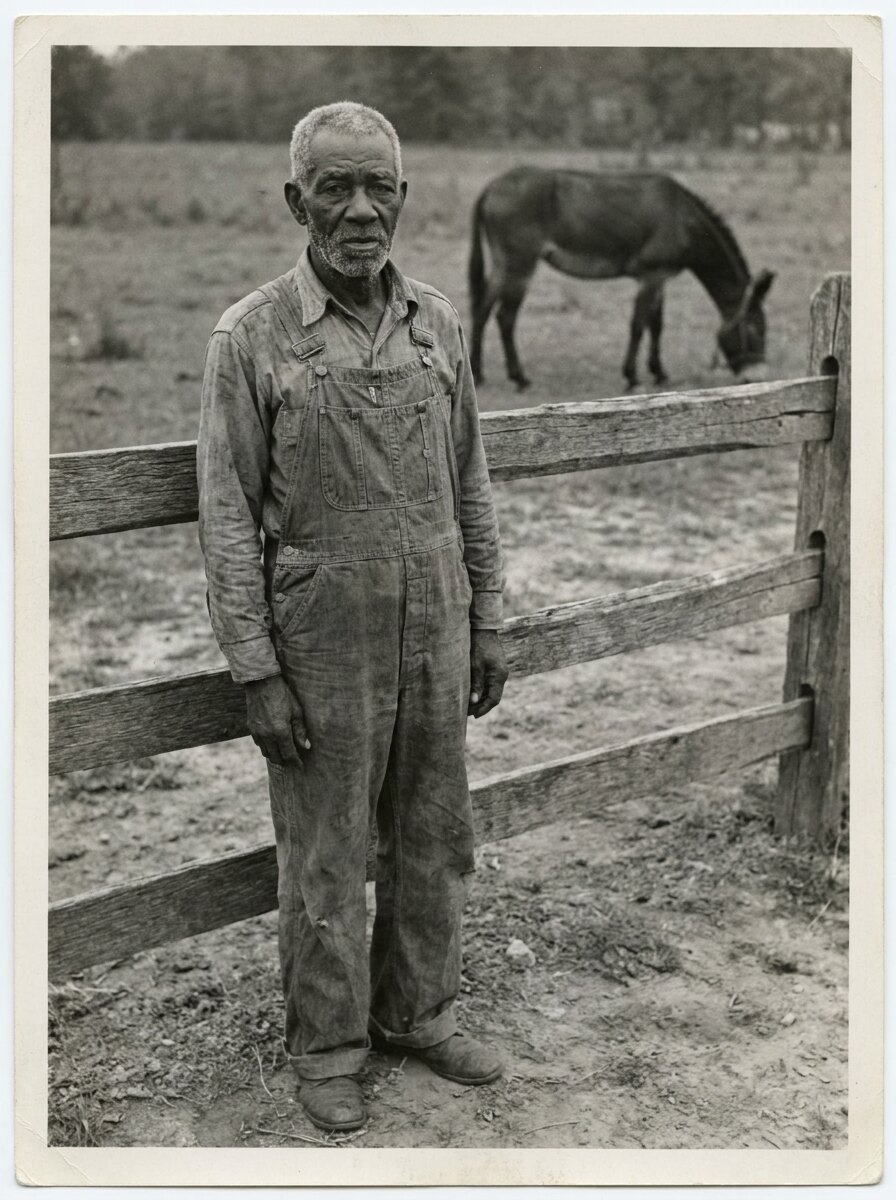
Portrait: artist's interpretation. No photograph of Isom Moseley is known.
Isom Moseley
Recorded in Gee's Bend, Alabama, 1941 · Born about 1856; Dallas County, Alabama, about twenty miles from Selma
Their Story
Isom Moseley was born in Dallas County, Alabama, about twenty miles from Selma. His mother worked in the house and died when he was young. His father was a field hand. After his mother's death, Isom was raised by his master and mistress, whom he named by the initials L. M. and B. M., and kept around the house as a houseboy, carrying cool water. When fights broke out with the other children in the quarters, he was told to run back to the yard, where no one could punish him.
He described plantation work in detail. Wooden mills ground the cane, and the molasses was boiled in big kettles and stored in poplar troughs rather than barrels. He carried water to the ash hopper for the man who made soap for the whole plantation. Hides were tanned in board-lined pits layered with bark, and a shoemaker made shoes for children and adults alike. He called the family that held him "mighty good white folks."
He was told that people did not learn they were free until a year after the surrender, and that afterward they worked on shares. At seventeen he came to Gee's Bend, where he worked for J. P., whom he praised for making good crops without ever putting a rider over his hands. He had one child, who died. At about eighty-five, he said a government project gave him clothes, some food, and five dollars a month, and that he had no complaints. Robert Sonkin recorded him at Gee's Bend, Alabama, in 1941.
The Recordings & Transcripts
The recording Gee's Bend, Alabama, 1941
Captions open at the bottom of the screen when you press play. Click any transcript line to jump to it.
Transcript
Isom Moseley:My name is Isom Moseley. Raised up in old time without a mother. My old master and mistress raised me. [child screaming in background which continues intermittently throughout the interview] My master was named L. M. My mistress was name B. M. Well, are you ready for me to talk?
Robert Sonkin:Yeah, that's fine.
Isom MoseleyAnd, uh, and uh, after, my mother was a house woman, and uh, after she died, my father was a field hand, and white folks kept me around the house to tote cool water. Houseboy like. And uh, they had two weavers weaving, had two looms running every day. Well you know I'd go out in the quarter to play with them childr, other children. And if I hurt one and they caught me, they would wear me out. Well the, the white folk told me, when they get at me, make it to the yard. Well sometime I'd go out there and get to playing, one would hit me, I'd get a brick [unintelligible] it to him and to the yard I made it. Don't nobody say nothing after that. And, uh, I, went on that-a-way and, uh, I never can, uh, my master was name L., you got that, and my, my mistress had a master name, a young master named L. M. He was a doctor. B. M., he was a farmer. F. M., he was a farmer. J. M., he was a farmer. Well, I had two mistress, B. M. and M. J. M. They was my mistress. And then, as I went on to tell you about, they made molasses way back then, and uh, they had no iron mills like they got. They made wood, the carpenters made wooden mills. And they'd grind that molasses and they had a vat, big kettle to make it in, you know, had [unintelligible] put the kettles on. And when that molasses was made, they had [poplar (?)] trough to pour that molasses in. No barrels at all. I never seed a barrel long [seen] then, nothing but troughs. And when you get your molasses made, they had plank to cover them troughs. [intelligible]
Robert Sonkin:Uh, you told me something about the way they made soap in the old days.
Isom MoseleyYes sir, I've explain that. Now I was large enough to tote water to the soap maker, put on ash hopper. They had a barrel, uh ??? . [tape gets stuck]
Isom MoseleyYou ready?
Robert Sonkin:You were telling about the soap making.
Isom Moseley:Huh?
Robert SonkinYou were talking about the soap.
Isom Moseley:Now, now when I was a boy they used to make soap. Well I was large enough to tote water to the soap makers to put on ash hopper. Now they didn't have no barrels, they had boards, you know. And uh, them boards come in that-a-way, you know, that-a-way, boards was there. Well, all these here and you'd lay some crossway to hold the ashes. And then I'd tote water and put on that ash, ash hopper for the soap maker. Now he'd make soap for the whole plantation, and uh, make about two or three barrels. And along then captain, I ain't seen none, no bar soap. They might have had some but I never seen none. And uh, they uh, had, uh, something dug in the ground, hole, deep hole and board up on each side, it was plank. Well it was about three foot deep I reckon, as nigh as I can come at it, and about eight or ten foot long. Well, ??? tan leather. They'd lay a, lay a bark down in that hole, and then they'd lay, lay a hide over that bark. And then they would lay another layer of bark and another layer of hide, till they got it like they want. And then they'd fill that thing up with water. But now, now before they'd tan that, that leather, they had a place to put it in to get, lay a while and get the hair off it. And when they got done with that leather it's just like any tan leather, and they had a man there to make shoes for all us. Now we was children, good size children, going about, that shoemaker make shoes for we children. And the old folks too. We had mighty good white folks, my memory, far as I can remember, you know, mighty good, mighty good. You know they must have been good. After the country surrendered, didn't none move, more move there after surrender. More moved on the place.
Robert Sonkin:What happened after the surrender?
Isom Moseley:Sir?
Robert Sonkin:What happened after the surrender?
Isom Moseley:What happened?
Robert Sonkin:Yeah.
Isom MoseleyWell now, they tell me it was a, a year before the folks knowed that, uh, they was free. And when they found out they was free, they worked on shares, they tell me. Worked on shares, didn't rent no land, they worked on shares. Now you know I was a boy, I'm about explaining to the best of my understanding. They say they worked on shares. I think they said it was, was it fourth, or third I think. They got the third, I think they say, what they made,??? after surrender.
Robert Sonkin:How many children do you have?
Isom Moseley:Me?
Robert SonkinYeah.
Isom Moseley:Ain't got, didn't have but one and it died. None but one and it died. Now we was living twenty mile this side of Selma, in Dallas. That where I was birthed, I weren't birthed down here. No sir, I weren't birthed down here.
Robert Sonkin:How old were you when you came into Gee's Bend?
Isom Moseley:How old I was? Seventeen year old. Seventeen year old and I come in the Bend here. A man here name, J. P. was here when I come, but the first owners of this place, that I don't know nothing about it but I heard the older peoples, M. P. Now uh, uh, C. Gee was the first owner. But that was ??? old man M.'s brother-in-law, tell me. Well, after old man Gee, M. took place, M. P. And then that's when I come here. They say his son, J. P., I don't know nothing about old man M. and C. Gee, but old man J. P., he was, he was a good man. He stayed here, I stayed here with him. Then he died, he been dead for forty some odd year. And uh, another thing about him. No, he had ten wage hands and uh, four plowers and, and six hoe hands. Never had a ride over them the whole time. Now he'd get up soon of a morning and ride around. Now uh, what we would be, the sun be a half hour high before you left home, he'd be in the field. That he would. And you know he'd make good crops. Now he'd go soon of a morning, about eight o'clock he done been all around to his renters and to his wage hands and making it out to the house. And late in the evening, he'd go back again. Now he had a colored man for his foreman and the old hands and a colored man head of the plowers. that's what [unintelligible]. Now he make plenty corn with them ten hands, and forty and fifty bales of cotton. And he never had no rider over them.
Robert Sonkin:What's the government doing for you now ??? ?
Isom Moseley:Sir?
Robert SonkinWhat is the government doing for you now?
Isom Moseley:For me?
Robert SonkinYeah.
Isom Moseley:They give me clothes, something to eat, and giving me five dollars a month. They treating me all right. I don't find a bit of fault on it. Yeah, I got, I don't have to buy no clothes at all. Well I buy, they give me five dollars a month, I buy my uh, uh, flour. Well they give me some flour some time, and some sugar and coff, coffee, I'm a coffee drinker, and tobacco. I have that to buy, but clothes, things I don't buy that.
Robert SonkinYou're about eighty-five years, eighty-five now aren't you?
Isom Moseley:Sir?
Robert SonkinYou're about eighty-five years old?
Isom MoseleyYes sir, eighty-five. And they treating me fine, I don't find a bit of fault on it. I ain't had no clothes to buy since I been on the project. And I've been on it I think, about nine, about eight or nine years I believe. [tape gets stuck]
END OF SIDE A
Share their words
Post this card so more people hear Isom's voice.
Discuss Isom's story in the Community
Recorded by Robert Sonkin, Gee's Bend, Alabama, 1941. From Voices Remembering Slavery: Freed People Tell Their Stories. Bracketed notes and question marks in the transcripts mark sounds or words that are hard to hear.