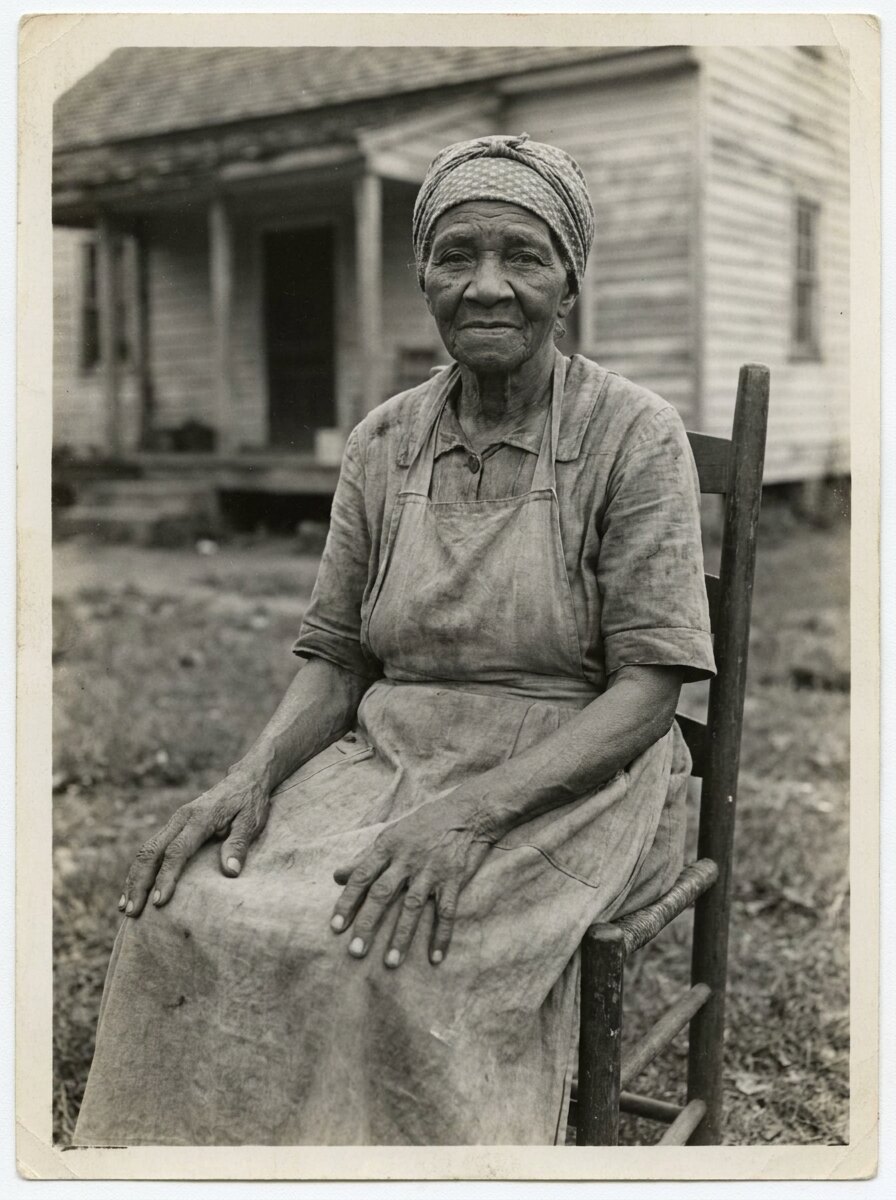
Portrait: artist's interpretation. No photograph of Sally Ashton is known.
Sally Ashton
Recorded in Albemarle County, Virginia, Summer or Fall 1934
Their Story
Sally Ashton's short recording is mostly about farm and kitchen work in the old days, and she says little about her own life. Asked who she used to work for, she answered "Hancock," who she said had a hundred servants or more.
She described working in the tobacco and wheat fields without the kind of shoes people had later. She remembered threshing wheat the old-fashioned way with eight horses, a job that took about three weeks, with women and children standing by the machine to keep it from running over anyone. When asked about her own work, she said she cooked all the time. She explained cooking at a fireplace with no stove, hanging pots on racks and baking bread in a big brick oven heated red-hot.
Parts of the recording are hard to make out. She was recorded by Archibald A. Hill and Guy S. Lowman in Albemarle County, Virginia, in the summer or fall of 1934.
The Recordings & Transcripts
The recording Albemarle County, Virginia, Summer or Fall 1934
Captions open at the bottom of the screen when you press play. Click any transcript line to jump to it.
Transcript
Archibald A. HillAll right. Can you tell me about tobacco planting?
Sally AshtonYeah. [I can tell you a little (?)]. No. I went along putting it in the field. And, ah ??? . Taken them off the tobacco wagons, you know. [Taken them off the back of it (?)]. And I was afraid of them. Do you know what I'm saying? Didn't you? Catch a ??? Behind the old shed. We had an old shed, you know. “[And if, and if you don't catch it and find one behind me (?)].” I say, “A you must found one.” He say, “I found one. And, catch another one behind you going to make you break your head off.” “I'm afraid ???. You didn't have to break your head off.” And, and look all in the tobacco fields, in the wheat fields. I did, didn't have shoes like they have now, you know. I seen, used to ah, have eight horses here to thrash wheat. And we be thrashing for about three weeks, for we could get through the crops. Because it's so much, you know. Old fashioned way of working. And me and the other girls. ??? turned up wheat, you know ??? Hooked up on the cables. A man helped put it in there, the what do you call it? The drum. He dragged to one to us and he put it in there and thrash the wheat out and he go down and ??? Sometimes things come to me. ??? Old fashion way of thrashing wheat. Hitch your horses to it and let your ??? horses broke loose. He had to run and catch them. They whole thing, you know ??? used to call it in them times. We had to [stand (?)] there, women, children and all, stand [there (?)]; keep the thing from running over the other person. [For it could (?)] break your leg ??? .
Archibald A. Hill???
Sally AshtonWhat did my ??? ?
Archibald A. Hill???
Sally AshtonCook. Cook all the time.
Archibald A. Hill??? How did you cook in that place? How do you cook?
Sally AshtonCook by fireplace. Didn't have no stove. And had these, ah, so many hands, you know, what a hundred hands. ??? Had skillets. And had a great old brick oven. This old brick oven, you know. Make. Build a fire in it. Make the fire red-hot. Put your bread on the pan, you know. See what these pans were, you get [on black top (?)] whole thing open them and put the bread on down. Push it back in there, while the thing was red-hot. While this old brick oven was red-hot. That way they can ??? the pots on the [stool (?)], on the fireplace lounge. Fireplace lounge and ??? , had racks, racks you know, hang pots up on. Ain't got no stove ??? ham and meat and ??? throw that something in there, pull it out and shove it back in the fire. Put it back on the fire and then sit down and eat. Potatoes and cut stuff a hundred hams. We get bread out the oven and ??? .
Archibald A. HillWho did you use to work for?
Sally AshtonWho we use to work for? Hancock. ??? had a hundred servants or more. Did you ??? .
END OF SIDE B
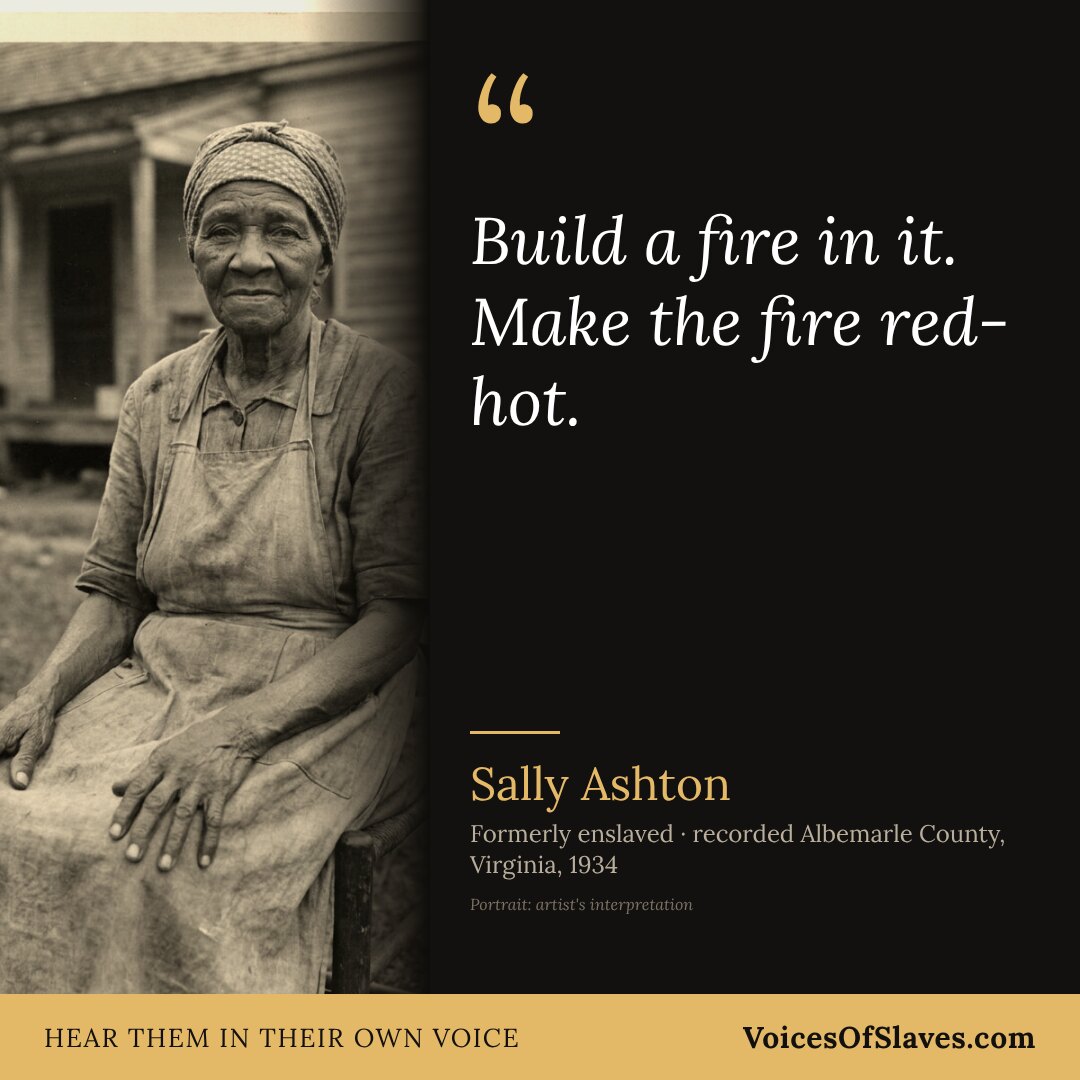
Share their words
Post this card so more people hear Sally's voice.
Discuss Sally's story in the Community
Recorded by Archibald A. Hill and Guy S. Lowman, Albemarle County, Virginia, Summer or Fall, 1934. From Voices Remembering Slavery: Freed People Tell Their Stories. Bracketed notes and question marks in the transcripts mark sounds or words that are hard to hear.