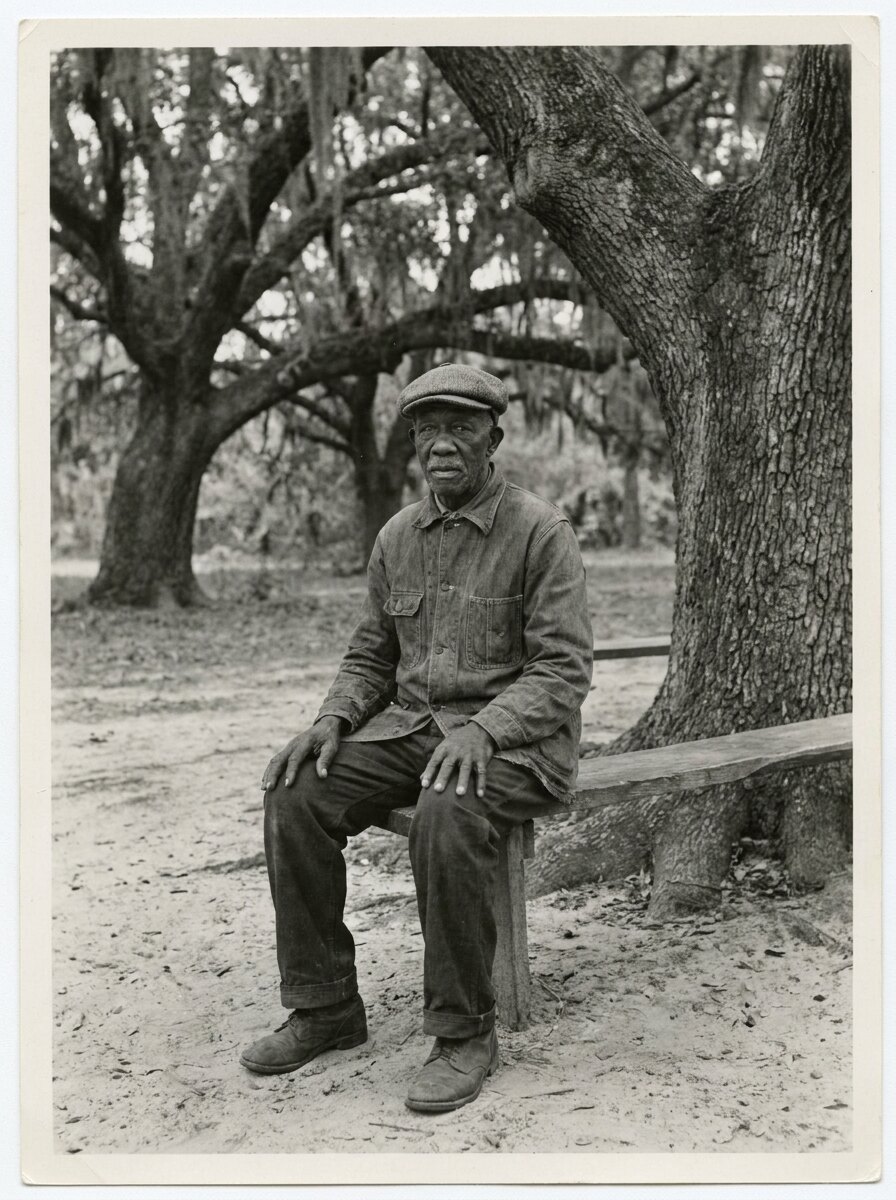
Portrait: artist's interpretation. No photograph of Samuel Polite is known.
Samuel Polite
Recorded in St. Helena Island, South Carolina, June 27, 1932
Their Story
Samuel Polite's recording is hard to hear in places, and parts of it cannot be understood. He said that when the old man who held his family died, the enslaved people were divided among Tom, Billy, and Johnny Fits, and his family went to Johnny Fits. During the war, when Union forces came, they were told to move inland. He traveled up and down the country with them as a boy and later came back to the coast once, he said, "everything was over."
He remembered an overseer who put his mother to work plowing. Because she did not know how, Samuel had to lead the horse and hold the plow handles. He called that overseer the devil, describing him making people kneel and whipping them hard. He said that from a boy up to a man, he had nothing good to say about slavery.
Much of the interview is about farming. He explained how he raked fallen leaves from pine, oak, and gum trees in the woods, hauled manure, broadcast it over his fields, and planted corn so that it grew up through the manure. He said he would not use commercial guano even if it were free. Lorenzo Turner recorded him on St. Helena Island, South Carolina, on June 27, 1932.
The Recordings & Transcripts
Part 1 of 2 St. Helena Island, South Carolina, June 27, 1932
Captions open at the bottom of the screen when you press play. Click any transcript line to jump to it.
Transcript
Mr. Samuel PoliteI was the [last soul (?)] ??? and after ??? the old man dead. We were shared: one to Tom Fits, one to Billy Fits, one to Johnny Fits. ??? out my son ??? forward to Johnny Fits. So Johnny Fits had all of his people and gone over on the old Giddy Main, of Mr. Webs place, we brought there. And we was there [recording glitch] before the war. Then after the war he run from there, helped the people from there. Run gone to a place he called ??? . Then he been there a while and the Yankees come across on the old Giddy Main. They tell us to run away up in Bonrad. And we been up in Bonrad, Weepers Bridge and Savannah and ??? and, you see I was a traveling boy then. Been up and down with them and they [did (?)] the same. Them ??? the same. I was so ??? . And then from there a fighter come up from behind me and brought her from there come back over on the Main on [Savannah (?)]. And I know everything was over. Slavery and ??? everything that slaves do I are doing the same thing today for myself.
Dr. Lorenzo Turner??? in slavery times?
Mr. Samuel PoliteHuhh? ??? Well, in slavery time after we went up to the country, we had an overseer he called, Brunswick. He took my mother and sent her in to plow. To plow. And we didn't know how to plow and had me to lead the horse though he was the plowman. I have to fit him in the plow. Fit him inside. And I hold the handles allowing him to plow. And he was a plowman up to his death.
Unidentified WomanHow'd he treat you?
Mr. Samuel PoliteHuhh?
Unidentified WomanHow did he treat you?
Mr.Samuel PoliteTreat you? Well, I believe [with uhmm (?)] the only somebody that is, that is that man. That is the devil. That is the only one died is him.
Unidentified WomanWhat did he do?
Mr. Samuel PoliteHuhh?
Unidentified WomanWhat did he do?
Mr. Samuel PoliteWell, he would get up in the morning, run his hands in his pockets. Into his pockets and tell you, you know ??? work. And came right out and ??? and rub that horse and pull them up in the sun and then he tell you ??? get yourself dirty from rubbing that horse, he would go down, down on your knees. And he would whip, whip you and [just fist you had a gash (?)] on you. And so the way I been through from a boy up to a man today ain't nothing better for tell me today about slavery. Ain't nothing better to tell me about ??? .
END OF SIDE A
Part 2 of 2 St. Helena Island, South Carolina , June 27, 1932
Captions open at the bottom of the screen when you press play. Click any transcript line to jump to it.
Transcript
Mr. Samuel PoliteI come to the manure. I ah fit seven load of ??? back in the barn. Then I get three cord of [mashed corn (?)]. Then I fit a load of [dry corn (?)] on them again. Some of [dry corn (?)] on them again. Then I fit about [loud distortion] [eight loads of (?)] ??? broadcast ??? from ??? from ??? mud. And I keep on with that, and keep on with that until you see how mine shine there now. I keep on with that and, when this wind done and this rain done with that manure. I just ??? something and broadcast. I sow, sow mine this way, you know. I sow one corner that way and I'll sow one this way. And when I went plant the corn, I drop the corn right in there and took that cultivator and put right on, you know. After them put right on with that cultivator, then I hauled the manure and broadcast them in there. And then let out corn come up throughthat manure. You see? And as long as that corn coming up, as long as that manure will be on the corn root, the corn root can't come out of, over on it. And that manure will stay on that corn roots there and we would see crops. But guano, I wouldn't be on ten cents got all the bags they can bring to me. And she wanted to [smooth (?)] that manure you would [say (?)], that manure you haul you from there and carry me you trust my, [hide your (?)] and chop down in there, chop down in the age of that manure ??? manure. She done manure ??? .
Dr. Lorenzo TurnerWhat did you do to ??? after ??? ?
Mr. Samuel PoliteI took my plow and went in there. Now I show her I don't choke.
Unidentified WomanChoking.
Mr. Samuel PoliteHmm? I throw it out, sow one furrow that way and I sow one this way. [Crops make (?)] good now. Now that, is there a row there or a plantation? Now I wanted to plant the corn. I come there and I drop the corn [disc scratch] [seed (?)]. [knocking] I go on. See, I done that way. Then I done that row. I turn the [sweepers (?)] right in that row, with the cultivator now, took up the back teeth and led these two front teeth go this way. And them two front teeth go that way. And cover up that corn from the [sweepers (?)]. Then when I done cover that corn I load up the [shaft (?), you know. And I get my fork and my ??? [bag (?)] for my manure ??? in that thing. And then that corn come out there, and that corn come up, it, it got to come through that manure and it, and that manure it steady, it steady lay on that corn [and weeds (?)]. And the more the corn grow the blacker it gets.
Dr. Lorenzo TurnerWhat was that [plant (?)]?
Mr. Samuel PoliteHmm?
Dr. Lorenzo TurnerWhat did you [plant (?)]?
Mr. Samuel PoliteWell, ah the leaf will fall off the tree, you know. And the tree—
Dr. Lorenzo TurnerWhat kind? What kind of tree was it?
Mr. Samuel PolitePine tree. Oak tree. Gum tree. Any kind of tree that had been in the woods, you know. We raked that same stuff. That bring your house. That make me a man. And slave [disc scratch] and slave and sla, and sla make me work, make me work your a man.
END OF SIDE B
Share their words
Post this card so more people hear Samuel's voice.
Discuss Samuel's story in the Community
Recorded by Dr. L. Turner, St. Helena Island, South Carolina (Gullah), June 27, 1932. From Voices Remembering Slavery: Freed People Tell Their Stories. Bracketed notes and question marks in the transcripts mark sounds or words that are hard to hear.