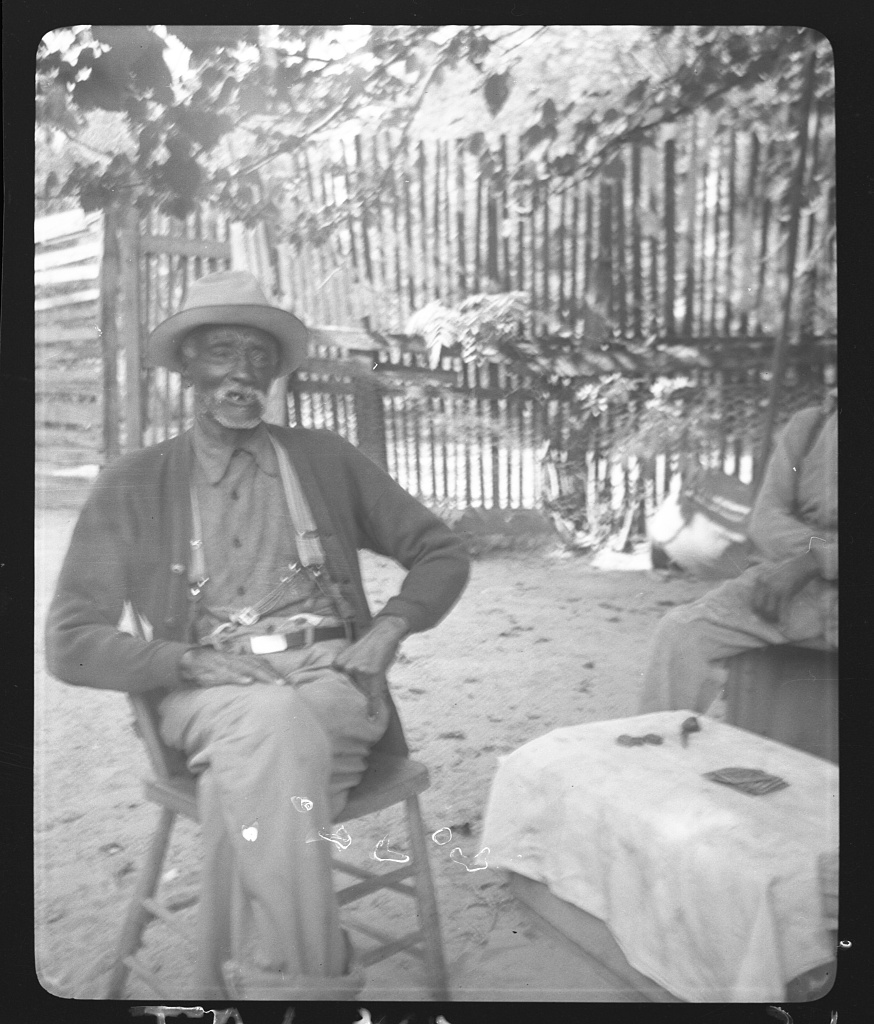
Uncle Billy McCrea
Recorded in Jasper, Texas, 1940 · Born about 1851; place not stated
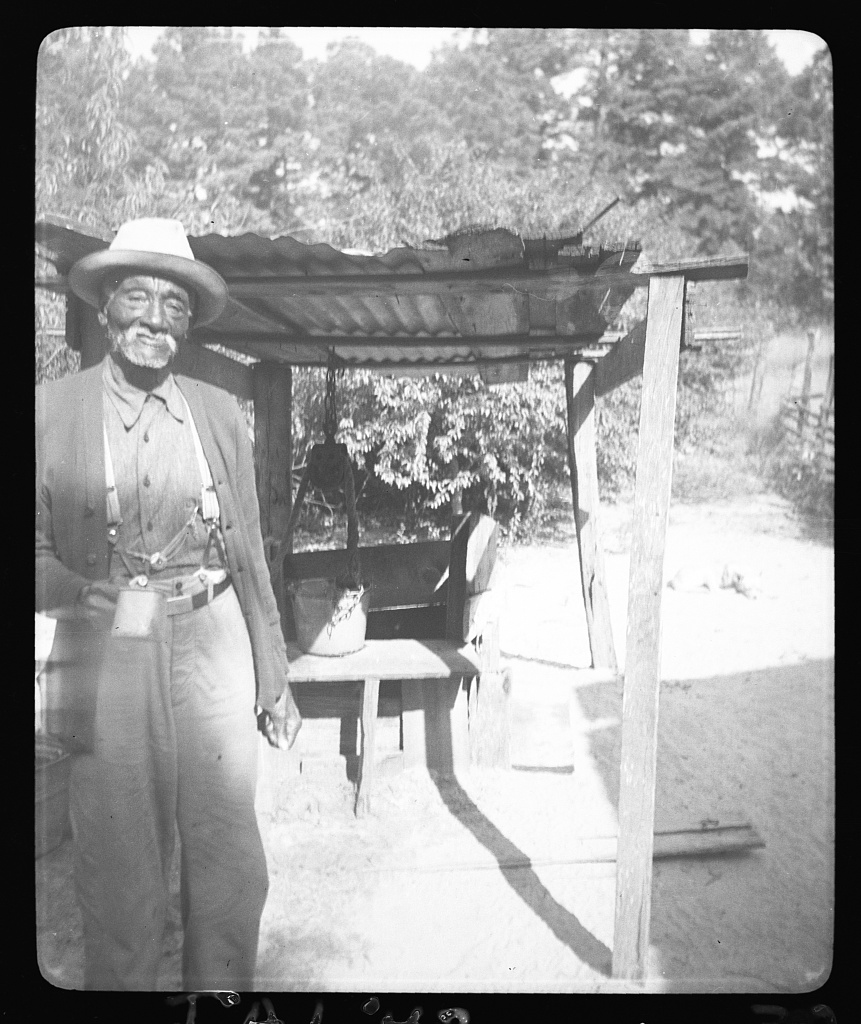
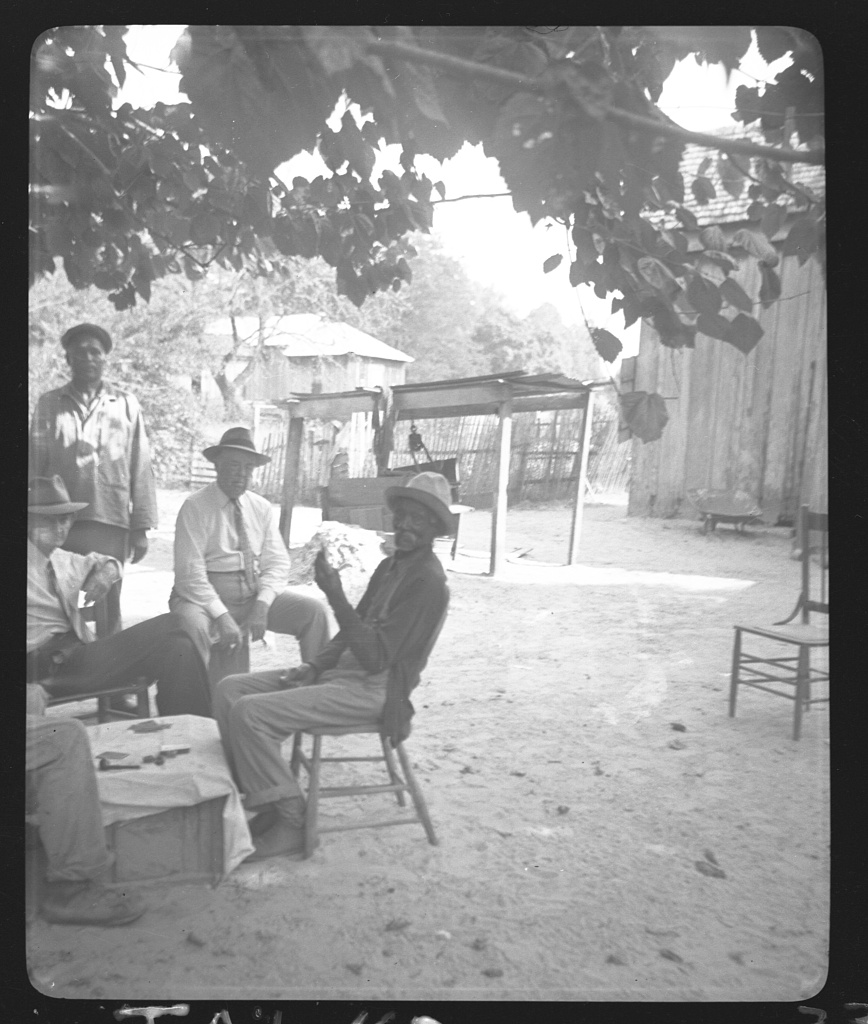
Their Story
Billy McCrea told the interviewers he would turn eighty-nine on October 15, though he said others reckoned his age differently. He grew up enslaved in the town of Jasper, Texas, held by a man he called Col. M. He said his enslaver owned a whole square of the town, from where the new post office stood down to the Citizens Bank. He described Col. M. as a speculator who hauled cotton away by the wagonload and came back with enslaved people to sell around the county. Billy's father drove the wagons, and Billy often went along on the hauls from Jasper to Wise's Bluff, riding an ox named Brandy.
He remembered seeing three men who had run away brought in from the woods with hounds, then tied down on logs by the creek and whipped before being put in jail. He also recalled that he and a white boy used to sneak bread to the prisoners through the bars of the old log jail. At the end of the war he watched Union soldiers in blue pass through Jasper for two days, with cannons pulled by teams of six and eight mules. He remembered the Freedmen's Bureau punishing men by hanging them up by their thumbs, and his enslaver telling a woman named Harriet that everyone was now free.
After freedom he cooked on steamboats for about six years on the run between Jasper and Beaumont. He sang the work songs the men sang while carrying salt from the boats up the bank to the warehouse, including "Blow Cornie Blow" and "Walk Dooley," and he tried to recall "Handy Gal." He said he had thirty-six children, sixteen of his boys raised in Jasper County.
He was recorded in Jasper, Texas, in 1940 by John A. and Ruby T. Lomax. He was also interviewed for a written Federal Writers' Project narrative, which appears on this site under the name Bill McRay.
The Recordings & Transcripts
Part 1 of 2 Jasper, Texas, 1940
Captions open at the bottom of the screen when you press play. Click any transcript line to jump to it.
Transcript
John A. LomaxMiss Sarah, this is Uncle Billy.
Ruby T. LomaxHow ya doing Uncle Billy? How are you this evening?
Uncle Billy McCreaI'm feeling very well ??? .
Ruby T. LomaxHave a seat?
John A. LomaxUncle Billy, come sit right here and let's, oh, you want sit—
Ruby T. LomaxI think maybe he—
John A. Lomax??? right over [over] there. Sit in that.
Uncle Billy McCreaYes, sir.
John A. LomaxAnd I want sit over here by you and talk to you some. [equipment set-up noise and pause]
Uncle Billy McCreaThis ??? always ??? .
Ruby T. LomaxRest your hat down there. That right. Rest your hat down there.
Uncle Billy McCreaI didn't want come, [door slams] my voice is not good. I can't, I'm afraid I can't do what I, talk like I wanna talk.
Ruby T. LomaxWell, that'll be fine. We—
Uncle Billy McCrea[grunts]
Ruby T. Lomax—get along fine.
John A. LomaxIf you don't sing, Mr., please you tonight I'll, we'll bring you back in the daytime.
Uncle Billy McCreaSir?
John A. LomaxIf you're not satisfied with them tonight, well I'll bring you back in the daytime, when you're feeling better.
Uncle Billy McCreaYes, sir.
John A. LomaxNow go head and, and ah sing one of those steamboat songs.
Uncle Billy McCrea[pause] You want hear one of those steamboat songs?
John A. LomaxYep.
Uncle Billy McCrea[I'm just steady now. I don't wanna start then (?)]. They want me to sing that song sort of like—
John A. LomaxBlow Cornie Blow.
Uncle Billy McCreaYou want me sing that song like before they going to work.
John A. LomaxYeah.
Uncle Billy McCreaYeah. Well. I'll sing ??? going to work. I'll sing it for you.
John A. LomaxGo head. Nothing here gonna hurt you, Uncle Billy. [microphone noise before Uncle Billy sings]
Blow Cornie Blow
I think I hear a the captain call me—blow cornie blow. I think I hear the captain calling—blow cornie blow.
A blow cornie blow. Blow cornie blow. A blew it cold, loud and mournful. Blow cornie blow.
I think I hear the captain [say (?)] ??? —blow cornie blow. They carried lo-o-o-o-ong onto bend. Blow cornie blow. They soon will be to the landing corner. Blow cornie blow. De captain hand me down my [salary (?)]. Blow cornie blow. Oh, blow boy and let them hear you. Blow cornie blow.
Oh, blow loud and ??? . Blow cornie blow. Oh, blow loud just so he can hear you. Blow cornie blow. I think I hear the captain call you. Blow cornie blow.
Uncle Billy McCrea[concludes song] Yeah. That's the best I—
John A. Lomax. Now, what were the boys doing when they were singing that—
Uncle Billy McCrea??? . What you ??? doing?
John A. LomaxYeah.
Uncle Billy McCreaToting salt.
John A. LomaxToting salt?
Uncle Billy McCreaYes, sir.
John A. LomaxWhere from the boat to the bank?
Uncle Billy McCreaFrom the boat goes back to the warehouse.
John A. LomaxWhere that salt come from?
Uncle Billy McCreaI don't know where it come from. We used, we got, they got it for old master.
John A. LomaxYeah.
Uncle Billy McCreaOld master just sit beside you know and they ah, when they land now, then you had to tote it up this bank and put it in the warehouse. And they would sing the while they's toting it.
John A. LomaxWell [now (?)] they'd sing Handy Gal also, wouldn't they?
Uncle Billy McCreaNo. This here's another one.
John A. Lomax. All right.
Uncle Billy McCreaLet's see here how's that go. [We used to just tear that up (?)]. Now I sung them you see—
John A. LomaxOh, Sally, What Ya Gonna Have For Dinner? was that one of them?
Uncle Billy McCrea??? that's one of them.
John A. LomaxWell, sing that one.
Uncle Billy McCreaLet's see now how that [go (?)]. I got to study it a while. That's the reason why I didn't even, didn't want come cause I done have it preach now—see, I tell you how this. Let, I need talk a little bit. You see here? Why yes. See, I had to run here for two years, and, and not going, and you hurt me. It seem like it, aged my voice. But you don't hurt me on just this time. Well, now I see, let me see how that go?
John A. LomaxHow about the [Jerah Rall (?)] Don't Come To My House?
Uncle Billy McCreaYeah. That's a good one too.
John A. LomaxAlright. Sing in that one.
Uncle Billy McCrea[sings]
Ju Rawsy Row, Row, Don't Come To My House
Ju rawsy raw, raw, don't come to my house. Ju rawsy raw, raw, don't come to my house. Ju rawsy raw, raw, hoe ??? hoe. Ju rawsy raw, raw, hoe nigga hoe. Ju rawsy raw, raw, hoe nigga hoe. Ju rawsy raw, raw, a good dog. Ju rawsy raw, raw, ??? . Ju rawsy raw, raw, [old ties (?)] they frighten me. Ju rawsy raw, raw, [old ties could (?)] bake your bread. Ju rawsy raw, raw, ??? [old ties (?)] a good dog. Ju rawsy raw, raw, ??? [old ties (?)] a horse ??? . Ju rawsy raw, raw, tote boy. Tote boy. Ju rawsy raw, raw, ??? . Ju rawsy raw, raw, ju rawsy raw. Ju rawsy raw, raw, ??? [old ties (?)] a good dog. Ju rawsy raw, raw, ??? . Ju rawsy raw, raw, [s'ick them old ties up (?)]. Ju rawsy raw, raw, [take them old ties up (?)]. Ju rawsy raw, raw, ??? [to go (?)]. Ju rawsy raw, raw, [old ties tend the crop (?)]. Ju rawsy raw, raw, [old ties tend the crop (?)]. Ju rawsy raw, raw, [old ties to bake your bread (?)]. Ju rawsy raw, raw, [old ties a good dog (?)]. Ju rawsy raw, raw, ju rawsy raw, raw. Ju rawsy raw, raw, [s'ick them old ties up (?)]. Ju rawsy raw, raw, [cut them old ties up (?)]. Ju rawsy raw, raw, [cut them old ties up (?)]. Ju rawsy raw, raw. [drumming] Ju rawsy raw, raw. [drumming] Ju rawsy raw, raw, [old ties a biting dog (?)]. Ju rawsy raw, raw, [old ties will bite you (?)]. Ju rawsy raw, raw, [old ties will hurt you (?)]. Ju rawsy raw, raw [old ties a good dog (?)]. Ju rawsy raw, raw, [s'ick them old ties up (?)]. Ju rawsy raw, raw, [cut them old ties up (?)]. Ju rawsy raw, raw, [hold them ties up (?)]. Ju rawsy raw, raw.
Uncle Billy McCrea—how you like that?
John A. LomaxI'd say that's a good one.
Uncle Billy McCrea[laughs]
John A. LomaxNow, well now, hold up. Ah, go on. Let's finish with those, ah, how about that one Walk Darley. How did that one go?
Uncle Billy McCreaWhich?
John A. LomaxWalk Darley, you said, or, Dooley or something like, or—
Uncle Billy McCrea[sings] Walk Dooley .
Walk Dooley. Walk dooley. Dooley's a good. Do walk a dooley. Dooley's my honey [girl (?)]. Do raz ??? Walk dooley. Walking and a talking. Walk dooley. Walking and a talk. Walk dooley, dooley's a hand gal. Dooley ???
Uncle Billy McCreaLet me see. I got that wrong. That's why you don't want my mind don't process nothing. Let me see now. Let me see how I can get that started again. Nope. Cause ??? . That's it. Let's see, now. [he attempts to sing and Ruby T. Lomax comments about something] Ahha. I got it wrong. [Uncle Billy McCrea, resumes song]
Walk dooley. Walk, talk and dooley. Walk dooley. Walk, talk, dooley. Walk dooley. Dooley is a— Walk dooley. Oh, dooley. Do walk. Dooley. Oh, dooley. Walk dooley. Walk them and a talking. Walk dooley. Walk them and a talk.
Do raz. Araz-raz. ??? dooley. Walk dooley. ??? dooley. Do raz. Araz-raz, hoe nigga. Hoe man. Do raz. ???
Walk dooley, hoe down nigga. Walk dooley, I am a good man. Walk dooley, I can do ??? . Walk dooley, walk, talk dooley. Walk dooley, run along dooley. Walk dooley, talk long dooley. Walk dooley, stepping on dooley. Walk dooley, dooley is a good thing. Walk dooley, dooley let the hogs out. Walk dooley, hoe nigga hoe me. Walk dooley, hoe nigga hoe me.
Do raza I am ??? Do raza I could pull two men. Do raza I could handle three men.
Walk dooley, I could whoop five men. Walk dooley, dooley she's a good gal. Walk dooley, I could slap her husband. Walk I slap Julia. Walk sometime I slap Julia. Walk sometime I slap her jaw. Walk Julia is a good gal. Walk when I slap Julia on the jaw. Walk then she come to be a good girl. Walk Julie—
Uncle Billy McCrea[laugh] I got, now, now let me see now. ???
John A. LomaxHandy Gal.
Uncle Billy McCreaHandy Gal. Let me see how it is. [he attempts to sing] Handy Gal . Handy gal. Handyeeee. Handy gal. Handyeeee. Let me see. Handy gal. Handy. Let me see. Handy gal. Let me see. Walk. Handy gal. Let's see. Handy gal. See, I've got to study it. You see. I've got to get to study it, before I could sing it.
John A. LomaxThat's all right. Ah, oh what about ta— [recording glitch]
Uncle Billy McCreaLet me see how it is. How that, that song is. That's one of those songs on the boat I was just talking about.
John A. LomaxYeah.
Uncle Billy McCreaI don't know what's going happen here.
John A. LomaxYeah.
Uncle Billy McCreaLet's see. [he sings one note—Oh.] Let's see. How's that go. I had that down good today. Because I told them, I remember sort of leaving. See. [sings—Ohhhh] [leave won't you ??? (?)]. Told you I come around here and g-o-o-o-o. G-o-o-o-o, sunny your horse is gonna have a [good stable (?)]. Let's see. ??? carry on. ???
John A. LomaxWhat did you do on the boats? Ah, ah Uncle Billy?
Uncle Billy McCreaCook. I cooked.
John A. LomaxHow long?
Uncle Billy McCreaOn the boat?
John A. LomaxYeah.
Uncle Billy McCreaI cooked boats about six years.
John A. LomaxAnd where did the boats run?
Uncle Billy McCreaFrom Beaumont to Jasper here [Gulfport (?)].
John A. LomaxHow many miles was that?
Uncle Billy McCreaN-nnn, I think they taught us, fifty-miles, from Jasper to Beaumont. I cooked on. I cooked on about, cooked for about six years on steamboats.
John A. LomaxAnd how old are you Uncle Billy?
Uncle Billy McCreaWell I—
John A. LomaxSit over a little bit.
Uncle Billy McCrea—could tell you my age. Now I, I don't rightly know my age. But I can tell you what I go for. The fifteenth of this, of October, I be eighty-nine. Eighty-nine-years-old. And on the second time, the way they've got my age fixed there on the fifteenth I will be a hundred-and-seventeen-years-old. But I register in the courthouse, of my age be ninety-eight, ah eight, no eighty-nine, this coming, the fifteenth of this month. Next Oc, October.
John A. LomaxHow many children have you, Uncle?
Uncle Billy McCreaHow many children? I have [Ruby T. Lomax utters—Two children.] I, how many children? Let's see. Thirty-six.
John A. LomaxThirty-six?
Uncle Billy McCreaThat's right.
John A. LomaxHow many boys?
Uncle Billy McCreaHow many boys? Eighteen boys.
John A. LomaxAnd how many girls?
Uncle Billy McCreaI don't know. Cain't [can't] rightly tell you how many girls. But the boys I got sixteen raised right here in Jasper County.
John A. LomaxSixteen boys?
Uncle Billy McCreaYes, sir. And them two boys you seen with ??? the other day?
John A. LomaxYeah.
Uncle Billy McCreaThem my boys. Twin boys. You see another boy there?
John A. LomaxYeah.
That's my boy. And another boy come out there, and that's one of my boys raised right here. I have, I have one in, I have one in ah, in Beaumont. And I have one boy— [recording ends]
END OF SIDE A
Part 2 of 2 Jasper, Texas, 1940
Captions open at the bottom of the screen when you press play. Click any transcript line to jump to it.
Transcript
John A. LomaxWhat do you remember about the, when slavery was over?
Uncle Billy McCreaWhen slavery was over, let me see if I can't tell you about that.
John A. Lomax:Well you said you, they all kept going, tell be about them coming through here with cannons.
Uncle Billy McCreaYes, yes. Now I'll tell you when slavery, way back in slavery time, I was standing at, that's when the Negro was free. I would, we all would go out every day, right here in town, to see the Yankees all going back home. I can recollect just as good. They'd just have, they'd have, uh, six and eight mules to a cannon, going through and bolts on them there, uh, uh cannon, cannon. Then they'd take the wagon, and have bolts all on them wagons. Now, walk, nothing but them mules, nothing but them mules, and one man a-riding, riding two mule, we all use to take a look at them. You understand? All day long be crossing, I remember just as well, and all the Yankees I recollect was blue, was dressed in blue clothes, I can remember it, with ??? blue junk right here, and had a little pin on, on the coat right there. In fact I'm, and course it was up here. You, yeah, I recollect just as well, day they come around, and they, black mules, have uh, maybe, oh I don't know how many black horses. Men they come along in with lot of these old gray mules, on it, hitched to them cannon, cannon. And then they come back with horses, sorrel horses. Horses to [unintelligible]. That way for two days, they was going out through
Jasper, two day. And I remember and the Yankees stop here, and the Yankees stop right here on the courthouse square. I was a good size boy then. And then what they call Freedman Bureau, you hear tell of it ain't you? And they prosecuting people you know, what they do, you know, and all like that, and I mean just as hard as they could. I've seen two mens they had they were punishing for what they do. And I see them just take them. I, uh, uh, uh, had [unintelligible] a big tent. We, we boys would go out and see them, and they'd take them, hang them up by his thumb. And just let that-tip- [unintelligible] hang out so many men then let him down. That's the punishment they got. I recollect an old man that they had in town, an old dep, uh, sheriff. His name was Yankee White. And the man, the judge's name, I forgot his name. But anyhow I know you recollect Yankee White. That's when you was young. Well then they come, and my old master, old Col. M. he bought one, two of the horses from him. I recollect, I rode the horse a many a time. One of those big horse they call Yankee Tom, big sorrel horse. And another big old horse was a saddle horse, old Col. M.bought, and he was called B[oston (?)]. He was a great big black horse. Now [unintelligible] he took them all down to the farm, I recollect all of that. I was a big, big boy then. A good big boy. And the Yankees had come, and after a while there'd be a whole troop of men come, they said they was Yankees. All walking, all walking. That crew of Yankees would go through. Next time you see, there come a whole troop of Yankees, all riding horses, big guns a-hanging on in there, and all like that you know. Yeah. We all would standing looking at them, all going home. And I said, I ask them, I said, I ask them, I say, "Mama, where they, where they going?" Said, "They all going home now." And old Col. M. that was our master, he was in there, and he say, "Well, Harriet, all of you niggas is all free now. Yankees all going home." I remember that just as well. Right, right in town where we living at. Right above the new, the new, uh, Post Office. That was my old, old master's home, right, uh, up, up above the old new Post Office. Well that is his square, from that Post Office clean down to the Citizen Bank. All that was his whole square there. And clean over to the old part, coming on up to, toward the Methodist Church. That was my old master's place. I can remember he was a speculator. I can remember it, I was good big boy then. He had a big old shed there. And he, and he had cotton all in that shed, and we boys would all go up and play in that shed everyday. And he had, a, had wagon, every, everyday he'd load up all them wagon and take all that cotton and go off, go off. Now you see, that, that was in slavery time. I recollect just as well, and he'd bring back whole lot the colored people. Old Col. M., they said he was a speculator. And he sell them to all these people around this country. There's lot of old people, they all dead now, what he brought there and sold. He'd go off and bring them in. I recall that my old, my old, my old papa was his wagoner. I used to go, he used to carry me with him all the time. Used to haul cotton, carry cotton from Jasper to Wise's Bluff. And, and carry it to Wise's Bluff, and they'd carry cotton over here and weigh it up at a place they call uh, forgot that place now. Carry cotton there and weigh it. I remember he used to be, he used to always work. I was good, big boy at the time, and he had a oxen, had a old, had a oxen, had a old oxen name Brandy. That how come he was his wagoner. He'd get tired and sit down. "Bill." "Yes sir." "Get on, that, get this whip and get on it." And I'd ride old Brandy. Ride old Brandy, drive the rest of them. Ride him, till I get tired and get down, then walk side of them. I been, I own it, I been through a heap [laughs] all that stuff. That, that was in slavery time, that was old slavery time, it was. And I remember I can tell you some more about slavery time. Right down, [mumbles], right down close to Miss, uh, M.'s place there was an old jail house there, old log jail house. Old log jail house was there. That, that's only, that's all, that's the, that's the way, and wasn't no, wasn't no court, wasn't no, uh, some king of courthouse, I recollect it. And used to put prisoners in that jailhouse. And me, me and another young white fellow I believe his name C. M., [unintelligible]. And we used to go home to people that worked in the kitchen. We used to go home and steal bread and stuff and poke it through them little bars to the prisoners. We was boys. That's right here in Jasper. And it was an old log jailhouse. And all around [unintelligible]. And I recollect one time, we all was looking at it. And they, and they brought in, had hounds. And they brought them hound in and brought three niggas with them hound, runaway niggas, you know, caught in the wood. And they, right, right across, right at the creek there, they take them niggas and put them on, and put them on a log lay them down and fasten them. And whup them. You hear them niggas hollering and praying on them logs. And there was a nigga bring them in. Then they take them out down there and put them in jail.
Ruby T. Lomax:That'll be enough. [slight pause]
Uncle Billy McCreaNow I see all of that I was a boy. [tape gets stuck and interview ends]
END OF SIDE A
Share their words
Post this card so more people hear Billy's voice.
Discuss Billy's story in the Community
Recorded by John A. and Ruby T. Lomax, Jasper, Texas, 1940. From Voices Remembering Slavery: Freed People Tell Their Stories. Bracketed notes and question marks in the transcripts mark sounds or words that are hard to hear.