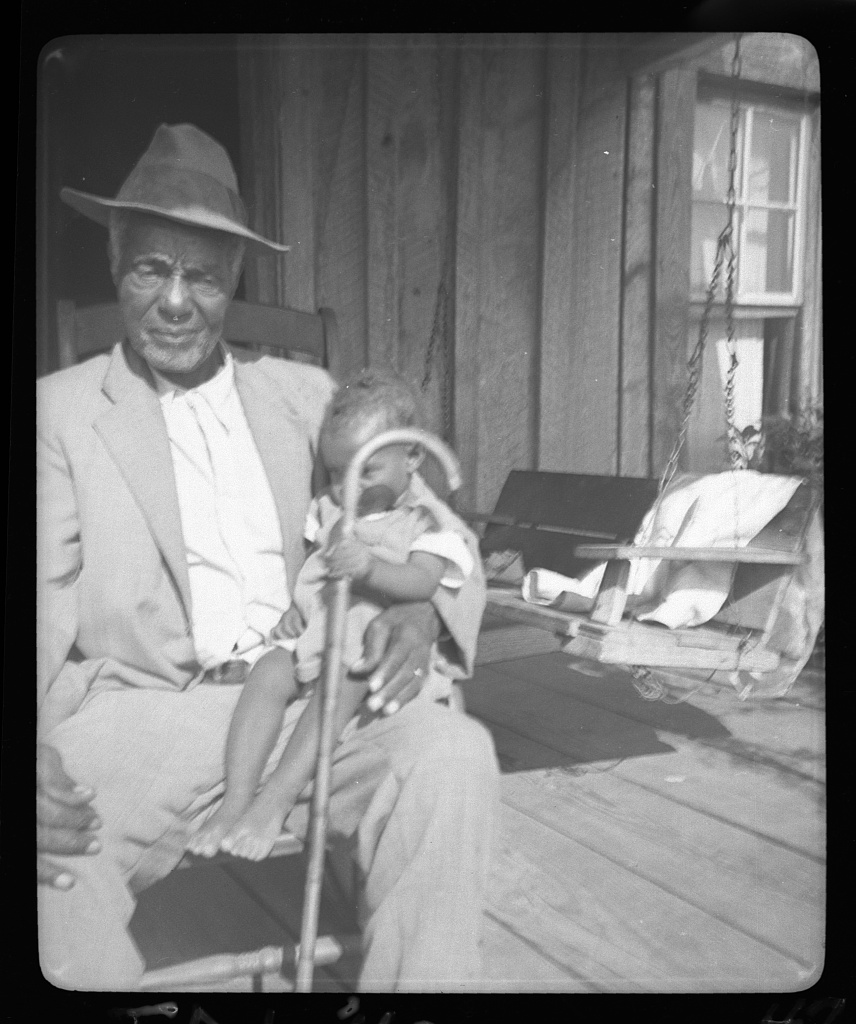
Uncle Bob Ledbetter
Recorded in Oil City, Louisiana, 1940 · Born December 18, 1861 (by his father's reckoning); near Oil City, Louisiana
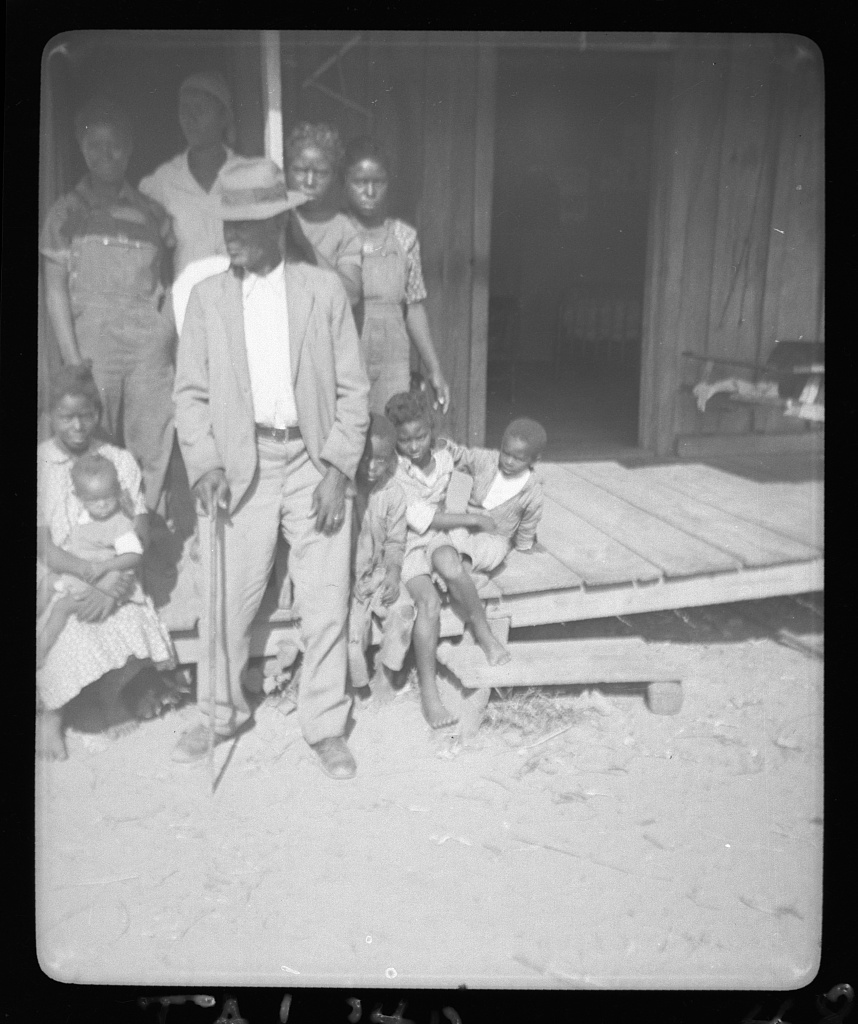
Their Story
Bob Ledbetter was born about five miles southwest of Oil City, Louisiana. He was unsure of his age: he said people called him seventy-something, and that his father told him he turned nineteen on December 18, 1880. He did not talk about slavery in this recording. Instead he spoke about his working life, his songs, and his principles.
His father was a churchgoing man who sang only hymns, but Bob sang reels and field hollers while he worked. For John A. Lomax he sang "No soap, no starch, nobody to wash my clothes," a holler he used to call to a friend across the fields. The friend would answer with the same words, or with "I'm going home" once he was on his way after supper. Bob never went to school "a hour" in his life, but his father, who could read print, taught his children to spell and read at night, and Bob taught himself to write by copying.
He worked about twelve years for a local family who, he said, had a reputation for being hard but always treated him well. He proudly told a store owner that he had never been arrested or in trouble, and the man replied that no white man could say better. He joined the church at nineteen on his own, married in his early twenties, and said he had voted only twice, once on whiskey and once in a presidential election. John A. and Ruby T. Lomax recorded him in Oil City, Louisiana, in 1940.
The Recordings & Transcripts
The recording Oil City, Louisiana, 1940
Captions open at the bottom of the screen when you press play. Click any transcript line to jump to it.
Transcript
John A. Lomax:What was that you said, uh? What was that you said, uh, Uncle Bob?
Bob Ledbetter:What about?
John A. Lomax:Uh, then. I, the machine went off I didn't hear you.
Bob Ledbetter:I said I'm glad [Norris (?)]. got acquainted with you because I believe you is a good man and I want him to be with a good man ??? .
John A. Lomax:Well, tell, tell me, where were you born Uncle Bob?
Bob LedbetterI was born not far from this place. Up here south, uh, west of here. About five miles.
John A. Lomax:And how old are you?
Bob Ledbetter:Well now uh, I told you about, oh, they say I'm seventy something, two or three. My daddy told me I was uh, nineteen years old on eight, on the eighteenth, of, uh, December. And that's all I can go by.
John A. Lomax:Eighteenth of Decem, December when?
Bob Ledbetter:Well, 1880.
John A. Lomax:Yeah. And you, you don't know to figure how much that is, that makes you now?
Bob Ledbetter:No sir. I'm a poor figurer.
John A. Lomax:Uh, you told me, uh, uh, you told me a story or two about yourself and about your father as we came along. What were they?
Bob Ledbetter:Well they, mention it so I know what you talking about and I can start it over again I reckon.
John A. Lomax:Well, was your father a songster like you?
Bob Ledbetter:Nothing but old hymns, hymns. He was regular church man.
John A. Lomax:Well what kind of songs did you sing when you were young?
Bob Ledbetter:Well, I didn't, just hollered reels, just fiddle and reels, you know, all the time, my singing.
John A. Lomax:Was it, were you a fiddler yourself?
Bob Ledbetter:No sir, no sir. I couldn't make no music at all.
John A. Lomax:Well you could make music with your mouth.
Bob Ledbetter:Oh yes sir, I could do that. I sure would do that. Everywhere you hears me you hear me singing a song, a reel.
John A. Lomax:And out in the field what did you do when you were working?
Bob LedbetterThat's what I'd do. Hollering, singing reels.
John A. Lomax:And, and what was it you sang about, the cotton?
Bob LedbetterAbout uh, little Joe?
John A. Lomax:Yeah.
Bob Ledbetter[recites] Little Joe, my Sam told me to pick a little cotton, the boy says don't for the seeds all rotten.
John A. LomaxI said just like you did to me in the car and say it louder.
Bob Ledbetter[laughs] [starts to sing]
My Sam told me to pick a little cotton.
My boy says don't, the seeds all rotten. Get out off the way, old Dan Tucker, Come too late to get your supper. I don't remember, I never did sing it.
John A. Lomax:Well how, how did you tell me you used to call your sweetheart out at night?
Bob LedbetterLet me see, I'm near forgot what I was to holler, what sort of holler. [John A. Lomax interrupts]
John A. Lomax:And holler.
Bob Ledbetter:Just tell me one word of it so I'll know what you talking about.
John A. Lomax:You said you didn't have any starch or soap.
Bob LedbetterYeah. [starts to sing] No soap.
John A. Lomax:Louder. Sing it louder.
Bob LedbetterNo soap, no starch. Nobody, nobody to wash my clothes, nobody to wash my clothes. I hate to sing to anybody. My voice, it, it broke.
John A. Lomax:Well uh, didn't you say you used to sing that in the field too?
Bob LedbetterYeah I sing that in the field too. Yes sir.
John A. LomaxWould your sweetheart be out there in the field?
Bob LedbetterNo, she'd be enjoining [enjoying], enjoining fields you know.
John A. Lomax:Uh huh. Well what was some of the other old field hollers that you used to have???
Bob Ledbetter:[starts to sing] I'm going home. I'm going home. I'm going home. That was one of them.
John A. Lomax:Well when you wanted to, when you wanted to summon a boy from across the creek way far off, how would you, how would you notify him?
Bob LedbetterI just holler that holler, you hear me a-hollering. And he'd answer me way over yonder.
John A. Lomax:Well what was, what was the holler?
Bob Ledbetter:That same thing I was singing. [starts to sing] No soap, no starch,
Nobody to wash my clothes, nobody to wash my clothes. That same old holler. And he'd answer me way out at his field.
Ruby T. Lomax:What'd he say?
Bob LedbetterMa'am?
John A. LomaxWhat would he say?
Bob LedbetterWell he'd sing the same thing.
John A. Lomax:And how would he sing it? Sing it like he did.
Bob Ledbetter[starts to sing]
No soap, no starch,
Nobody to wash my clothes, nobody to wash my clothes. And if he took a notion then he'd say: [sings] I'm going home. I'm going home. I'm going home.
I knowed that he's coming soon as he got supper. At the white folk kitchen [laughs] I looking for him.
John A. LomaxNow you told me about the, the man that you worked for, for ten or twelve years.
Bob Ledbetter:Mr. [Norris (?)]
John A. Lomax:Yeah, and you said he was the meanest man in the country.
Bob Ledbetter:Well they said so. Them [Norris' (?)] would work for the meanest people there was around.
John A. Lomax:Well, how'd they treat you?
Bob Ledbetter:They treat me all right. Nary a one of them never did cuss at me the whole twelve year. And didn't care what I went to them for, I got it. Barrels of flour, middlings of meat, kegs of molasses, money any time. Now that [Judge Norris (?)], that was the oldest boy. And his store would be full of hands you know, and he wouldn't want them all to know what he's doing. I just tell him, give me [your (?)] pencil and piece of paper. He'd hand it to me and I'd write on there, I'd tell him I want five dollar, please sir. I'd hand it to him and go on about my business. First thing you know he'd come on by me, touch me, and give it to me. He'd do me that-a-way just as sure as he is, just as sure as I'm living.
John A. LomaxWell now what was it the old merchant, what was it the old merchant told you? You told the old merchant down here that ???
Bob LedbetterUh, Mr. [John A. Lomax interrupts]
John A. Lomax:[Morinfort (?)].
Bob Ledbetter:Me and him was talking now one day and uh, wasn't nobody in there but me.
John A. Lomax:Now say exactly what you said now.
Bob LedbetterYes sir. Wasn't nobody in there but me and him and his son and his son's daughter. And I say "Mr. C.," I forgot what just exactly how old I was, but anyhow I said, "I'm sixty-one or two years old, and I never had no trouble in my life." I say "I never ask the [Norris' (?)] for a nickel what they didn't give it to me, in my life and nary a one of them never did cuss at me." And say "I ain't never been summoned and ain't never been arrested, and ain't never been to the jail house but twice in my life and I ain't been to the courthouse but twice." He, he looked at me and he cussed. He said, "Well, Bob, I be damn if that ain't too much for a nigga to say." Said "there ain't nary a white man can say any better than that." Said, "There ain't." I say, "Well, I'm telling you the truth," I say, "You can ask these people all around [Morinfort (?)] that know me, and they'll tell you I ain't never been no trouble since I been there."
John A. LomaxWell you said you hadn't been in, to the jailhouse but twice. Did they put you in jail twice?
Bob LedbetterNo sir, no sir, just went by there.
John A. Lomax:Went by the jail.
Bob Ledbetter:Down the street, yes.
John A. Lomax:Well when you had friends in jail, didn't you go see them?
Bob Ledbetter:I didn't go see them because I always said practice makes perfect. [laughs] I was proud I said so, and I just wouldn't go to see them. I says no I ain't going see them. I said practice makes perfect. I ain't going there. Well Lord knows I'm telling you the truth what I said.
John A. Lomax:Uh, uh, how much, how much school did you go to?
Bob Ledbetter:I never went to school a day in my life, not a hour. [someone enters the room]
Hey, hey, hey, hey, howdy, howdy, howdy, howdy.
Unidentified PersonIs that you?
Bob LedbetterYeah. How you folks feel?
Unidentified PersonAll right.
Ruby T. Lomax:We're gonna have to get some more chairs.
Bob LedbetterWell Nora here can tell you I never went to school a hour in my life.
Ruby T. Lomax:See if I can get you a chair.
John A. Lomax:Well is it still running here?
Ruby T. LomaxYeah.
Bob LedbetterWell go ahead. Talk to Nora
John A. Lomax:So you never went to ??? .
Bob Ledbetter:I, I say, he can tell you, I never went to school a hour in my life.
John A. LomaxUh huh.
Bob LedbetterNot a hour.
John A. LomaxWell, you, you, then could you read and write?
Bob LedbetterI could read and write too. I do, I can send a letter all over this world if I just knowed where to send it. Course I can't write it pretty like people do do, but anywhere I know where to send it, I can send it.
John A. Lomax:Well, uh, how did you learn to write?
Bob Ledbetter:Well my daddy just taught me how to spell a little at night. Well after that then he kept, uh, copies, and I take copies and just learn myself.
John A. Lomax:And how you learn to read?
Bob LedbetterWell he learn me at night. He said he, he wasn't no educated man. He could just read printing. And he set up at night and teach his children. That's the way we learned.
John A. Lomax:I heard a story about, uh, a judge asking a colored boy on the witness stand, he said, uh, "Jim, can you read writing?" He said, "No sir, Judge. I can't even read reading." [all laugh] But you can read reading and writing both.
Bob LedbetterYes sir. [coughing in background] They had a, they had a preacher treated us fine. He could make a, uh, preacher out of him. And they ask him could he, did he know, did he know theology. He said, "No sir, I never knowed that man in my life. I, I never have been acquainted with him." [laughs] So I don't know, knownothing about no, nothing like that.
John A. Lomax:Uh, how old were you when you joined the church?
Bob Ledbetter:I was, uh, uh, nineteen years old.
John A. Lomax:And how old were you when you got married?
Bob LedbetterI was, uh, just, just in my twenty. Just started in my twenties.
John A. Lomax:Well did your wife make you join the church?
Bob LedbetterNo sir. Just joined myself. Just took a notion and join myself.
John A. Lomax:Well how have you got along so well in life? What, what, what, what's been your principles?
Bob LedbetterWell people around, ask the people, anybody you know around here, ask them about my principles. I just went on, just knowed, I just ??? knowed what was right to do and I always try to do what's right.
John A. Lomax:Well that's a mighty good way to do Uncle Bob.
Bob LedbetterYes sir, I know what's right and I tried my best to do what's right in everything I do.
John A. Lomax:How many times have you voted?
Bob Ledbetter:Ain't voted but twice. Vote for whiskey once and voted President election once.
John A. Lomax:What President election?
END OF SIDE A

Share their words
Post this card so more people hear Bob's voice.
Discuss Bob's story in the Community
Recorded by John A. and Ruby T. Lomax, Oil City, Louisiana, 1940. From Voices Remembering Slavery: Freed People Tell Their Stories. Bracketed notes and question marks in the transcripts mark sounds or words that are hard to hear.