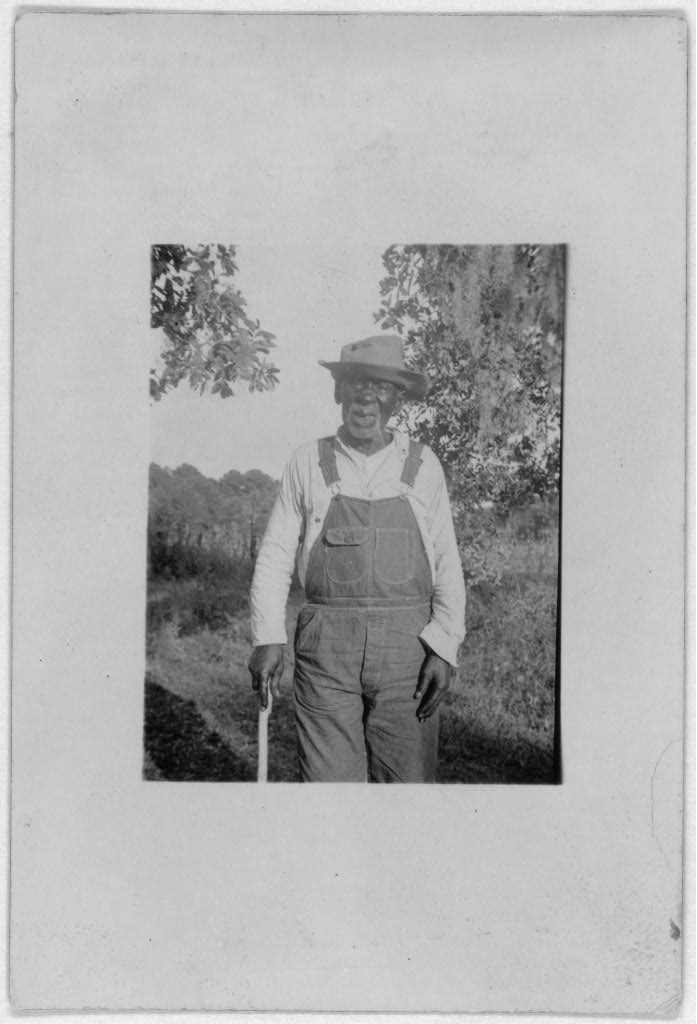
Wallace Quarterman
Recorded in Fort Frederica, St. Simons Island, Georgia, June 1935 · Born 1844; birthplace not stated
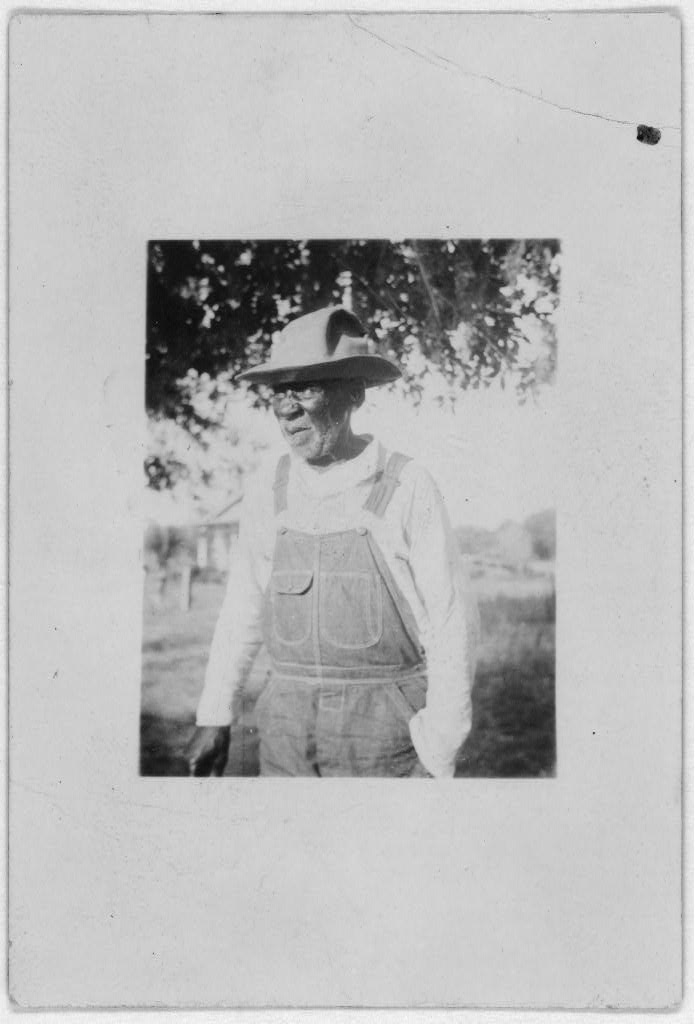
Their Story
Wallace Quarterman said he was born in 1844. He was enslaved by a man he called the Colonel, who had a plantation on Skidaway Island and land in Chatham County near Savannah, Georgia. He spoke warmly of his master, saying the two of them "was just like one," and said the man later died of yellow fever. In his 1933 session he described planting potatoes, corn, and beans, picking huckleberries in the woods, and men killing bears with sticks or old muskets when the bears raided beehives. He also said his master let him read the Bible.
His most vivid memory was the day the Union forces arrived. He was carrying breakfast into the house when big guns began firing until the plates rattled on the table. The overseer asked if it was thunder, then sent him running to the field to tell Peter, the driver, to turn the people loose because the Yankees were coming. At first Peter said Wallace was lying. Wallace said the people threw down their hoes, and when the master offered wages, many said they would rather go free.
Speaking about Reconstruction, he said Black men held offices as judges, lawyers, and jailers, but in his view the violence of the time grew so bad that he and others backed Democratic candidates, which he believed brought more protection under the law. He said he never wanted an office himself. He described working as a foreman and said he had done work for the United States.
He was recorded twice on St. Simons Island, Georgia: by Lorenzo Turner on August 5, 1933, when he recited the months and days and counted to twenty, and in June 1935 at Fort Frederica by Alan Lomax, Zora Neale Hurston, and Mary Elizabeth Barnicle. In 1935 he also sang "I Surrender" and "Kingdom Coming," thumping a washtub bass.
The Recordings & Transcripts
Part 1 of 4 Fort Frederica, St. Simons Island, Georgia, June 1935
Captions open at the bottom of the screen when you press play. Click any transcript line to jump to it.
Transcript
Wallace Quarterman[seems to quote religious text] The Lord gave the whole earth my grace with thee.
Unidentified Woman InterviewerUh huh.
Wallace QuartermanFor them that do [loud dog bark] and trust my word he shall be saved. [barking] [unintelligible]. But he that won't believest [shall go to hell (?)] [four barks].
Unidentified Woman InterviewerUh huh.
Wallace QuartermanI make him great [loud barking] commission. Know that he is preach my gospel truth by all the work that him can do, that all the wonder I will do.
Unidentified Woman InterviewerUh huh.
Wallace QuartermanYou must teach all nation my command, I am with you until the world shall end. Well I think that's enough [I had enough (?)]. [barking and yelping]
Unidentified Woman InterviewerUh humm. Okay.
Wallace QuartermanOkay
[short pause before Wallace Quarterman sings]
I Surrender
Oh, let me come on i-in. I surrender, and open the door. Let me come in open up. Yeah, let me come i-inn. Oh, let me come i-i-i-innn. I surrender, yes open the door, and let me come in. I said baby don't you cry, mothers and father are born to die. I surrender [recording gets stuck]. Oh, let me come i-inn. I surrender and open the door and let me come in.
Wallace Quarterman[heavy cough, singing stops] I can't sing much.
Unidentified Woman InterviewerHumm. [brief pause in recording]
Wallace QuartermanBorn in 1844.
Unidentified Woman InterviewerWhat's your name sir?
Wallace QuartermanHuh?
Mary Elizabeth BarnicleWhat's your name?
Wallace QuartermanMy name is Wallace Quarterman in and through the state of Georgia. [brief pause in the recording— interview resumes in the middle of conversation] Morning I was toting in breakfast in the house.
Unidentified Woman InterviewerYeah.
Wallace QuartermanAnd the, the, the big gun shot—
Unidentified Woman InterviewerUh huh.
Wallace Quarterman—suppose to have.
Unidentified Woman InterviewerYes.
Wallace QuartermanThe big gun shot so I buy a ??? take back within the house. The overseer ask me: “What is that, if that is thunder?” I tell him I don't know. I know what the Yankees. [background noise] I'm sorry.
Alan LomaxThat's all right.
Wallace QuartermanThree time and he commence to shoot until the plate commence to rattle on the table. And he call me and told me to run down in the field and tell Peter to turn the people loose, that the Yankee coming. And so I run down in the field and, and whooped and holler, they done, he done told them Mr. [Gaeggles (?)] said turn the people loose because the Yankee coming.
Alan LomaxAnd who was Peter?
Wallace QuartermanThe driver. And so he said that, uh, Wallace is lying if he, he said so, then he said so, then the Yankee [beat to the landing the drum (?)]. You understand? [starts to recite] Way Down South getting mighty poor. Say they, used to drink coffee but now they drinking rye. They said, left [music Union Band (?)] make the rebel understand. To leave our land for the sake of Uncle Sam. Way down South getting might poor. Shot at the wildcat and see the Rebel run. I ain't going [anywhere them see me (?)] again. I've been to war already I—
Unidentified Woman Interviewer???
Wallace QuartermanYeah, yeah. And that, the people then throws away their hoe then. They throwed away they hoe, and, and they call we all up, you know and, and give we all freedom because we are just as much as free as them. Now you understand. But the Yankees saying we must go back to the South they'll help we. Well they didn't. Of course there was so much doubt, and [it seems to me (?)] I, they would have done more, but it so much doubt in the way. They couldn't because the colored people sure [been (?)] poor, and some white people sure [went (?)] poor too. You understand and they rather help them than, uh, help we. I satisfied so far, for the Lord has done for me, I come through, through all the, been up and downs through the ??? .
Unidentified Woman InterviewerWell tell me about how they went to Hawkinsville and drove the sword down in the ground?
Wallace QuartermanThey told them, said now you—
Alan Lomax??? . [conversation trails off]
END OF SIDE A
Part 2 of 4 Fort Frederica, St. Simons Island, Georgia, June 1935
Captions open at the bottom of the screen when you press play. Click any transcript line to jump to it.
Transcript
[Alan Lomax (?)]: [brief pause here and scratching throughout recording] All right now!
Zora Neale HurstonAfter they said you can go free, then what did you do? Did you run on off the plantation that day? Did you leave the plantation that day after they told you to go free?
Wallace QuartermanThat day master promised so, to give we forty dollars a month in pay. The [lot (?)] said the boys said they ain't want it. They rather go free you know.
Zora Neale HurstonUhmm.
Wallace QuartermanWell, of course, why I have them pay us, you understand? I get along with them you know. He brought out the big pot, you know. [loud thump]
Zora Neale HurstonYeah.
Wallace QuartermanAnd ah, after they, after this place closed down, sword down they just make them, sword down, and they just lay down their sword, and squash them down. You go in Hawkinsville and you see all the swords down now—
Zora Neale Hurston[Yeah (?)].
Wallace Quarterman—in the ground. And after the sword was down the tension, in the South tension. And after the South tension then they play. Yeah. Play they. [he thumbs a washtub base and sings]
Kingdom Coming
One foot one way. One foot the other way. One foot all around. Jumping. Standing. Couldn't cut a figure. And he couldn't go halfway around. Old master run aw-a-a-a-a-y. And set them darkies free. For you must be think thy kingdom a coming in the hour of jubilee.
Wallace QuartermanSo we had a big breaking up right there, you know, after it. That's right.
[Alan Lomax (?)]: [says something inaudible] What about afterwards? You know when the, when the colored people had the jailer and everything? Tell us about that.
Wallace QuartermanYes, we, everything been in we hand. But they couldn't control the colored people. [thumbs washtub] They do so much mischief until we have to go on back and to the white people we had education. You know when a man ain't got no education he ain't got nothing. All we tried to show them they wouldn't they just killone another and going on. So we had to nominate democrat over they head. They didn't like it the many got killed by nominate the democrat but we couldn't help it, to stop them so much killing. You understand?
Zora Neale HurstonUhmm.
Wallace QuartermanSo we nominate the democrat, [washtub] and we had a big time from that till now.
Zora Neale HurstonUhmm.
Wallace QuartermanThe time ain't bad no because we been then.
Zora Neale HurstonUhmm.
Wallace QuartermanBecause a man think nothing killing a man and taking a drink of water.
Zora Neale HurstonUhmm.
Wallace QuartermanBut since we nominate the democrat we have more assurance. You understand.
Zora Neale HurstonYes.
Wallace QuartermanThe law come in protecting them, you know they wouldn't [yell (?)] at the colored people.
Zora Neale HurstonYeah.
Wallace QuartermanAt all ma'am, at all.
Zora Neale HurstonMhmm.
Wallace QuartermanYes. And that's the way they come in protect them. But we had we own lawyers, judge and everything, well they just would, run everything in the dust, you know.
Zora Neale HurstonYes.
Wallace QuartermanKill everything. Couldn't stand it. No, no—
Zora Neale HurstonWell, did you ever have a office? Did you, would you ever, did you ever hold a office?
Wallace QuartermanI wouldn't want an office.
Zora Neale HurstonOh, yeah?
Wallace QuartermanNo ma'am. I'm a man. I wouldn't want an office. An office ??? kind of thing.
Zora Neale HurstonUhmm.
Wallace QuartermanYou understand. You got to go and please the, the fellow you know.
Zora Neale HurstonYes.
Wallace QuartermanYou got to stop do what God said. You don't go please that fellow.
Zora Neale HurstonYes.
Wallace QuartermanAnd they're right there where you left out.
Zora Neale HurstonBut what become of your old master?
Wallace QuartermanOld master? He died in the yellow fever.
Zora Neale HurstonUhmm.
Wallace QuartermanHe was a nice man to me.
Zora Neale HurstonYes.
Wallace QuartermanI wouldn't take anything from him.
Zora Neale HurstonWhat was his name?
Wallace QuartermanColonel [Fedwary (?)].
Zora Neale Hurston[Fedwary (?)].
Wallace QuartermanYes. And he was a colonel.
Zora Neale HurstonMhmm.
Wallace QuartermanI wouldn't take anything, why me and he was just like one, you know.
Zora Neale HurstonYes.
Wallace QuartermanYes, ma'am.
Zora Neale HurstonWell, where was his plantation?
Wallace QuartermanHis plantation on, on Savannah River. You know, Skidaway Island?
Zora Neale HurstonUhmm.
Wallace QuartermanAnd he had another one Chattum County, you know. Savannah.
Zora Neale HurstonYeah.
Wallace QuartermanSkidaway Island.
Zora Neale HurstonUhmm.
Wallace Quarterman[And umh, yes, sir (?)], I wouldn't take nothing from him.
Alan LomaxWell, did the white folks like it when you all were in power?
Wallace QuartermanOh, they liked me. They would like me all the way, because I protect them, you know.
Zora Neale HurstonYes.
Wallace QuartermanI protect them I told them, I told them the Yankee myself and they didn't feel sorry them you know. You see I just would understand how they think, you know.
Zora Neale HurstonYes.
Wallace QuartermanTell me things you know.
Zora Neale HurstonAhha.
Wallace QuartermanI see a man going a do a wrong thing I should stop it though. I stop him. Why—
Zora Neale HurstonWell, did the white people, did your master and all them, like to see the Negroes be the judge and the jailer and everything?
Wallace QuartermanWhooo! You see according to law you know, they don't mind you be that, I mean, if you know what you doing.
Zora Neale HurstonUhmm.
Wallace QuartermanDon't you see?
Zora Neale HurstonYes.
Wallace QuartermanYeah. We, we, you see, they, they don't know what they doing.
Zora Neale HurstonYeah.
Wallace QuartermanAnd they prove that they don't know.
Zora Neale HurstonMhmm.
END OF SIDE A
Part 3 of 4 St. Simons Island, Georgia, August 5, 1933
Captions open at the bottom of the screen when you press play. Click any transcript line to jump to it.
Transcript
Dr. Lorenzo Turner (?): ??? [Mr. Powers (?)] ??? ?
Wallace Quarterman[noisy recording] [Mr. Powers (?)] is the overseer the whole plantation. [His father was D. Philip (?)]. And his father said you [have (?)] make a slave. Right after father when his son say, do, I do it now. I just do it cause ain't nobody else can do it. That's all. We went to house [mate some pain (?)] out in there. And tried to get somebody's [help (?)] and couldn't get it. Went to, went to all them place from God's ??? . Went out towards, we didn't know where [we been we went (?)]. There you see I just trying to learn the people how to talk, you know. Down at the South. They could [read (?)] but I not know they understand it. Yes, sir. And they miss us. If, we had a, do you understanding? I could understanding shouting they could live by. And I sought hard to learn them. You understanding. I learned them how to shout. I shout and tell them Mr. [Fenigan (?)] then shout. And there's money man. Yes, sir.
Dr. Lorenzo TurnerYou were shouting at the wrong time.
Wallace QuartermanThe wrong time.
Dr. Lorenzo TurnerYou shout before you were a [carpenter (?)]?
Wallace QuartermanYes, sir. Whoo yes. And then I done it [recording repeats: And I done it...]
Dr. Lorenzo TurnerWhat were some of the things you raised there? What were some of the crops planted South? Can you tell me about the South?
Wallace QuartermanYes. Yes, sir. I plant potato. I plant corn. I plant green. I plant beans. Every day, you understand. I got plenty of that. That's the kind of people used to around here, you know. Back in the woods, you know. [Them moved (?)]. And them be in the woods we pick huckleberry. Of course, we couldn't get nothing else. But eat huckleberry until you go and cut them you know after. Divide them up to the [dog (?)] and cut them. It's nothing new deal at all, you know. Right now. But I never been to that confess yet. You know, cause I always been on my master you know. Right. You understand? And all them kind of things is more than I can tell you. It's more than I could tell you because I know I see them sticks going out to kill bear. We used to see them on a Sunday morning at six, bears. The bears. The bears they be out in the woods you know, and robbing them bee hives, you know, and we just [stay on (?)] the plantation near them. That's the truth. We go there and kill them. Yes, sir. Bear, you know, and all them kind of things we used to kill with sticks.
Dr. Lorenzo TurnerYou didn't have guns?
Wallace QuartermanNo. We had these old muskets, you know. We have a, put a, a lots of powder on the tine you know, then and that's plenty enough shouting. There, once we make so much noise, make so much smoke, you know. Sometime it blind you. They didn't know what gun is then. The Indian used to use, the Indian made, the bow and arrow, you understand? And they [bending them (?)] than we could. Yes. They could sense foxes just as much as we [saluted (?)] the flag.
Dr. Lorenzo TurnerYou ah ??? Indians?
Wallace QuartermanYes, I be with them. I been with them but they don't talk. No, sir. They don't talk.
Unidentified Woman Interviewer[Where are those Indians (?)] ??? ?
END OF SIDE A
Part 4 of 4 St. Simons Island, Georgia, August 5, 1933
Transcript
[brief pause in the tape as a new recording (25,665B) begins]
Wallace Quarterman??? master and I stay behind ??? . And after master say that I could read the Bible.
Dr. Lorenzo TurnerHow old were you?
Wallace QuartermanHuh! Before I [schooled (?)] cause they say I was doing business for the United States. Yes, I was a boss man, for the United States. Yes, I've all, always begged the hardest on a white people working on the way. Yes, sir. I, I was I'm a real good service man, a foreman, you know. Foreman. Foreman for them. Yes, sir.
Dr. Lorenzo TurnerI, I want you [his voice drops out] ??? .
Wallace QuartermanFirst month, January. Next month, February. Next month, March. Next month, April.Next month, May. Next month, June.Next month, July.Next month, August. The next month,September. The next month, October.Next month, November.The next month, December. The next month, Octo— [recording speeds up] ??? . Sunday, Monday, Tuesday, Wednesday, Thursday, Friday, Saturday, Sunday. [recording glitch] [One (?)], two, three, four, five, six, seven eight, nine, ten, eleven, twelve, thirteen, fourteen, fifteen, sixteen, seventeen, eighteen, nineteen, twenty!
END OF SIDE B
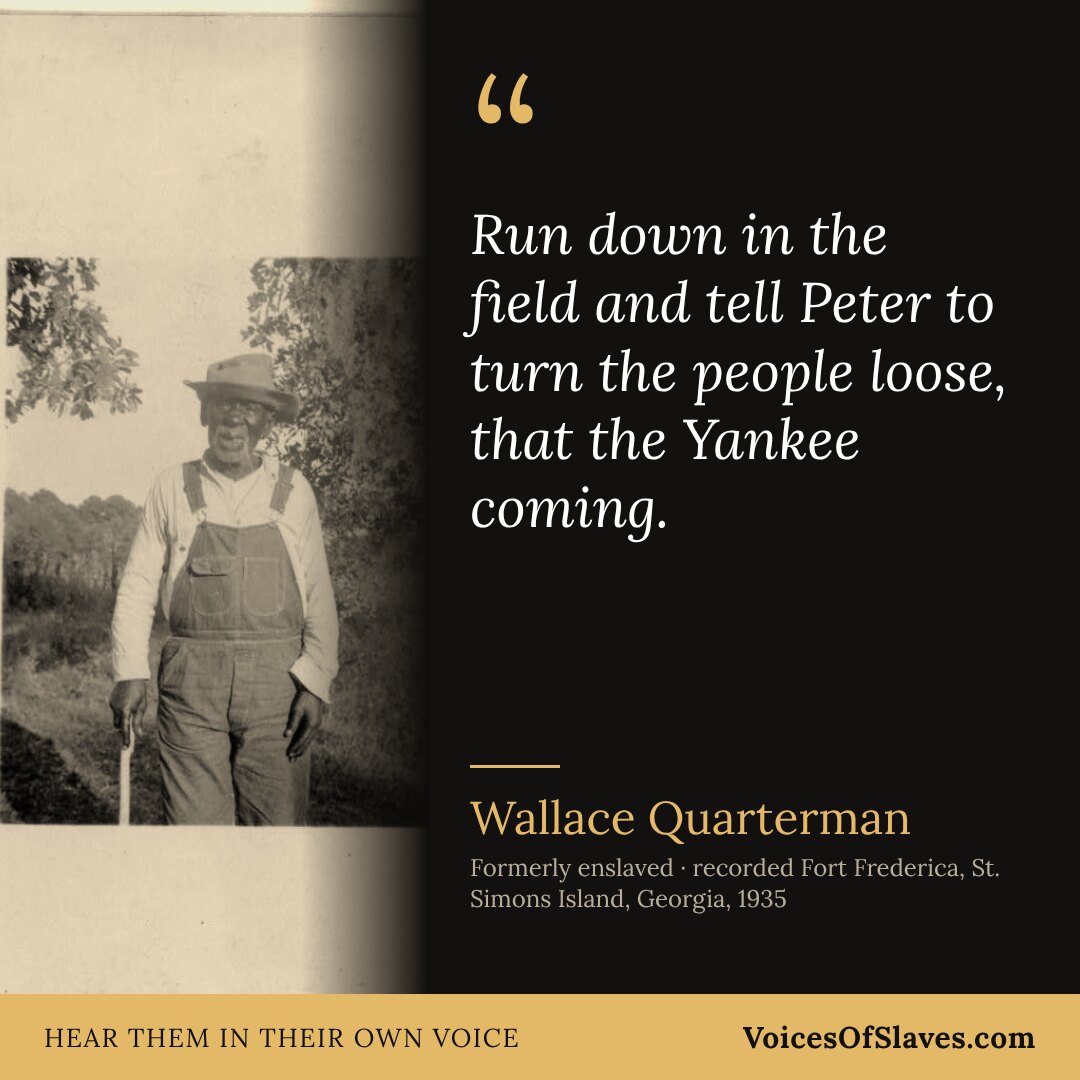
Share their words
Post this card so more people hear Wallace's voice.
Discuss Wallace's story in the Community
Recorded by Alan Lomax, Zora Neale Hurston, and Mary Elizabeth Barnicle, Fort Frederica, St. Simons Island, Georgia (Gullah), June 1935. From Voices Remembering Slavery: Freed People Tell Their Stories. Bracketed notes and question marks in the transcripts mark sounds or words that are hard to hear.